

Yeguas del Apocalipsis: Who Were Pedro Lemebel and Francisco Casas?

Originally published on January 28, 2026. Updated on September 20, 2026, with editorial revisions, new sources, and historical context.
Las Yeguas del Apocalipsis was an artistic duo formed by Pedro Lemebel and Francisco Casas Silva in Santiago, Chile, in 1987, when the country was still under the dictatorship of Augusto Pinochet. Between the late 1980s and early 1990s, they created art actions, public interventions, photographs, and installations that addressed homosexuality, political violence, the memory of the “disappeared,” the HIV/AIDS crisis, and the forms of exclusion present in both the cultural world and the political spheres of their time.
Their most intense period of activity spanned 1987 to 1993, although Lemebel and Casas worked together again on an occasional basis during the second half of the 1990s. During those years, they used their own bodies, public spaces, and cultural institutions to bring to the forefront conflicts that were not always addressed in official discourses or by much of the political opposition.
Who were Las Yeguas del Apocalipsis?
Las Yeguas del Apocalipsis consisted of Pedro Lemebel (1952–2015) and Francisco Casas Silva (1959). The two began working together in Santiago, Chile, in 1987 and developed a collaborative body of work that combined literature, public intervention, photography, installation, and physical performances. Their most active period spanned 1987 to 1993, as documented in the collective’s biography compiled by the Yeguas del Apocalipsis Archive.
In 1987, Chile remained under the dictatorship of Augusto Pinochet. The military regime formally ended on March 11, 1990, when Patricio Aylwin assumed the presidency and inaugurated the first democratic government after 17 years of military rule.
Lemebel and Casas began working together in the final years of the dictatorship. Their interventions addressed state violence and forced disappearances, as well as forms of exclusion related to homosexuality, HIV/AIDS, and the transvestite community. After 1990, they continued to stage actions in a country that had returned to civilian rule, but where many cultural and social disputes remained unresolved.
Why were they called Yeguas del Apocalipsis?
There are at least two different accounts of the name’s origin. Pedro Lemebel recounted in an interview conducted by Colombian writer John Better that the name came about in 1987. It was Holy Week; he and Casas were sitting on a sidewalk in Santiago, drinking wine and talking about forming a collective while the television aired major Hollywood biblical films. From that combination, “Yeguas del Apocalipsis” emerged—a name that Lemebel associated with epic films like *Ben-Hur* or *Cleopatra*. The full account can be read in *Latin American Literature Today*.
Francisco Casas offered another version. According to a statement of his cited in a study on the cultural heritage of sexual diversity in Santiago, the two were talking in the early morning hours in Parque Forestal about AIDS and about religious discourses that linked the epidemic to the horsemen of the Apocalypse; which is said to have given rise to the play on words between “horsemen” and “mares.” This version is included in a study on the cultural heritage of sexual diversity in Santiago, which refers to an interview originally published by Caras. Memoria Chilena also links the name to HIV/AIDS and the biblical horsemen.
Both versions agree on the provocative nature of the name, but differ on the exact circumstances of its origin. “Yegua” could be seen as the appropriation of a word used in a derogatory manner, while “Apocalipsis” referred to biblical imagery and, in one version, to the cultural climate marked by the HIV/AIDS epidemic.
Art, Body, and Provocation in Chile During the Dictatorship
Much of Las Yeguas’s performance art depended on the physical presence of Lemebel and Casas. They appeared naked, in drag, or with objects attached to their bodies; they danced, rode horses, disrupted ceremonies, and utilized public spaces, universities, cultural centers, and political events as part of their performances.
Many of these appearances were fleeting, and some were documented only through photographs, testimonies, press releases, or fragmentary videos. There were also spontaneous actions of which little information survives.
Today, it is common to include their work within the history of Latin American performance art, although the duo maintained an uneasy relationship with labels and with the art world’s mechanisms of validation. Their actions circulated among galleries, universities, political events, alternative spaces, and the streets, without relying on any single category.
That mobility was part of their way of working. A university, a human rights center, or a street in Santiago did not function merely as a stage: each location provided a specific political context for the intervention.
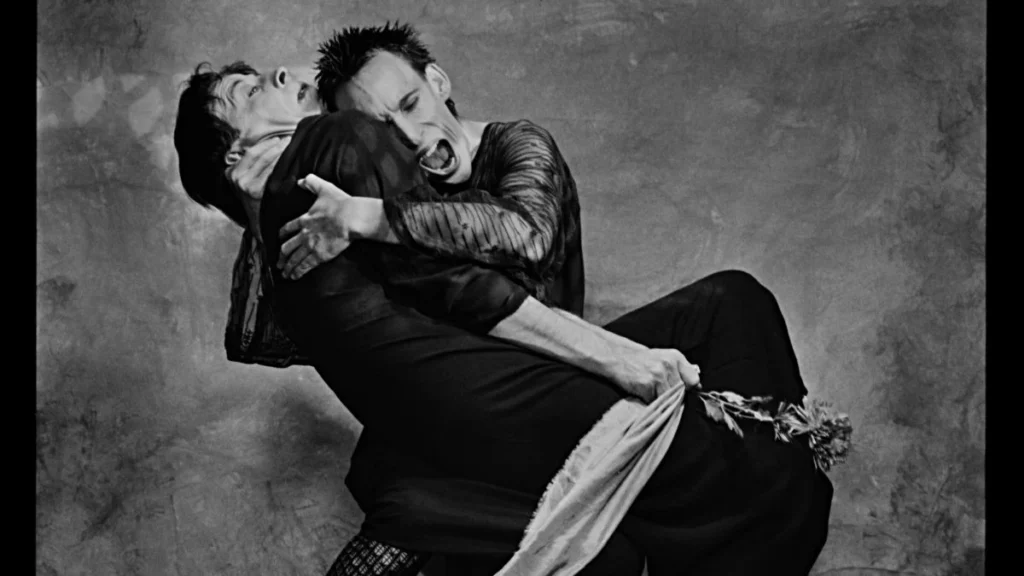
The Most Important Performances and Works by Las Yeguas del Apocalipsis
Reestablishment of the University of Chile
In 1988, during a student occupation of the University of Chile’s Faculty of Arts, Lemebel and Casas entered the campus via Las Encinas Street naked and riding a mare. The action, known as “Refounding of the University of Chile,” is dated to 1988, though no specific day is documented.
Francisco Casas linked the scene to two references: Pedro de Valdivia, the Spanish conquistador and founder of Santiago, and the medieval legend of Lady Godiva, associated with a naked ride on horseback. The image of the conquistador and the military horseman was replaced by the naked bodies of two gay men.
The intervention was also linked to a demand for minority admission to the university. The horseback ride placed that demand within a public institution and, at the same time, subverted the images of authority, conquest, and masculinity associated with the official history.
The Conquest of the Americas
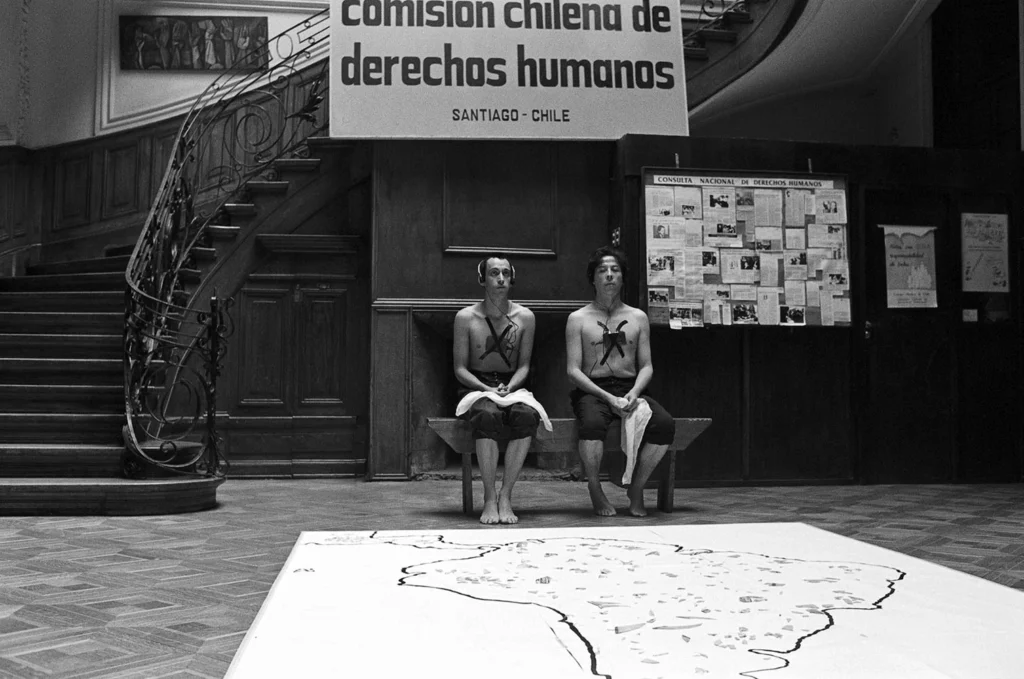
On October 12, 1989, while the dictatorship was still in power, Las Yeguas performed *The Conquest of the Americas* at the Chilean Human Rights Commission in Santiago. Lemebel and Casas placed a map of South America on the floor, covered with broken glass from Coca-Cola bottles, and danced a cueca barefoot on that surface. They wore black pants, were bare-chested, and had audio devices attached to their bodies. The performance on October 12, 1989, brought these elements together in an intervention addressing conquest, political violence, and memory.
The choice of October 12 linked the Spanish conquest to contemporary political violence in Latin America. The Coca-Cola bottles introduced a reference to the United States, to U.S. support for the Pinochet government, and to its political and economic influence in the region.
The cueca alluded to the “cueca sola,” created by relatives of detainees who disappeared during the dictatorship: women danced without a partner to make visible the absence of their missing family member. Lemebel and Casas revisited this tradition while the glass cut their feet and left bloodstains on the map.
The documentation of *La conquista de América* is part of the collection of theMuseum of Modern Art in New York, which holds four prints of the performance.
The Two Fridas
In late 1989, Pedro Lemebel and Francisco Casas recreated *The Two Fridas*, the painting Frida Kahlo had created fifty years earlier. The photo shoot took place in the studio of photographer Pedro Marinello, who captured an image that would eventually become one of the collective’s best-known records. The background to the photo shoot is documented in *The Two Fridas* within the Yeguas Archive.
Lemebel and Casas are shown sitting, holding hands and connected by a transfusion tube. The composition immediately echoes Kahlo’s painting but replaces the two original female figures with the bodies of members of Las Yeguas.
The piece also addressed the growing international commercialization of Frida Kahlo. Her image was reimagined within a different context: two gay men working in Chile during the HIV/AIDS crisis and at the end of a dictatorship.
The photograph is now part of the MoMA collection, where *Las dos Fridas* is attributed to *Las Yeguas del Apocalipsis*, Pedro Mardones Lemebel, and Francisco Casas Silva, with Pedro Marinello credited as the photographer.
What AIDS Took Away
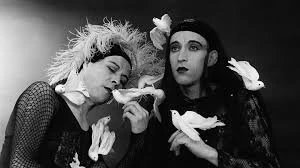
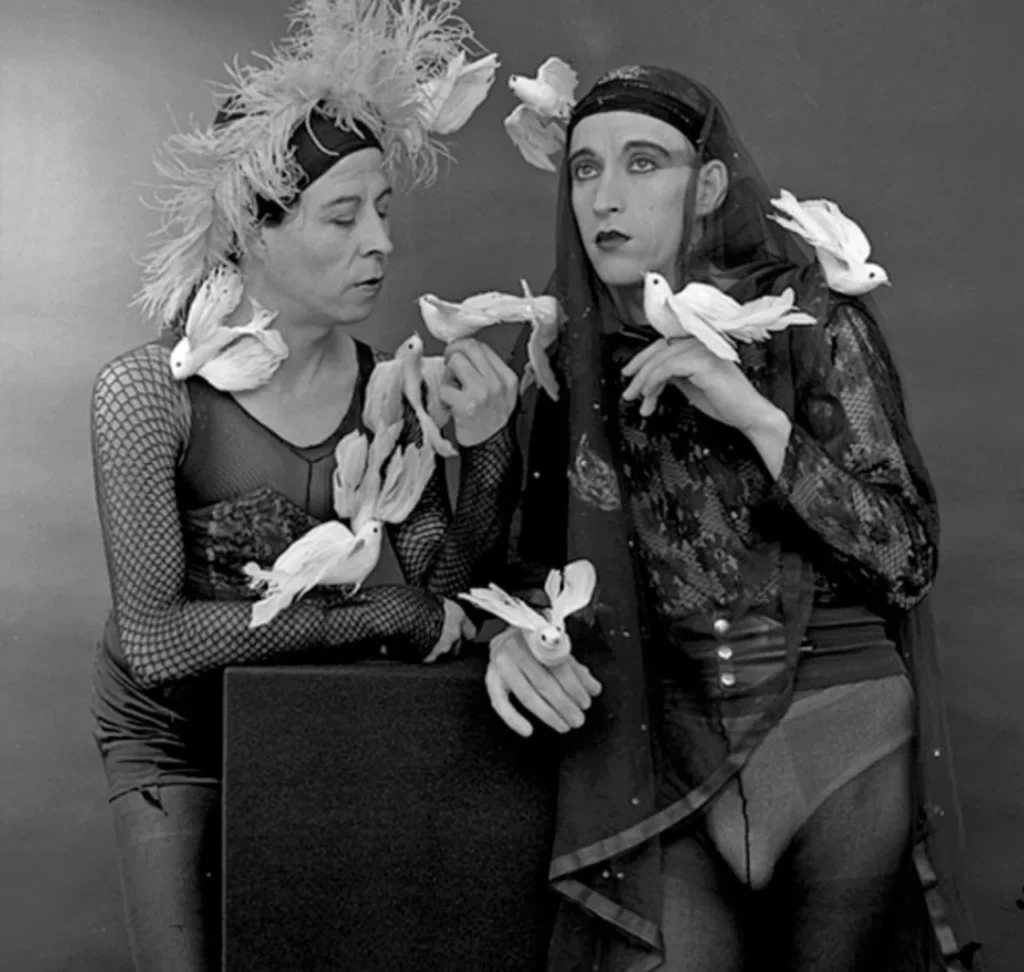
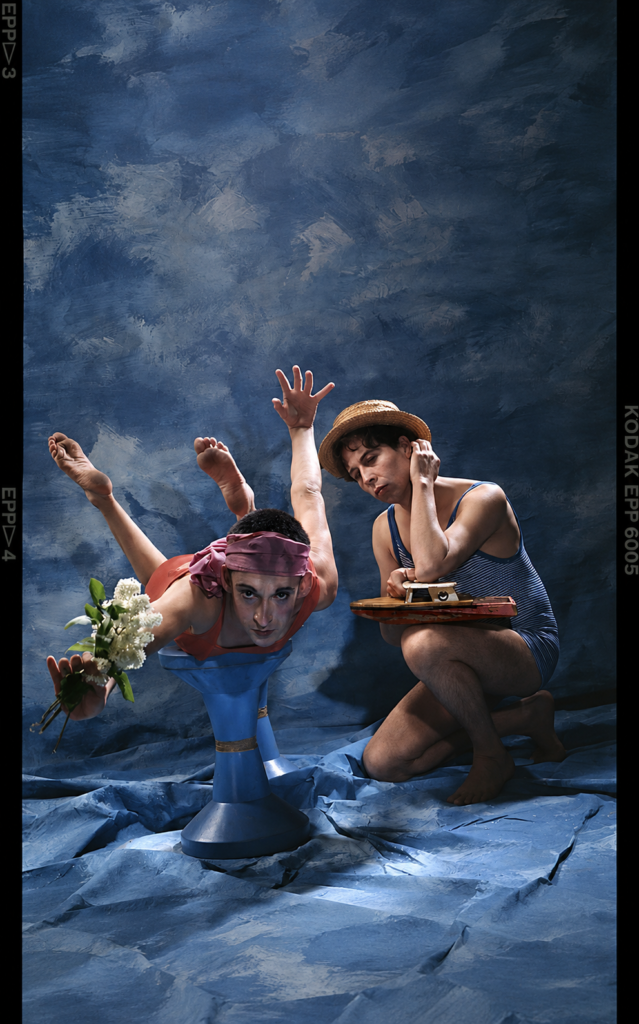
On November 29, 1989, the Chilean-French Cultural Institute in Santiago presented *What AIDS Took Away*, an installation built around 30 photographs taken and selected by Mario Vivado. Lemebel and Casas posed in scenes that drew on cinema, literature, and the performing arts, with references ranging from Marilyn Monroe and Buster Keaton to Federico García Lorca’s *The House of Bernarda Alba*.
Costumes played a central role. They used clothing purchased at a “persian market”—a term used in Chile for certain secondhand markets and miscellaneous goods—as well as garments belonging to trans women friends, some of whom were living with HIV/AIDS. These garments were also exhibited alongside the photographs.
The glamour of film divas coexisted with a specific community ravaged by the epidemic. AIDS was portrayed as intertwined with friendships, bodies, clothing, and personal losses, far removed from a purely medical representation.
On December 1, 1991, during World AIDS Day events in Concepción, Lemebel and Casas staged a tribute to Sebastián Acevedo. They had been invited by Christian Rodríguez, director of theCenter for Education and Prevention in Social Health and AIDS (CEPSS). In a classroom at the University of Concepción’s School of Journalism, they covered the floor with lime, used charcoal, and set up five video monitors.
Las Yeguas del Apocalipsis, Homosexuality, and HIV/AIDS
Homosexuality was not merely a biographical characteristic of Pedro Lemebel and Francisco Casas. It was part of the conflicts present in their interventions: who could appear in public, which bodies were considered acceptable, and what place homosexuality had within an authoritarian society as well as within opposition groups.
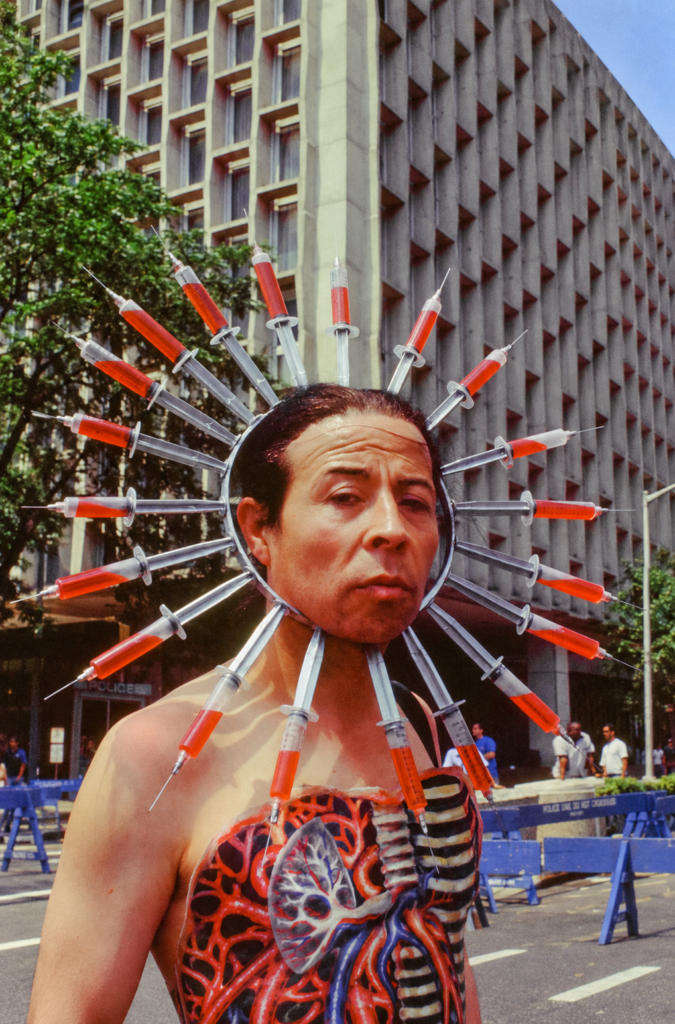
HIV/AIDS made those tensions even more visible. The epidemic swept through gay and transvestite communities close to the artists, while fear, prejudice, and stigmatization ran rampant. *Lo que el sida se llevó* and *Homenaje a Sebastián Acevedo* translated that context into photographs, garments, bodies, and performances staged before specific audiences.
Las Yeguas had ties to gay, lesbian, and HIV prevention organizations, but to summarize their work as a contemporary campaign for “LGBT rights” would erase part of its context. In the 1980s and early 1990s, the terms, organizations, and debates were different.
Today, their work often appears in studies on queer art and Latin American sexual dissidence. These are later categories that are useful for analyzing their work, but they do not automatically correspond to the way Lemebel and Casas described their practices during those years.
What was their relationship to the dictatorship and the Chilean transition?
The works from 1987, 1988, and 1989 were created while Augusto Pinochet was still ruling Chile. This period includes actions such as *Refundación de la Universidad de Chile* and *La conquista de América*. The latter linked the conquest, Latin American dictatorships, and the memory of the “detained and disappeared” through the use of a map, glass panels, and the “cueca sola.”
The political landscape changed on March 11, 1990, when Patricio Aylwin took office. Las Yeguas continued working during the early years of the transition and remained at the height of their activity until 1993.
Their actions during those years show that the formal end of the dictatorship did not put an end to discussions about memory, cultural institutions, censorship, and sexual exclusion. The change in government altered the political context but did not eliminate the conflicts the duo had been addressing.
Pedro Lemebel and Las Yeguas del Apocalipsis
Pedro Lemebel’s subsequent prominence as a columnist and author of books such as *Loco afán* and *Tengo miedo torero* has led some historical accounts to portray *Las Yeguas* primarily as an early phase of his career. This interpretation overlooks the collaborative nature of the project.
Las Yeguas del Apocalipsis consisted of Pedro Lemebel and Francisco Casas. The collective’s central works emerged from that collaboration, and shared authorship consistently appears in the records of their actions and in the collections that preserve their work today.
Lemebel would later go on to develop one of Chile’s most acclaimed literary careers, while Casas continued working as a writer and artist. Within Las Yeguas, both were co-authors of the project.
When did Las Yeguas del Apocalipsis disband?
The most intense and best-documented period of activity was from 1987 to 1993. The collaboration resurfaced sporadically during the second half of the 1990s.
In 1996, Lemebel and Casas participated in New York with *Cadáveres* (Homage to Néstor Perlongher) during the event “Crossing National & Sexual Borders: Queer Sexualities in Latin/o America.” The performance took place on October 3 at the Graduate Center of the City University of New York and incorporated audiovisual elements from *Tribute to Sebastián Acevedo*. *Cadáveres* forms part of the duo’s later chronology.
In 1997, they performed together again at the 6th Havana Biennial with *Ejercicio de memoria*. They presented a performative lecture accompanied by photographs, videos of previous performances, and the audio of Lemebel’s *Manifiesto (Hablo por mi diferencia)*. The performance took place around May 1997 at the Wifredo Lam Center for Contemporary Art. *Ejercicio de memoria* is one of the collaborations that followed their main period of work.
For this reason, it is more accurate to date the end of their most intense phase to around 1993 and to acknowledge subsequent sporadic collaborations.
Why do Las Yeguas del Apocalipsis remain important?
Many of their actions were ephemeral and circulated for years through photographs, recordings, testimonies, press releases, and scattered materials. In 2014, the National Archives of Chile publicly unveiled a collection comprising nearly 800 documents related to the collective’s history between 1987 and 1997.
Copies of the complete archive were made available for consultation at institutions such as the National Archives of Chile, the Municipal Library of Concepción, and the National Museum of Fine Arts in Santiago, in addition to the website dedicated to the project and its collection.
Their work has also entered international collections. MoMA holds *Las dos Fridas* and *La conquista de América*, two central works from their body of work.
From January 20 to April 19, 2026, the National Museum of Fine Arts of Chile presented *Desbocadas. Yeguas del Apocalipsis. Retrospective, the first retrospective dedicated to the duo. Curated by Gerardo Mosquera, it brought together works, photographs, videos, and documentation of actions that had circulated in a fragmented manner for decades. The 2026 retrospective consolidated materials from different stages of the collective’s history into a single space.
Dictatorship, democratic transition, homosexuality, HIV/AIDS, the memory of the disappeared, colonialism, and conflicts with cultural institutions are explicitly addressed in these works. The recovery of archives and records has made it possible to examine these actions with greater precision, distinguish facts from anecdotes, and trace their circulation within Chilean and Latin American art.
Frequently Asked Questions About Las Yeguas del Apocalipsis
Who were the members of Las Yeguas del Apocalipsis?
The collective consisted of Chileans Pedro Lemebel and Francisco Casas Silva. They began working together in Santiago, Chile, in 1987.
Why were they called Las Yeguas del Apocalipsis?
There are two main accounts. Pedro Lemebel linked the name to a conversation during Holy Week and the biblical films being shown on television. Francisco Casas offered another version connected to HIV/AIDS, the religious discourse of the time, and the horsemen of the Apocalypse.
When did they form?
Las Yeguas del Apocalipsis formed in 1987, while Augusto Pinochet’s dictatorship was still in power.
What did Las Yeguas del Apocalipsis do?
They carried out art actions, interventions in public and cultural spaces, installations, and photographic works. Lemebel and Casas’s bodies were one of their main resources.
What were their best-known works?
Among the most studied are *Refundación de la Universidad de Chile*, *La conquista de América*, *Las dos Fridas*, *Lo que el sida se llevó*, and *Homenaje a Sebastián Acevedo*.
What was Pedro Lemebel’s relationship with Las Yeguas del Apocalipsis?
Pedro Lemebel was one of its two members and co-author of the performances alongside Francisco Casas. The project was not a solo work by Lemebel.
What was *The Two Fridas*?
It was a photographic recreation of Frida Kahlo’s painting, created by Lemebel and Casas in 1989. Both appear seated, holding hands, and connected by a transfusion tube.
What was *La conquista de América*?
It was a performance held on October 12, 1989, in Santiago. Lemebel and Casas danced the cueca barefoot on a map of South America covered with broken glass. The piece drew connections between the conquest, Latin American dictatorships, the role of the United States in the region, and the memory of the disappeared detainees.
What was their connection to HIV/AIDS?
The epidemic featured directly in several of their works and in their community outreach. *Lo que el sida se llevó* used photographs and clothing associated with their trans friends—some of whom were living with HIV/AIDS—and *Homenaje a Sebastián Acevedo* was performed in Concepción during World AIDS Day events.
When did Las Yeguas del Apocalipsis stop working together?
Their most intense period ended around 1993, although Lemebel and Casas returned to occasional joint interventions during the second half of the 1990s, including *Cadáveres* in 1996 and *Ejercicio de memoria* in 1997.
An Archive to Understand an Era
Many of Las Yeguas del Apocalipsis’s actions were designed to happen only once: a parade, a dance, an intervention at a university, a photo shoot, or an appearance at a political rally. Their legacy subsequently depended on photographs, videos, testimonies, press releases, and scattered documents.
The recovery of these materials changed the public scope of their work. Part of their archives entered international collections; the National Archives of Chile received hundreds of documents; and in 2026, the National Museum of Fine Arts brought together several decades’ worth of materials in the retrospective *Desbocadas*.
This retrospective keeps visible the specific conflicts that Pedro Lemebel and Francisco Casas grappled with: the Pinochet dictatorship, the transition to democracy, homosexuality, HIV/AIDS, the memory of the disappeared, colonial history, and tensions with cultural institutions. From what were originally ephemeral actions, images, documents, and works remain that are now held in archives, museums, and collections both within and outside Chile.