

Before the New Age: How Theosophy Shaped Modern Spirituality
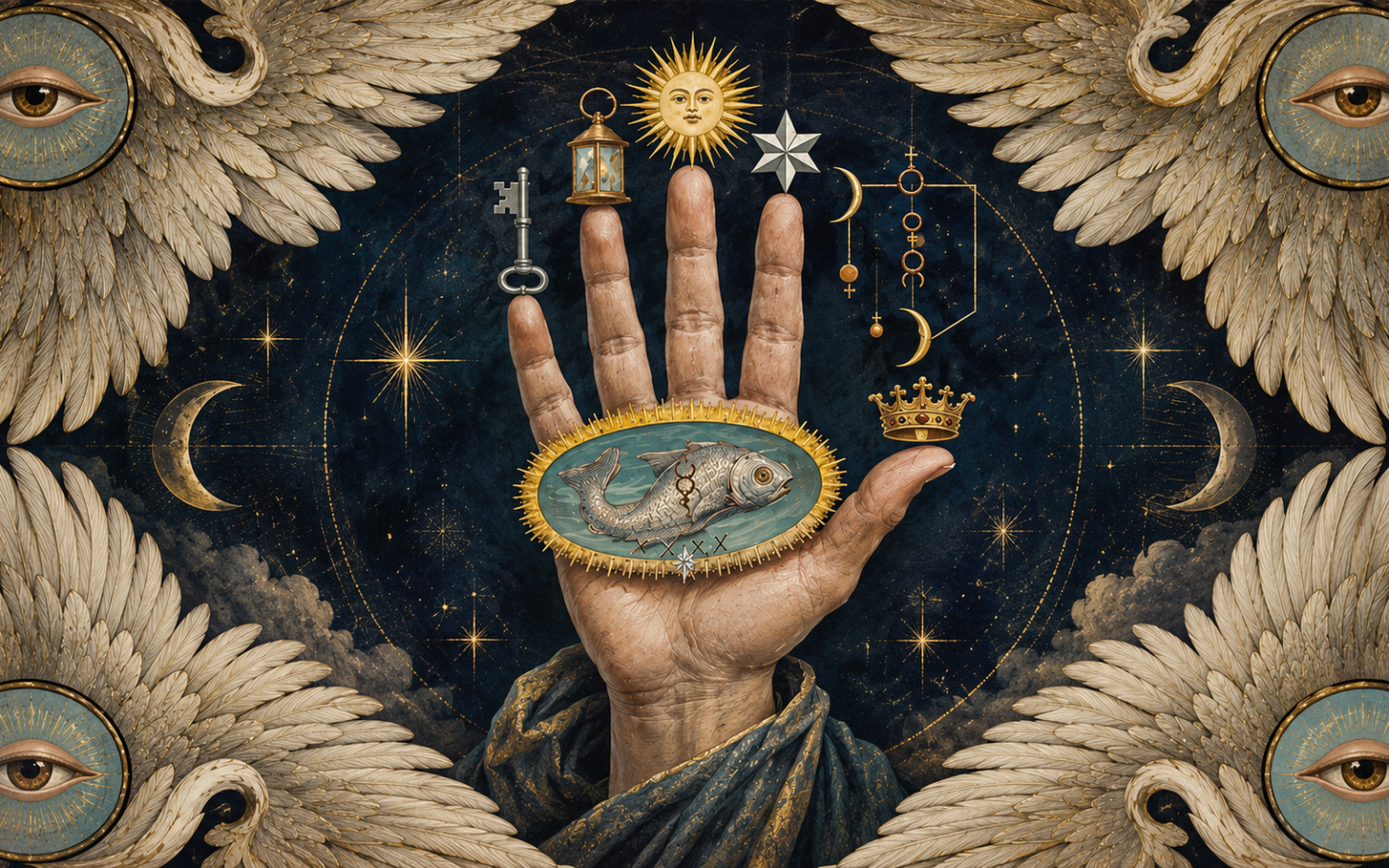

Born in the late 19th century as a movement dedicated to explaining the great mysteries of the universe and human existence, Theosophy proposed the existence of a shared, ancient Divine Wisdom. According to its followers, this wisdom was shared by different cultures and religions. Its ideas about karma, reincarnation, subtle bodies, spiritual evolution, and occult masters would eventually spread far beyond the Theosophical Society.
You’ve surely come across someone talking about other dimensions of reality, reincarnation, spiritual guides, or “vibrating high.” Today, many of these ideas in mainstream spirituality are often associated with the New Age movement. It’s a movement without a single institution or leader, where crystals, astrology, tarot, meditation, and various holistic therapies coexist.
But long before social media was flooded with modern witches and abundance gurus, Theosophy already existed. This movement blended European esotericism, philosophy, and its own interpretations of Asian religious traditions. Far from having disappeared entirely, part of its vocabulary continues to circulate among those who explore consciousness and spirituality outside of institutional religions.
What is theosophy?
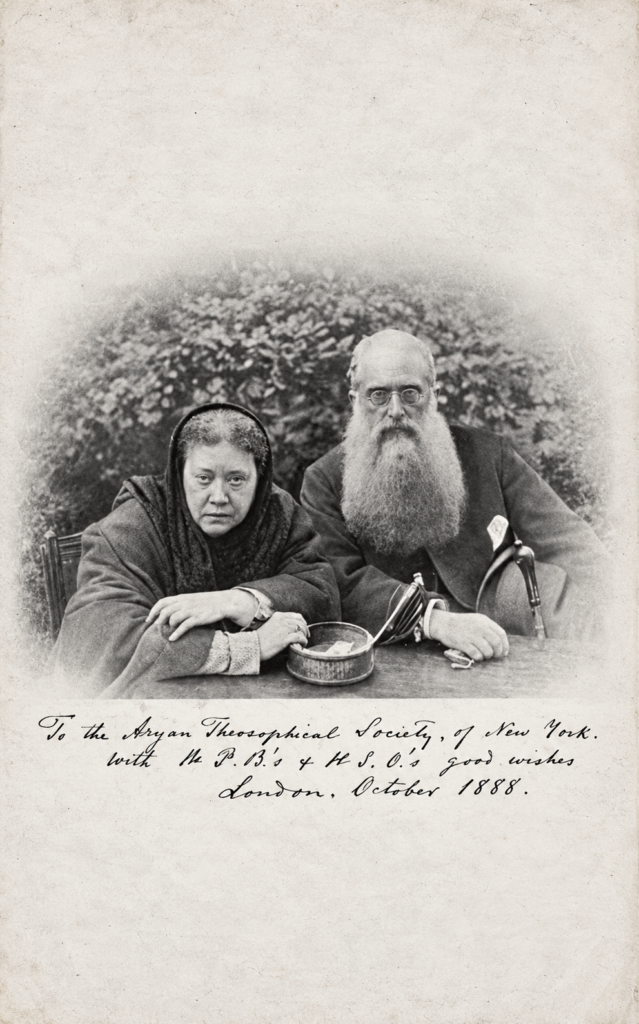
Etymologically, the word comes from the Greek theos—God—and sophia—wisdom—meaning “divine wisdom.” The term had existed for a long time. However, modern theosophy took shape in New York in 1875, when Helena Petrovna Blavatsky, Henry Steel Olcott, and others interested in spiritualism, the occult, and philosophy founded the Theosophical Society.
Rather than a church with religious hierarchies or mandatory doctrinal rules, the Society presented itself as a space to study, debate, and explore different explanations for the origin of the universe. In this way, they also analyzed religions and consciousness.
Its objectives were to establish a nucleus of universal brotherhood and to promote the comparative study of religion, philosophy, and science. In addition, they investigated what the Theosophical Society itself defines as the “unexplained laws of nature” and the “latent” powers of human beings.
Blavatsky maintained that theosophy was not simply another religion, but a “Religion-Wisdom”: a supposed primordial tradition of which historical religions preserved fragments. In *The Key to Theosophy*, she argued that seemingly distinct traditions could be interpreted as partial expressions of an older spiritual truth.
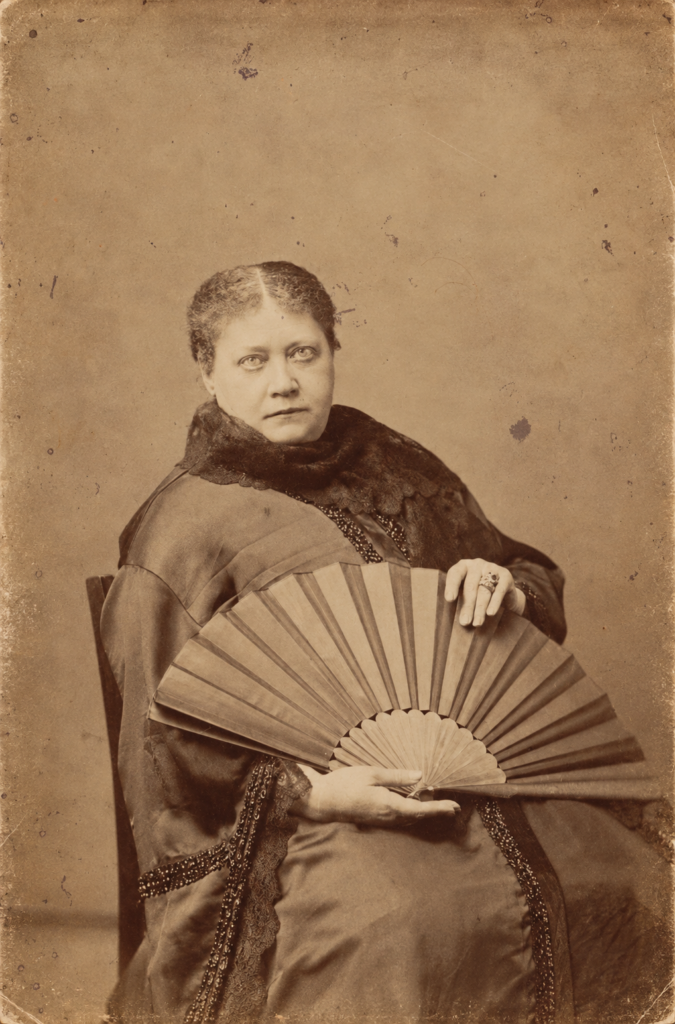
Who was Helena Blavatsky?
Behind this proposal was Helena Petrovna Blavatsky, born in 1831 in Yekaterinoslav—then part of the Russian Empire and now Dnipro, Ukraine. She traveled extensively, participated in spiritualist and esoteric circles, and ultimately became one of the most influential and controversial figures in 19th-century occultism.
It was not enough for Blavatsky simply to find out whether it was possible to contact the dead, as many spiritualists of her time did. She wanted to construct a much broader explanation of the universe, humanity, and its spiritual development.
In 1877, she published *Isis Unveiled*, in which she challenged both scientific materialism and the dogmatic forms of institutionalized religion. Her approach sought to reconcile religion, philosophy, science, and the occult through the idea of a primordial wisdom.
Years later, she settled in India with Olcott, and in 1882, the Theosophical Society established its international headquarters in Adyar, near Chennai.
In 1888, *The Secret Doctrine*, her most ambitious work, was published. In it, she developed a cosmology and a supposed occult history of humanity organized into major evolutionary stages called “root races.” Among these were the Lemurian, the Atlantean, and a fifth stage that Blavatsky termed “Aryan.”
These categories cannot be completely separated from 19th-century discussions of race, evolution, and colonialism. The historian of religions Julian Strube has pointed out that the “root races” occupied a central place in Theosophical doctrine. Furthermore, their spiritual dimensions had concrete consequences within the racial and political relations characteristic of the colonial world.
The Coulomb Scandal
Blavatsky also claimed to be in contact with the so-called Mahatmas or Masters of Wisdom, figures who, according to her, had attained exceptional spiritual development and imparted occult knowledge. Among the best known were Koot Hoomi and Morya, to whom several letters on doctrinal matters were attributed.
The existence of these masters as presented by Blavatsky has never been historically verified.
In 1884, Emma and Alexis Coulomb, former collaborators of the Theosophical Society in India, accused Blavatsky of fabricating some of the paranormal phenomena associated with her. The Society for Psychical Research commissioned an investigation by Richard Hodgson, who traveled to India and presented his findings in 1885. In the report published in the *Proceedings of the Society for Psychical Research*, Hodgson argued that the theosophical phenomena investigated were part of a fraudulent scheme. He also attributed to Blavatsky the authorship of documents used as evidence.
The controversy continued for decades. In 1986, Vernon Harrison, a document specialist and member of the Society for Psychical Research, reexamined the case. His study called into question Hodgson’s methods, handwriting analysis, and several of his documentary conclusions. The review did not prove that the paranormal phenomena attributed to Blavatsky were genuine, but it did cast doubt on the soundness of significant parts of the original report.
Despite the scandal, Blavatsky continued to write and teach until her death in London in 1891. By then, Theosophy had already outgrown its status as a small esoteric circle. It was also beginning to influence religious, artistic, and intellectual movements that would continue to develop throughout the 20th century.
Planes of Existence, Subtle Bodies, and Masters of Wisdom
Within Theosophy, a person is not merely their physical body. Reality consists of different levels or “planes,” and human beings possess aspects capable of interacting with them.
The idea that there is something intermediate between the material body and the soul was not invented by Blavatsky. In *The Subtle Body: A Genealogy*, Simon Cox traces the origins of the so-called “subtle bodies” and explains that Blavatsky drew upon elements from Neoplatonism, Kabbalah, German idealism, transcendentalism, and 19th-century European Orientalism. What was unique about Theosophy was its presentation of materials from different sources as parts of a single body of ancestral knowledge.
With the subsequent development of theosophical doctrine, a framework of various planes—physical, astral, mental, and other levels considered progressively more spiritual—became widespread; these were not necessarily to be imagined as separate places. Rather, they were viewed as states or degrees of reality capable of coexisting. Various theosophical authors eventually organized these levels into systems of seven planes and related them to different states of consciousness.
The “subtle bodies,” within this framework, would be non-physical vehicles corresponding to some of these levels. The so-called astral body, for example, would help explain experiences such as dreams, visions, or out-of-body experiences, according to the Theosophical interpretation. These claims are part of their religious and esoteric system and have not been scientifically established.
Something similar occurred with the Mahatmas. The term mahātma, derived from Sanskrit, literally means “great soul,” but Blavatsky gave it a specific meaning. She described the Masters as extraordinarily advanced human beings who were part of a brotherhood of adepts charged with preserving and transmitting spiritual knowledge.
Thus, concepts that had previously existed independently were woven together into a unified explanation of the cosmos and human evolution.
Karma, reincarnation, and a consciousness that also evolves
People would also undergo multiple incarnations under the influence of karma, understood in Theosophy as a universal law of cause and effect.
According to this view, each existence allows one to accumulate experiences and gradually advance in spiritual development. Life can thus be explained as a kind of school: actions have consequences, and the various incarnations are part of a much longer process.
Historian Julie Chajes has shown that Blavatsky’s interpretation of reincarnation did not emerge fully formed from the outset. In *Recycled Lives: A History of Reincarnation in Blavatsky’s Theosophy*, Chajes explains that Blavatsky held various theories about rebirth and that her formulations incorporated elements of spiritualism, Platonism, 19th-century scientific debates, and her interpretations of Asian religions, as well as references to Kabbalah and Egyptology.
The Theosophical approach was to extend the idea of evolution beyond biology: not only would the body or the species evolve, but so would individual consciousness and humanity as a whole.
So, did Blavatsky invent the New Age?
No. Nor is there a direct line leading from Blavatsky to all the expressions that are today labeled “New Age.” But academic research on contemporary religions does identify theosophy as one of the main channels through which certain 19th-century esoteric ideas were transmitted to later movements.
The historian of religions Wouter J. Hanegraaff situates the emergence of the New Age within a much broader transformation of Western esoteric traditions that gradually adapted to a modern, secularized society. His approach allows us to understand the relationship with Theosophy as part of a historical genealogy rather than as a simple list of similarities. Olav Hammer reaches a more specific conclusion: theosophical teachings were modified by numerous movements during the 20th century and exerted a significant influence on the diffuse religiosity commonly referred to as New Age.
What was passed down from one movement to the next? Among other things, the idea that humanity undergoes spiritual evolution; the belief in different levels of reality; the subtle bodies and the aura; reincarnation and karma reinterpreted for Western audiences; the possibility of receiving knowledge from higher entities or masters; and the search for a common truth underlying different religions. However, these ideas changed as they spread.
In the Theosophical Society, they were part of a relatively complex cosmology and were linked to an organization, doctrinal literature, and a supposed secret tradition. In much of the subsequent New Age movement, they became more flexible and combinable: a person could accept reincarnation, practice astrology, speak of energies, or follow a supposed spiritual master without accepting the entire theosophical system.
Alice Bailey was one of the most visible bridges, but not the only one. After participating in theosophical circles, she developed her own body of work on meditation, human evolution, masters, and a future “new age.” Other movements derived from or influenced by theosophy made similar modifications during the 20th century.
So there is no direct line connecting Blavatsky to the quartz crystals on TikTok. What does exist is a documented history of concepts that passed from one movement to another, shifted in meaning, and ultimately became part of the language of contemporary spirituality.
From Séances to Museums
Theosophy’s influence also reached art and literature. But its significance becomes clearer when we look at what certain artists did with those ideas.
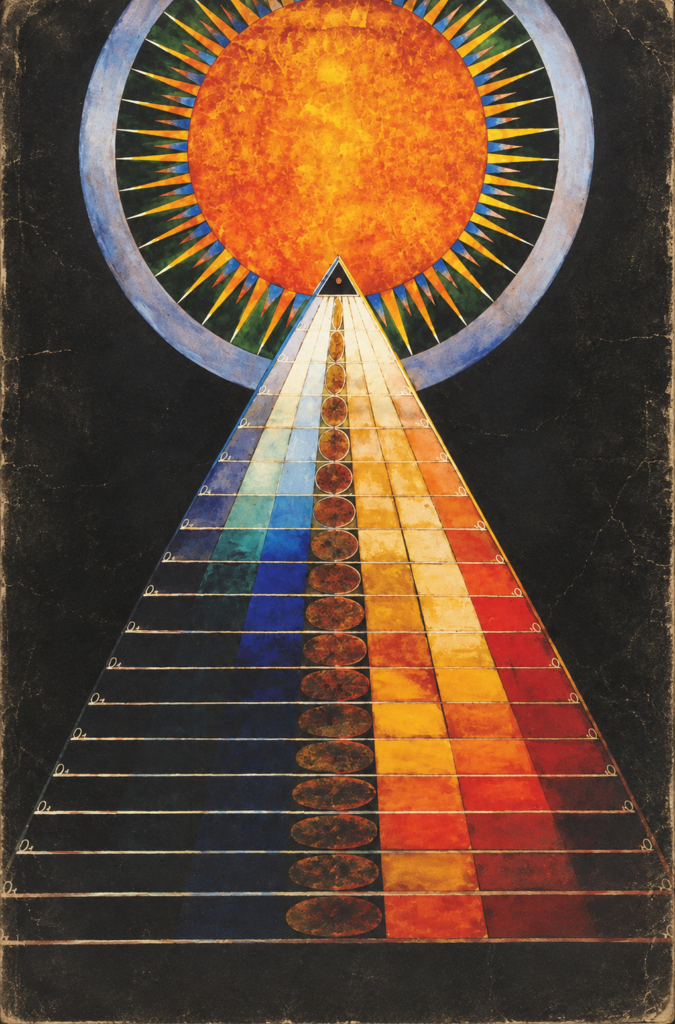
Hilma af Klint: Painting a Reality That Could Not Be Seen
Hilma af Klint participated in séances from a young age and later became involved with Theosophy. In 1904, she joined the Theosophical Society in Sweden and also maintained a deep interest in the teachings of Rudolf Steiner.
For her, these beliefs were not a hobby separate from her work. Her series *Paintings for the Temple* emerged from mediumistic experiences and the intention to represent spiritual processes through shapes, colors, spirals, dualities, and geometric figures.
Regarding her 1908 series *Evolution*, the Guggenheim Museum Bilbao explains that the artist worked with a notion of evolution closely aligned with Theosophical and Rudolf Steiner’s ideas: not merely biological change, but a spiritual process through which the soul develops and draws closer to the divine.
In other words, theosophy does not merely appear in her biography: it helps us understand part of the visual vocabulary and the ideas that structure her abstract work.
Piet Mondrian: Behind the Grid Lay a Spiritual Quest
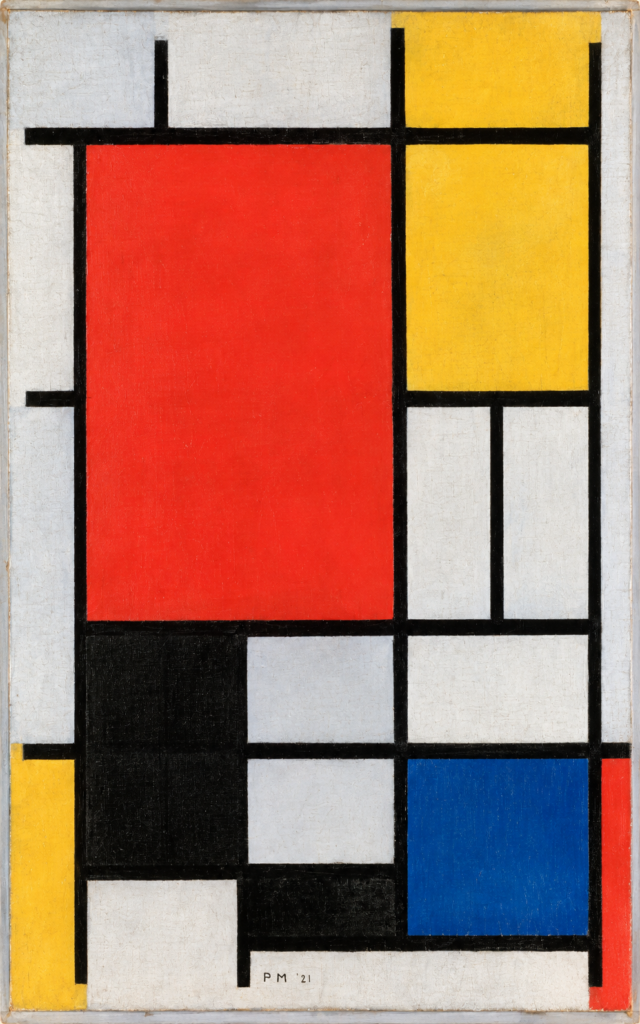
Piet Mondrian joined the Theosophical Society in 1909. His approach to abstraction was shaped by other decisive influences, including Cubism; therefore, it would be simplistic to explain his entire body of work solely through the lens of Theosophy. However, his writings and several of his compositions show that he sought to represent something more universal than the particular appearance of objects.
In describing *Pier and Ocean 5*, the Museum of Modern Art notes that Mondrian’s lines and intersections allude not only to the surface of the sea but also to a spiritual structure within nature; the museum itself links his abstraction to the search for a balance between the concrete and an underlying universal truth.
The theosophical interest in a universal reality hidden beneath appearances thus coincided with his quest for a style of painting that was increasingly less dependent on representing concrete objects.
Rudolf Steiner: From Theosophy to Anthroposophy
Rudolf Steiner exemplifies a different kind of influence. He was not merely an occasional reader: in 1902, he became general secretary of the German section of the Theosophical Society, and during that period he published works such as *Theosophy* and *Knowledge of the Higher Worlds*.
Over time, he distanced himself from the movement, and the Anthroposophical Society was founded between 1912 and 1913. His new movement retained themes present in theosophical circles—spiritual evolution, reincarnation, and knowledge of supersensible realities—but developed them in its own way, with an orientation more strongly influenced by Christianity and the European intellectual tradition.
Anthroposophy ultimately gave rise to independent cultural initiatives in education, the arts, agriculture, and other fields. From this emerged, among other projects, the educational approach now associated with Waldorf schools.
The influence of Theosophy can also be traced in W. B. Yeats. The poet joined the Theosophical Society in the 1880s and later became involved with the Hermetic Order of the Golden Dawn. An academic study on theosophical symbolism in *A Vision* argues that the ideas and methods of spiritual inquiry that Yeats encountered through theosophy left their mark on the metaphysical system he later developed in that work. *A Vision* also incorporated material from the automatic writing of his wife, George Yeats, as well as from other philosophical and esoteric traditions; therefore, it cannot be reduced solely to theosophical influence.
Theosophy in Mexico and a Problem Hard to Ignore
Theosophy did not disappear with Blavatsky. The Theosophical Society continues to operate internationally and has maintained an organized presence in Mexico since the early 20th century. A historical yearbook published by the Society itself records that the first lodges appeared in Mexico in 1906. Furthermore, the charter of the Mexican Section is dated November 12, 1919. But just because the movement spoke of universal brotherhood does not mean it was free from the racial and colonial categories of its time.
The Theosophical Society helped spark interest among numerous European and American readers in the philosophies and religions of India and other regions of Asia. This occurred at a time when such knowledge was often disparaged in the West. But Blavatsky and other authors also selected, translated, and reorganized these concepts. They did so through categories created within Western esoteric and Orientalist circles.
This means that terms such as karma or reincarnation did not enter modern esotericism while retaining all the meanings they had within the traditions from which they originated. Instead, they were reinterpreted to address questions characteristic of 19th-century Europe and the United States. These questions concerned evolution, science, progress, spiritualism, the origin of humanity, and survival after death.
What did Theosophy actually change?
The historical significance of Theosophy lay not so much in inventing new beliefs as in bringing together ideas that had previously circulated in different spheres. Furthermore, it offered, through these ideas, a general explanation of the universe, humanity, and consciousness.
Blavatsky combined elements of European occultism with interpretations of Hinduism, Buddhism, Neoplatonism, Kabbalah, and other sources. She thus presented them as remnants of a single universal wisdom.
Consequently, concepts such as karma and reincarnation began to be integrated into new, modern spiritual discourses, although often separated from their original religious contexts.
At the same time, Theosophy spoke of spiritual evolution, invisible levels of reality, and latent human capacities. It employed a vocabulary that sought to engage with the major scientific debates of its time.
This combination helped consolidate a form of spirituality that could function outside traditional churches. It would later be reinterpreted by numerous movements of the 20th century.
What remains of theosophy today?
More than a century later, much of the theosophical legacy endures. This is the case even though those who draw on its ideas have not necessarily read Blavatsky or belong to the Theosophical Society.
Talk of astral bodies, past lives, the evolution of consciousness, ascended masters, auras, or different levels of reality is now commonplace in many alternative spiritual circles. Today, however, the vocabulary has changed. These doctrines are no longer always presented as parts of a single system.
The way they are practiced has also changed. The original movement established societies, publications, national branches, and study programs. However, much of contemporary spirituality operates in a much more individualistic manner. Each person can combine meditation, astrology, reincarnation, alternative therapies, or beliefs about energies without accepting a common doctrine or joining an institution.
But this current reality also raises some uncomfortable questions. When concepts derived from Hinduism, Buddhism, or other traditions become generic terms for spiritual well-being, it is worth asking what parts of their original contexts were lost and who carried out those reinterpretations. In the case of Theosophy, this discussion is directly related to colonial conditions. These conditions influenced the way Europeans, Americans, and Asian intellectuals exchanged ideas during the nineteenth century.
Similarly, any contemporary reassessment of the movement must acknowledge that its advocacy of universal brotherhood coexisted with theories about “root races” and categories inherited from the racial debates of its time. However, studying this tension does not mean reducing all of Theosophy to racism or colonialism. Nor does it mean separating its spiritual ideas from the historical world in which they were formulated.
Theosophy did not invent the New Age, much less all of contemporary spirituality. Nevertheless, what it did was become one of the great meeting points. From there, concepts drawn from different traditions were reorganized and disseminated to modern audiences.
That is why its presence remains recognizable even where its name no longer appears. Furthermore, whenever someone speaks of past lives, astral bodies, spiritual teachers, or the evolution of consciousness, they are using language whose modern history is, at least in part, rooted in Theosophy.