

Banksy’s Simpsons Intro: What Fox Changed Before It Aired
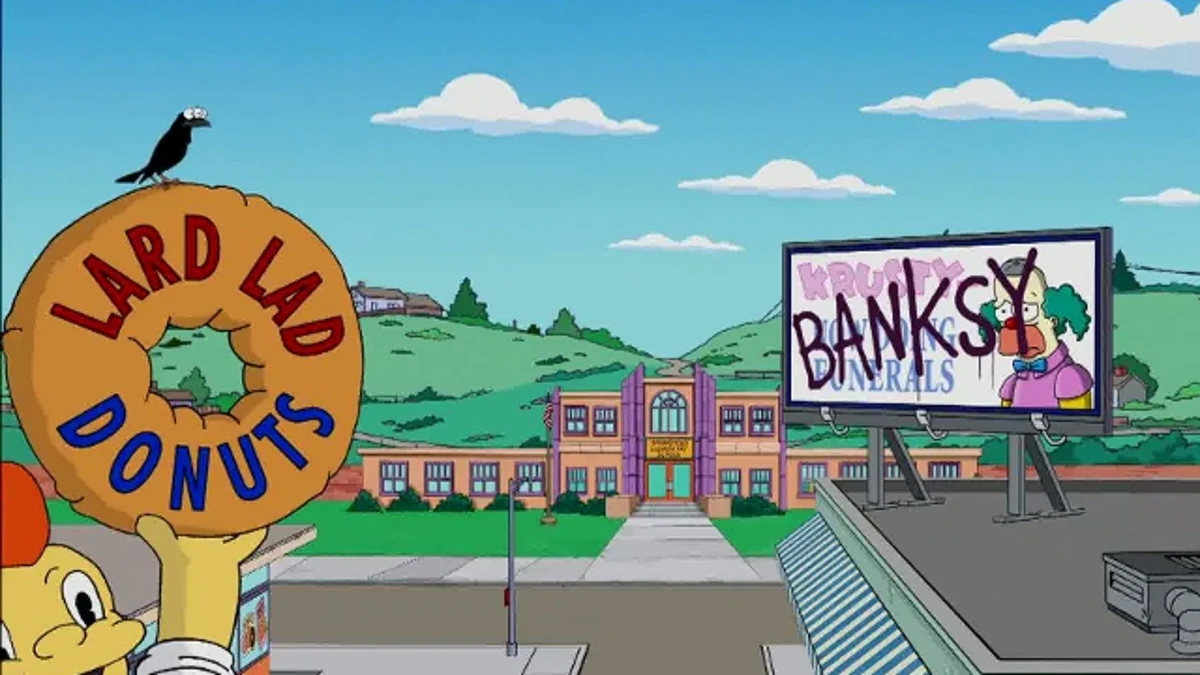

Banksy created one of the most controversial opening sequences in The Simpsons, but he did not write the episode itself. His contribution appeared in “MoneyBart,” the third episode of season 22, and focused on the opening titles and extended couch gag. Most of his original concept made it to television. However, Fox requested changes before broadcast and the South Korean animation studio AKOM separately objected to elements of Banksy’s depiction of Asian animators.
Those distinctions matter because the story is often reduced to the idea that Fox simply “censored” Banksy. Executive producer Al Jean said Fox’s Standards and Practices department requested a small number of changes. He estimated that about 95 percent of Banksy’s proposal survived. AKOM’s intervention was different: its founder, Nelson Shin, said his team considered aspects of the storyboard offensive and successfully pushed for some details to be altered.
Interest in Banksy intensified again on March 13, 2026, when a Reuters investigation into Banksy’s identity concluded from court records, immigration documents and other evidence that the artist was Robin Gunningham. He later adopted the name David Jones. Reuters said Banksy did not respond to detailed questions about its findings, while Pest Control told the news agency that the artist had “decided to say nothing.”
That renewed attention makes it worth returning to one of the most unexpected interventions of his career. Specifically, the moment Banksy used the opening of one of television’s most recognizable franchises to criticize the industrial production, outsourcing and merchandising surrounding it.
Which Simpsons Episode Featured Banksy’s Intro?
Banksy’s opening appeared in “MoneyBart,” which was first broadcast in the United States on October 10, 2010. He was responsible for the opening titles and couch gag rather than the episode itself. The collaboration marked the first time an outside artist had been invited to storyboard an opening sequence for The Simpsons. Contemporary coverage from The Guardian described Banksy’s role in creating the title sequence. It also documented how dramatically it departed from the show’s familiar opening.
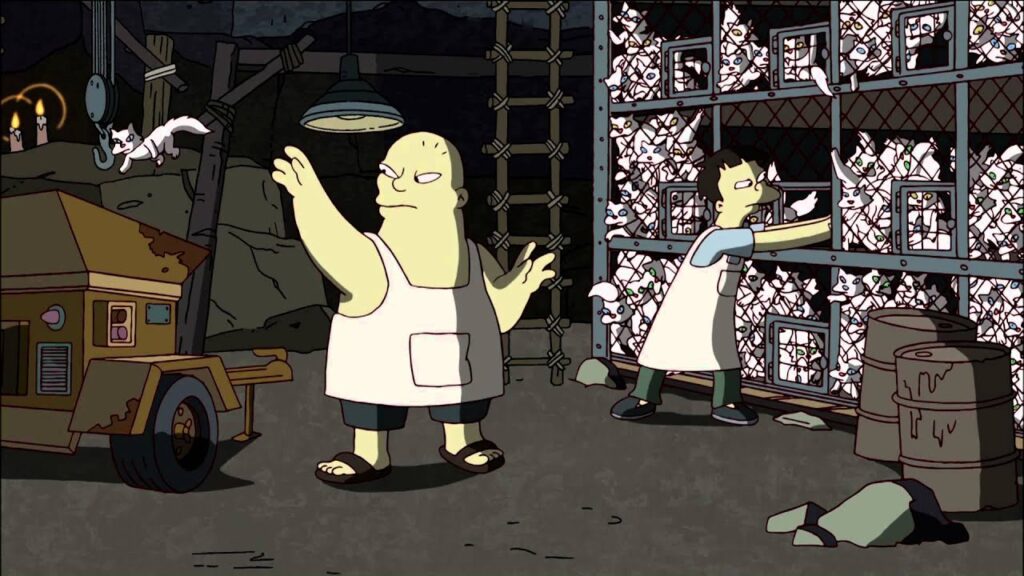
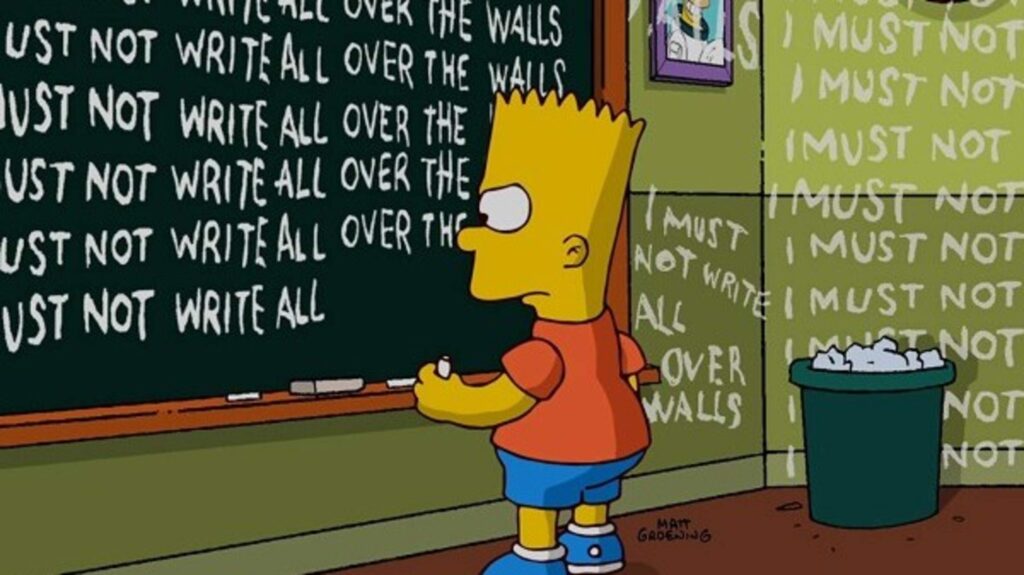
The sequence initially follows the recognizable journey through Springfield, although Banksy tags appear across the city and Bart covers his classroom walls with graffiti. Once the Simpson family reaches the couch, however, the familiar setting gives way to a bleak factory. There, workers produce animation frames and Simpsons merchandise under grim industrial conditions.
T-shirts, dolls and DVDs move through the production line while both people and animals are reduced to components in the manufacturing process. Notably, cats are used as stuffing for Bart Simpson dolls, a dolphin’s tongue seals packages and a chained unicorn repeatedly uses its horn to punch holes in discs. The sequence eventually pulls back to reveal the factory beneath a darkened 20th Century Fox logo surrounded by barbed wire, a guard tower and searchlights.
How Did Banksy End Up Working With The Simpsons?
The collaboration began with executive producer Al Jean, who became interested in Banksy after seeing Exit Through the Gift Shop, the artist’s 2010 documentary. Jean asked The Simpsons casting director Bonnie Pietila to try to reach Banksy. She eventually made contact through the documentary’s producers. Banksy never had to reveal himself in person; instead, he sent storyboards for the opening sequence, which the production team used as the basis for the finished animation.
Jean later said that the boards Banksy submitted were essentially what audiences eventually saw. Series creator Matt Groening approved the collaboration. The production team tried to preserve Banksy’s concept as closely as possible rather than softening it into a conventional guest appearance. The result was unusual even by the standards of a series long known for making jokes at the expense of its own network and corporate ownership.
That context is important to understanding why the sequence was ultimately broadcast. Banksy’s attack on corporate production was provocative, but The Simpsons already had a long tradition of satirizing Fox, Rupert Murdoch and the commercial structures surrounding the show. Moreover, Banksy pushed that self-criticism further by turning the opening itself into an image of exploitation.
What Did Fox Change in Banksy’s Simpsons Intro?
Fox did request modifications, but there is little evidence for the more dramatic claim that the network nearly prevented the sequence from airing. Jean said Fox’s Standards and Practices department asked for several changes that he accepted on grounds of taste. He also stressed that roughly 95 percent of Banksy’s original proposal remained intact. A contemporary account of Jean’s comments noted that the sequence had been fully approved by Fox. Additionally, the network had paid for the animation rather than being surprised by it after production. TVWeek reported Jean’s account of Fox approving the sequence.
That complicates the common description of the intro as something Fox simply “censored.” Some material was changed, but the network also authorized the sequence, financed its production and broadcast almost all of Banksy’s concept. Jean did not provide a complete public inventory of the material contained in the remaining five percent. This means claims about precisely what Fox removed should be treated carefully rather than reconstructed from speculation.
The more accurate account is therefore one of negotiation rather than wholesale suppression. Banksy was given unusual control over the opening. The show’s producers worked to preserve his storyboards and Fox Standards and Practices intervened only in certain details before transmission.
Why Did AKOM Object to Banksy’s Storyboard?
A separate controversy involved AKOM, the South Korean animation studio that worked on The Simpsons. Banksy’s fictional sweatshop drew on the show’s long-running use of animation production in South Korea. However, AKOM’s staff objected to the suggestion that their own working environment resembled the degrading factory shown in the sequence. TIME reported Nelson Shin and AKOM’s objections to the Banksy sequence after speaking with the studio founder and South Korean animators.
Shin said he complained to Film Roman after seeing the storyboard and argued that parts of the depiction were excessive and offensive. He said his lobbying resulted in some changes. However, the changes were not as many as he wanted. One of the clearest documented differences involved the workers’ hats: Banksy’s storyboard depicted animators wearing pointed conical hats. These were replaced with more generic caps in the finished sequence.
The distinction between AKOM and Fox Standards and Practices is essential. Fox asked for content changes as the broadcaster and corporate owner of the program. In contrast, AKOM objected specifically to the way South Korean and other Asian animation workers were represented. Treating both interventions as a single act of “Fox censorship” obscures how the sequence actually evolved before broadcast.
Jean also rejected the idea that Banksy’s factory should be interpreted as a literal description of the studios producing the show. He characterized the images as deliberately exaggerated and fantastical. This approach underscored the obvious unreality of details such as the chained unicorn rather than presenting the couch gag as documentary evidence about animation conditions in Seoul.
How Was Banksy’s Original Storyboard Different?
Banksy later made his original storyboard public, making it possible to compare the drawings with the completed television sequence. The comparison reinforces Jean’s claim that the finished version remained remarkably close to the artist’s original concept. The basic structure, the oppressive factory, the merchandise production and the final attack on the Fox logo all survived.
The most clearly documented alteration is the removal of the conical hats from the workers, a change tied to AKOM’s objections. Beyond such identifiable differences, however, Fox never released a definitive list explaining every element altered before transmission. That absence is another reason to avoid headlines claiming that an entire hidden version was “banned” or dramatically censored. The available evidence shows that most of Banksy’s storyboard was preserved.
What makes the storyboard valuable is precisely that it allows the controversy to be examined through Banksy’s original drawings rather than through later mythology surrounding the collaboration. The surviving evidence points to a provocative concept that underwent targeted revisions but reached television substantially as its creator intended.
What Was Banksy Criticizing in The Simpsons Opening?
Banksy’s sequence works on several levels, but its most obvious target is the conversion of popular culture into an industrial product. Inside the factory, episodes of The Simpsons are manufactured alongside T-shirts, dolls and DVDs. This collapse merges the distinction between creative production and merchandising into a single grotesque assembly line.
The exploitation extends beyond human labor. Animals and the unicorn are treated as disposable machinery, exaggerating the logic of mass production. In doing so, everything inside the fictional factory becomes raw material for the franchise. The result is not simply a joke about overseas animation; it is a broader image of a global entertainment property sustained by production, licensing and the endless reproduction of recognizable characters.
Banksy’s choice of The Simpsons made that critique particularly effective because the show itself belonged to the system being attacked. The couch gag used a Fox property to criticize the commercial machinery surrounding that property. In addition, Fox then broadcast the criticism as part of the program. The contradiction was not an accidental by-product of the collaboration; it was central to why the sequence attracted so much attention.
Contemporary criticism also noted that the show had long been willing to mock corporate power and its own network, which complicates the idea that Banksy somehow smuggled an unauthorized attack into an unsuspecting television company. The Guardian’s contemporary analysis of Banksy’s Simpsons satire placed the couch gag within that longer history of The Simpsons attacking business and the institutions around it.
Why the Banksy Simpsons Intro Still Matters
More than 15 years later, the opening remains memorable because Banksy transformed one of television’s most familiar rituals without abandoning the visual language that had defined his street work. The Simpson family’s routine journey to the couch becomes a gateway into a hostile production system. This transformation turns a comforting and instantly recognizable sequence into something deliberately uncomfortable.
The collaboration also remains an unusual example of a mass-media franchise permitting a guest artist to criticize the economic machinery behind that same franchise from inside the product itself. Fox requested changes and AKOM challenged aspects of the representation. Nevertheless, the overwhelming majority of Banksy’s proposal was still transmitted to millions of viewers.
That tension is what gives the sequence its lasting power. Banksy entered Springfield using the same strategy he had used on streets, walls and gallery spaces: take a recognizable image, disrupt the assumptions surrounding it and force viewers to consider the system behind what they are seeing. This time, however, the system under attack was also the one responsible for putting his work on television.
Redacción
Montserrat RM
Montserrat RM is a journalist focused on lifestyle, travel, music, entertainment, and culture. Her work combines an informative and contextual approach to create relevant, audience-centered content, with a particular interest in stories that connect trends, experiences, and cultural expressions.