


Tour to the Valley of the Catrinas from Mexico City: What the Tour Is Like and Whether It's Really Worth It
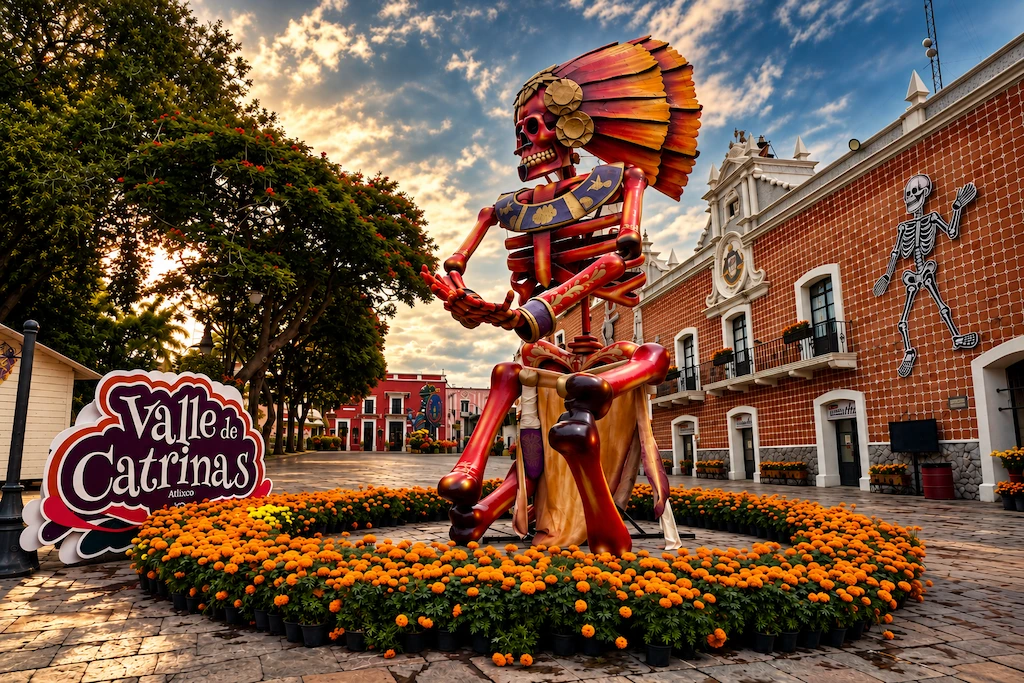

Taking the tour to the Valley of the Catrinas from Mexico City takes care of a complicated part of the trip to Atlixco all at once: round-trip transportation, schedules, a guide, and transfers during an outing that easily takes up the entire day. In exchange, you have to accept the pace of an organized tour. You won’t have unlimited time at each stop, nor will you necessarily get to see all 19 of the Monumental Catrinas installed in the municipality. After taking the tour, this is perhaps the expectation you should adjust most before buying a ticket.
The experience works best if your goal is to explore Atlixco during the Day of the Dead season, see several of the monumental sculptures, stroll through the “Pueblo Mágico,” take photos, and return to Mexico City that same night. The day can be tiring due to the hours spent on the road and the walking, but it also saves you from having to drive, look for parking, or plan a route between different spots in the municipality. On the other hand, for those who want to take their time exploring each Catrina, traveling on your own offers much more freedom.
What It’s Like to Take the Valle de Catrinas Tour from Mexico City
The day begins early in Mexico City. For the 2026 season, there are several pick-up points along the same route: the National Auditorium at 7:00 a.m., the Angel of Independence at 7:10 a.m., Reforma 222 at 7:15 a.m., Glorieta de Colón at 7:20, Hemiciclo a Juárez at 7:25, and Zócalo at 7:30. These are successive boarding times, not separate departures. This prevents all passengers from having to arrive at a single terminal. Once the group has gathered, the journey to Atlixco, Puebla, begins.
On the trip organized by Yaconic, the bus proved comfortable for this type of journey: it had a restroom and USB ports for charging devices—which is quite useful when you’re using your cell phone for much of the day for photos, maps, and communication. There is also friendly and helpful staff on board during the excursion, along with a local guide who provides context about various sites in Atlixco. On the return trip, the team may also make a few stops along the way when the route and traffic conditions allow the bus to pull over. However, this depends on the specifics of each trip and should not be assumed to be a door-to-door service.
The duration explains much of the itinerary. The official itinerary for the “Monumental Catrinas of Atlixco” tour specifies an experience lasting approximately 13 hours, with return around 8:00 p.m. For 2026, the program includes round-trip scenic ground transportation, a trained driver, a buffet meal, a visit to the “Pueblo Mágico” of Atlixco, admission to the Catrinas Monumentales exhibition, a certified guide, travel insurance, and a one-day pass for the Turibus City Tour in Mexico City, with access to the four circuits: Historic Center, South, Polanco, and the Basilica. As of this publication, the advertised rate is 1,499 pesos per person. Therefore, it’s a good idea to review the terms and conditions before booking, as schedules, availability, and packages are subject to change.
The package we tried is operated by Rehiletes as part of the Turitour/Turibus offering. Regardless of who markets the trip, the trip is structured like an organized excursion. Your transportation and a good portion of the itinerary are taken care of. Even so, the time you have available in Atlixco depends on the return time and the pace of the entire group.
Do you get to see all the Monumental Catrinas during the tour?
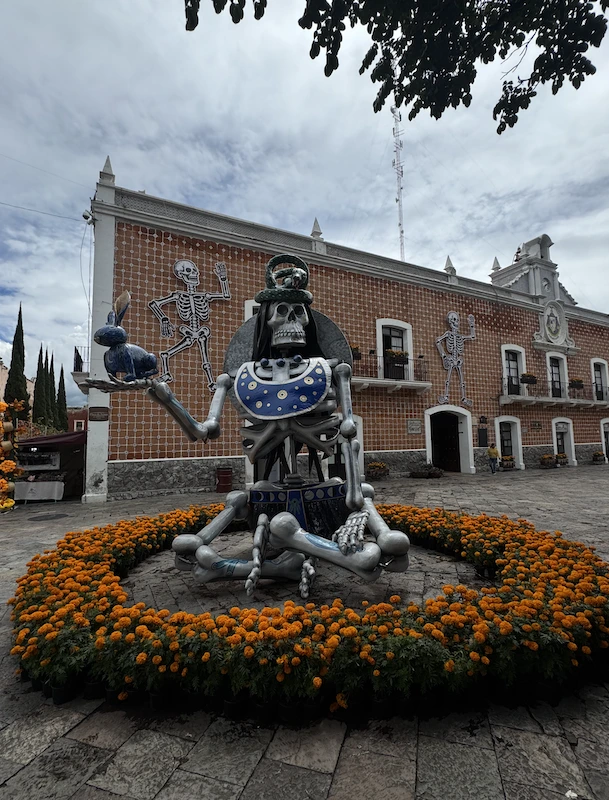
No. And it’s worth knowing this before you travel. The Valley of the Catrinas 2026 features 27 figures in total, but 19 are located at various spots throughout Atlixco, while the other eight were sent to exhibitions outside the municipality. This year’s edition is dedicated to pre-Hispanic deities and includes representations of Tonatiuh, Metztli, Coatlicue, Mayahuel, Tzinacantecuhtli, Macuilxóchitl, Huitzilopochtli, Tláloc, Mictlantecuhtli, Quetzalcóatl, Xochiquetzal, Ehécatl, Chalchiuhtlicue, Xochipilli, Centéotl, Xipe Tótec, Itzpapálotl, Ometéotl, and Tezcatlipoca. The map and official information for Valle de Catrinas 2026 make it clear that the pieces form a route spread throughout the municipality, not an exhibition concentrated in a single plaza. Additionally, the exhibition will be open from October 2 to November 9, 2026.
This dispersion is important when planning a tour. Some Catrinas can easily be incorporated into a walk through the central areas. However, reaching others requires traveling to different parts of Atlixco. On a day trip from Mexico City, the itinerary necessarily involves making some choices. You’ll see several sculptures, and there’s time to stop in front of them and take photos. However, the experience isn’t designed as an exhaustive search for all 19 pieces.
This may disappoint those who book the tour expecting to cover the entire map. On our tour, however, it didn’t feel like a wasted visit: the sculptures are large and detailed enough that each stop stands on its own. The appeal also lies in discovering them nestled within Atlixco’s streets, plazas, and public spaces—not just in checking off figures on a list. Therefore, anyone whose priority is to photograph each one, compare the designs, or explore all the locations will need more time and a separate itinerary.
What You Can Do in Atlixco in a Day
The tour allows time for walking, viewing several Monumental Catrinas, exploring part of Atlixco, and stopping to take photos. It’s not a contemplative or particularly slow-paced tour. There are times when you follow the group and others when you have free time, so the day alternates between the guide’s explanations and periods for exploring on your own.
There’s also an opportunity to shop. In the central streets, you’ll find handicrafts, souvenirs, seasonal products, food, and various shops catering to both visitors and the town’s daily life. This part of the tour is important because Atlixco isn’t just a backdrop for the festival. The town center has its own vibrant activity, and during October, this blends with the influx of visitors drawn by the Day of the Dead celebrations.
Atlixco has been part of the Pueblos Mágicos program since 2015, and its identity as a tourist destination has long been linked to flower production, nurseries, Cerro de San Miguel, its religious architecture, and the views of Popocatépetl. During Catrinas season, that image changes considerably: monumental structures appear among buildings, plazas, and streets that would normally have a different rhythm. The festival takes advantage of precisely this relationship between urban space, landscape, and cardboard art to transform the town’s streetscape for a few weeks.
Is the tour of the Valley of the Catrinas tiring?
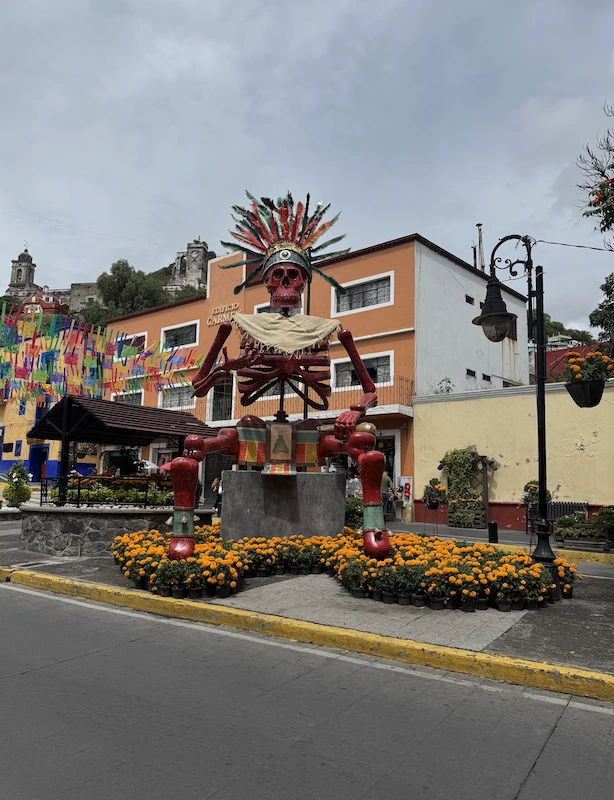
It certainly can be. The sculptures are enormous, but they aren’t all lined up next to one another. You’ll have to walk, get on and off transportation, wait for the group, navigate the streets, and spend many hours away from home. Add to that the drive between Mexico City and Puebla. Even if you spend most of the trip seated, by the end of the day the hours really add up.
Comfortable clothing and shoes make a significant difference. It’s also a good idea to bring a light jacket for the return trip, water, a raincoat or umbrella, sunscreen, enough battery on your phone, and only what you’ll actually use during the day. A backpack that’s too heavy will start to take its toll after several hours. If you’re traveling with older adults, young children, or anyone who has difficulty walking for extended periods, it’s worth checking before you book. That way, you can find out just how long the walking segments will be on your chosen tour.
Fatigue is also a result of the tour format. On an independent trip, you can sit down whenever you want, change your route, or spend more time eating. On a guided tour, there are group schedules and a meeting point that must be adhered to. The advantage is that, once you’re back on the bus, you no longer have to drive several hours to Mexico City.
Why the Monumental Catrinas of Atlixco Aren’t Just “Giant Skulls”
The 2026 edition uses the figure of the Catrina to represent gods and entities from pre-Hispanic Mexico. It is a visual combination that brings together references from very different eras. La Catrina as we know her today does not originate directly from Mesoamerica. Her origins lie in the graphic work of José Guadalupe Posada. Furthermore, the subsequent transformation of that image took place during the 20th century.
The National Institute of Anthropology and History traces the history of La Catrina back to an image by Posada that was published posthumously in 1913. Decades later, Diego Rivera incorporated that skull into *Dream of a Sunday Afternoon in the Alameda Central* and depicted it with a full body and elegant attire. The contemporary association between Catrinas and the Day of the Dead developed later. Thus, the figure became one of the most recognizable visual motifs of this holiday. The sculptures from Atlixco take this visual language and translate it into monumental papier-mâché. This year, this is achieved through figures associated with various Mesoamerican worldviews.
This distinction also helps dispel the notion that everything associated with the Day of the Dead has a direct pre-Hispanic origin. Today’s Mexican celebration brings together elements that have been constructed, transformed, and reinterpreted at different points in history. At Yaconic, we’ve explained these blends in greater detail. For example, we’ve examined the differences between the Day of the Dead and Halloween and how symbols such as skulls, flowers, and offerings came to be used as they are today.
The Valley of the Catrinas and Catrinia Are Not the Same Thing
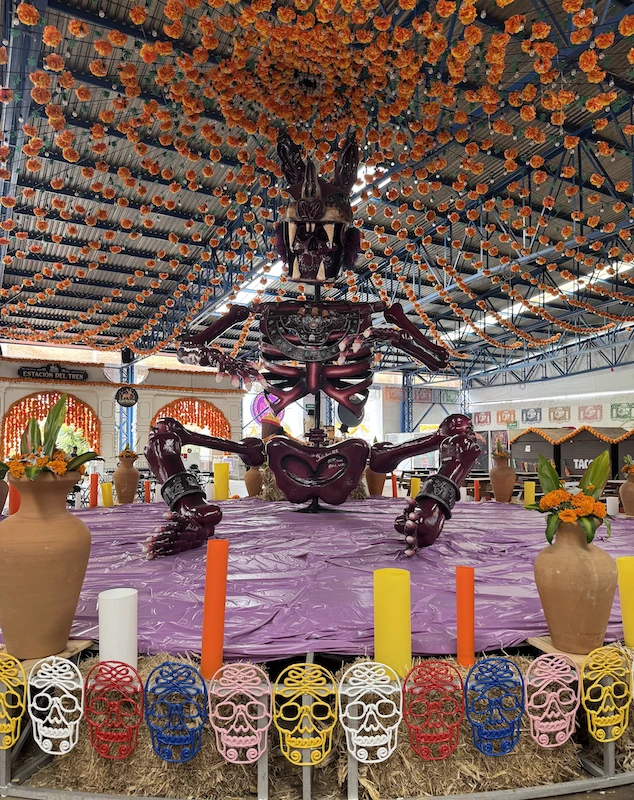
The names can be confusing because both events take place in Atlixco during the same season. Valle de Catrinas is the festival that displays monumental sculptures at various locations throughout the municipality. Walking through Atlixco and discovering the figures installed in their different locations is part of that experience.
Catrinia is a separate project. Its second edition is scheduled for 2026 and takes place at the Atlixco Convention Center, featuring activities and artistic expressions organized within a specific program. Information published by the Atlixco City Council regarding Valle de Catrinas and Catrinia indicates that the latter runs from October 2 to November 1, from 2:00 p.m. to 11:00 p.m. Therefore, it’s a good idea to carefully check what access is included when purchasing any tour. Seeing the Monumental Catrinas scattered throughout Atlixco and participating in an additional experience are not automatically the same thing.
What does the tour include, and how much does it cost in 2026?
The published rate for this season is 1,499 pesos per person, and the official package includes round-trip panoramic ground transportation, a trained driver, a buffet meal, a visit to the “Pueblo Mágico” (Magical Town) of Atlixco, admission to the Monumental Catrinas exhibition, a certified guide, travel insurance, and admission to the Turibus City Tour in Mexico City for one day, with access to the four circuits: Historic Center, South, Polanco, and the Basilica. There are various sales channels, and different options or promotions may be available. For this reason, it’s advisable to review the specific package description before payment, especially regarding meals and admissions.
For those departing from Mexico City, the boarding points are convenient because they are distributed along a central route. The 2026 itinerary includes the National Auditorium at 7:00 a.m., the Angel of Independence at 7:10 a.m., Reforma 222 at 7:15 a.m., Glorieta de Colón at 7:20 a.m., Hemiciclo a Juárez at 7:25 a.m., and the Zócalo at 7:30 a.m. These are successive stops along the same route. The schedule may change on certain dates; for example, the Hemiciclo stop has restrictions on Sundays. Arriving early prevents you from starting a 13-hour tour by having to run after the bus.
Starting October 12, there are still scheduled departures for October 17, 18, 24, 25, and 31, as well as November 1 and 2. The Valley of the Catrinas, meanwhile, remains open until November 9. Therefore, those who prefer to organize their own trip have a few extra days after the last scheduled tours.
So, is the tour to the Valley of the Catrinas worth it?
It’s worth it if you want to leave Mexico City in the morning, explore Atlixco during the Day of the Dead season, and return that same night without having to worry about transportation or logistics—and if you want a guide to explain everything worth seeing and why you should see it. The bus makes for a comfortable long day, and the Rehiletes team is very friendly throughout the trip. Plus, having a guide ensures the visit isn’t just about walking past sculptures without any context. There’s time for photos, shopping, and exploring part of this “Magical Town.” However, the itinerary never stops feeling like a scheduled tour.
It wouldn’t be our first choice for someone whose specific goal is to see all 19 Monumental Catrinas. In that case, it’s better to spend more time in Atlixco and plan your route using the official locations. Nor should you expect a relaxed experience: between the drive, the walks, group meetings, and the return trip, it’s a tiring day.
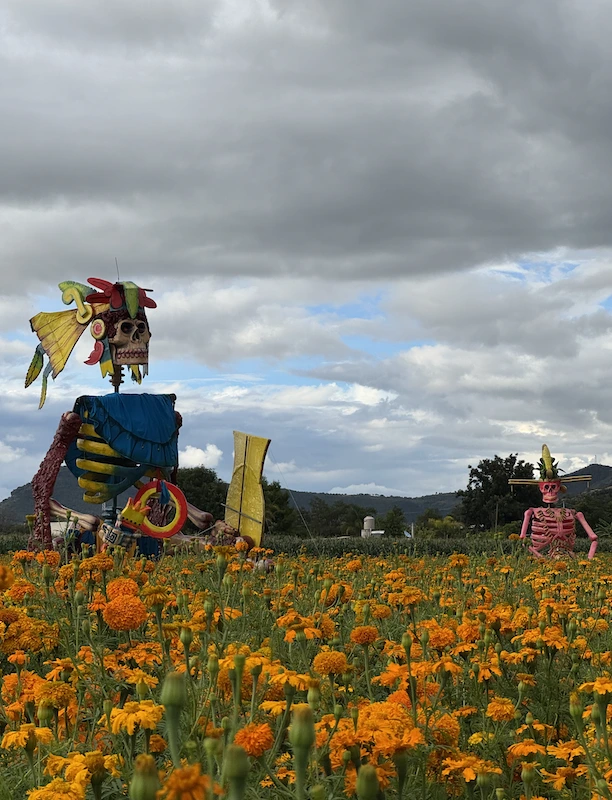
For a first visit, however, it’s a good balance. The Catrinas are impressive in scale—ranging from five to eight meters tall. There’s plenty of time to observe and photograph them. The trip also gives you a pretty clear picture of how Atlixco transforms its public spaces during October. Some sites are left out. However, that might be the most accurate way to describe this tour: it’s a leisurely introduction to the Valley of the Catrinas, not a comprehensive tour of the entire festival.
If this visit is part of your plans for the season, you can also check out our guide on how to set up a Day of the Dead altar and the meaning of its elements. That way, you can delve deeper into many of the images and objects that appear during the November celebrations.
Editor
Viridiana Velázquez
Viridiana Velázquez is an editor at Yaconic and a journalist who graduated from the Carlos Septién García School of Journalism. She has a decade of experience working for media outlets such as Grupo Mundo Ejecutivo and Indie Rocks!, as well as the Mexico City Government’s Department of Social Communication. She specializes in cultural consumption, media narratives, and their relationship with art, the market, and society.
LinkedIn:Viridiana Velázquez