


Mexico City Punk in the 1980s: Anarchism, DIY and West German Connections
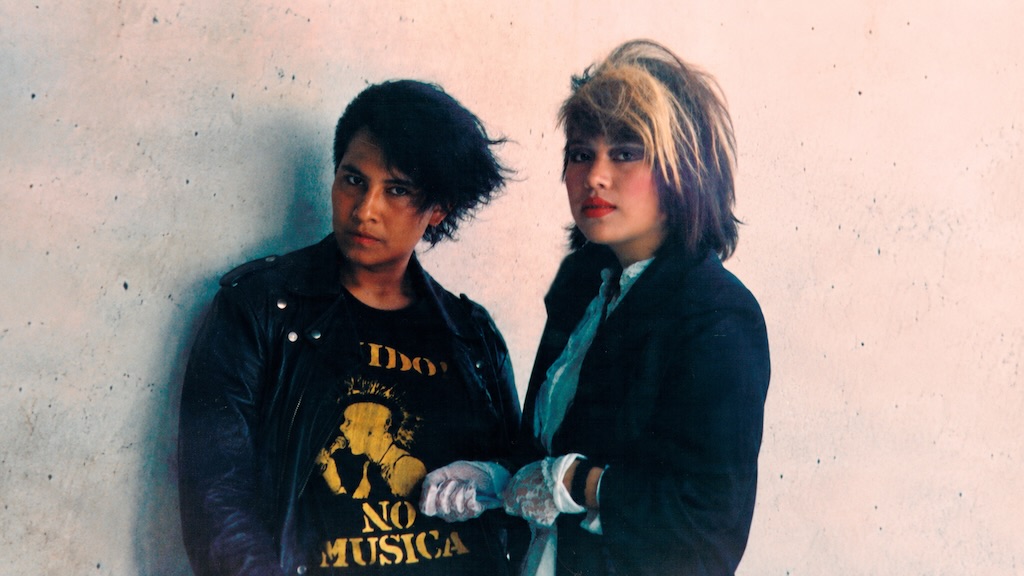

What kind of anarchism existed in Germany and Mexico between 1970 and 1989? How did the punk scene intersect with squatting, housing struggles, self-management, mohawks, work boots, and chaotic noise? The relationship between the German and Mexican scenes is also explained through urban movements, independent publications, anti-nuclear struggles, self-management experiences, as well as bands, albums, and musical influences.
I call this intersection “Sponks” (a neologism combining “Sponti” and “punk”). The Spontis—from *spontan*, meaning “spontaneous”—were political activists in 1970s Germany who rejected traditional forms of organization and favored creative interventions in everyday life, incorporating cultural, artistic, and humorous elements. They were also one of the precursors to the Autonomen, who emerged in the early 1980s. In my conception of Sponks, “spon” also means “source”: from there, I associate the spontaneous with those who manifest the actualization of primordial experiences. That is the conceptual framework from which I propose tracing affinities between movements that occurred thousands of kilometers apart.
From the Spontis to the German Squats
In the late 1960s and throughout the following decade, cities in West Germany were the scene of squatting, tenant strikes, and housing struggles linked to various currents of the extra-parliamentary left. West Berlin and Frankfurt became important centers for these struggles, which, by the early 1980s, converged with a new wave of house occupations and the public emergence of the Autonomen.
At the same time, protests against nuclear power, war, and various policies of the German government gained momentum. Migrants, students, farmers, activists, and autonomous groups came together in some of these struggles, even though they did not necessarily belong to the same organization or share the same political strategy.
During those years, the anti-nuclear movement took on significant momentum in places such as Brokdorf, Grohnde, and Gorleben. In Brokdorf, there were large protests beginning in 1976; Brokdorf and Grohnde became associated with the massive demonstrations and clashes of 1976 and 1977, while Gorleben became, starting in
1977 one of the main centers of opposition to the storage and processing of nuclear waste. In May 1980, thousands of anti-nuclear activists occupied a plot of land near Gorleben and established the “Free Republic of Wendland,” which was cleared by the police on June 4. This was also the era of the Red Army Faction (RAF), the June 2 Movement, and the Revolutionary Cells/Rote Zora—armed organizations whose relationships with the autonomous and anti-nuclear movements varied and, in the case of the Revolutionary Cells/Rote Zora, included ties to anti-nuclear struggles.
In January 1978, Spontis and various groups from the non-dogmatic left participated in the TUNIX congress in West Berlin. The gathering brought together thousands of people and became one of the defining moments of German alternative culture during those years. These struggles helped spread alternative projects, squats, and self-managed spaces, which gained greater momentum at the start of the 1980s. The Spontis were one of the precursors to the Autonomen, who later became key figures in the struggles for squatted houses and so-called “free spaces.”
It was in this environment that the tactic known as the Black Block also began to take shape. In the late 1970s and early 1980s, groups of protesters linked to the autonomous movement began marching together, wearing dark clothing, helmets, masks, and other protective gear. The term “Schwarzer Block” began to circulate in the early 1980s and became associated in 1981 with legal investigations targeting autonomous activists in Frankfurt. Subsequently, the tactic would be adopted by anarchist and anti-capitalist movements in other parts of the world.
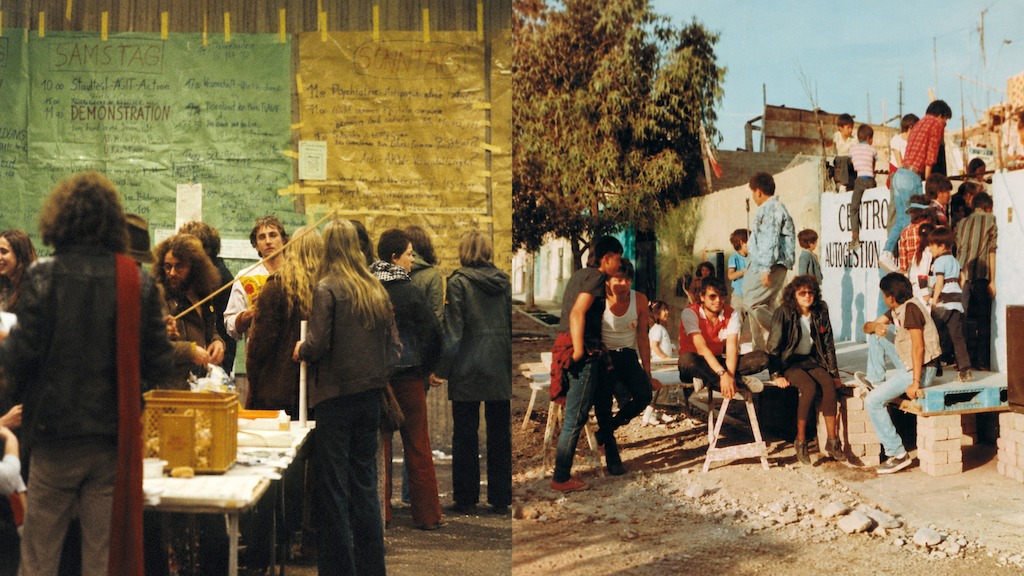
In Mexico City, punk also had a history of its own
While all this was happening in Germany, here in Mexico City the nascent popular urban movement was taking shape. In September 1971, the mass occupation of land in Pedregal de Santo Domingo, Coyoacán, gave rise to a neighborhood whose development required community organization to defend the land, open streets, and secure public services. There, the first generation of anarcho-plebeians heard the first punk sounds on Radio Juventud and, later, on *El lado oscuro de laluna* (*The Dark Side of theMoon*), broadcast on Radio Educación from August 1, 1978, to November 12, 1981. That history was part of the popular urban movement that, in the years that followed, fought for housing, services, and territory in a city that was expanding toward its outskirts.
The popular urban movement also had its own ideological sources. Among them was the 1922 tenants’ strike in the port of Veracruz, organized around the Revolutionary Tenants’ Union led by Herón Proal and sustained by broad participation from women. María Luisa Marín was one of its central figures and led the Federation of Libertarian Women. There were also the publications of the Flores Magón brothers, which decades later continued to circulate through various libertarian publishing projects, including Ediciones Antorcha, which published texts by Ricardo Flores Magón in 1980 and 1981.
An event that marked Mexico’s political life was the student massacre of October 2, 1968, in the Plaza de las Tres Culturas. A decade later, various libertarian movements came together again in the streets. Thus, among neighborhood students, communes, self-managed projects, and anarchist groups, names such as Academia Negra, Rosa Negra, the Coordinadora de Estudiantes Libertarios, Regeneración Sexta Época, and the Práxedis G. Guerrero Brigade emerged, in addition to experiments in university self-governance.
The Mexican pre-punk band of the late 1970s also took shape amid anarchist readings and a context in which young people from the city’s outskirts faced evictions and other forms of control over their neighborhoods. This was a generation that created its first cultural initiatives while listening to the early social critiques of the band Energía.
That is why I assert that Mexican punk did not arise solely from the importation of a musical aesthetic. Among its antecedents were also anarchist literature, housing struggles, forms of self-management, and a youth culture emerging from the peripheries.
Fanzines, Self-Management, and “Do-It-Yourself”
Thus, anarchism, self-management, and “do-it-yourself” publications are inescapable affinities in this history of anarchist and punk intersections.
On another geographical scale, during the “Disturbio Funeral” in Mexico City, we witnessed the repression of the urban guerrilla movement, the “oil boom,” and the entry of left-wing parties into parliament. Within the rebellious margins, in 1978, the Catalan anarchist Ricardo Mestre Ventura founded the Biblioteca Social Reconstruir in Mexico City, a libertarian collection that brought together books, newspapers, magazines, and pamphlets from different parts of the world and which, over the years, also incorporated a wide range of punk and youth publications.
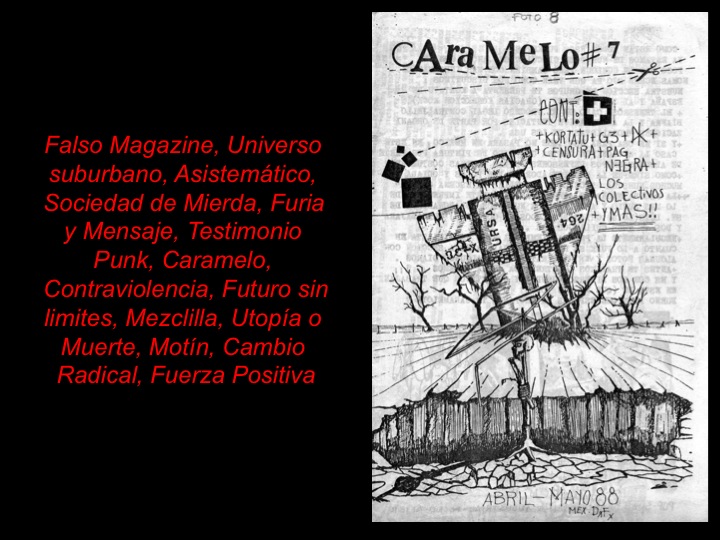
Also part of these circles were the magazine *Tierra y Libertad*, the magazine *CAOS*, and the Antorcha Publishing House. These publications reached young students in the neighborhoods, who launched self-managed projects and anarchist and pre-punk publications. During the early 1980s, publications such as *La Pared*—the newsletter of the Consejo Popular Juvenil—circulated, with its first issue appearing in March 1983.*Falzo Magazine* also circulated; it was one of the first fanzines linked to the Mexican punk scene and was produced by Chucho Punk in the early 1980s.
Fanzines allowed news, ideas, images, and experiences to cross borders without relying on the mainstream media. They gradually built international networks through letters, exchanges, P.O. boxes, and contacts with collectives in Spain, Argentina, Brazil, and Peru; even before the internet, these materials were already circulating across different regions.
In 1983, punk gained visibility in the marches against the economic crisis and austerity measures organized by independent labor and university groups, and Enrique Estévez’s film *Corazones de humo* was released; the following year, the PND collective organized the CAOS I and II exhibitions. At the same time, *Tierra y Libertad* featured the logo of the anarcho-punk band CRASS in its publication, which included critical analyses of the environmental movement in Mexico, notably an article on URAMEX and information on the SUTIN’s struggle regarding radioactive waste dumps and self-management. These were texts that neighborhood anarchists took up.
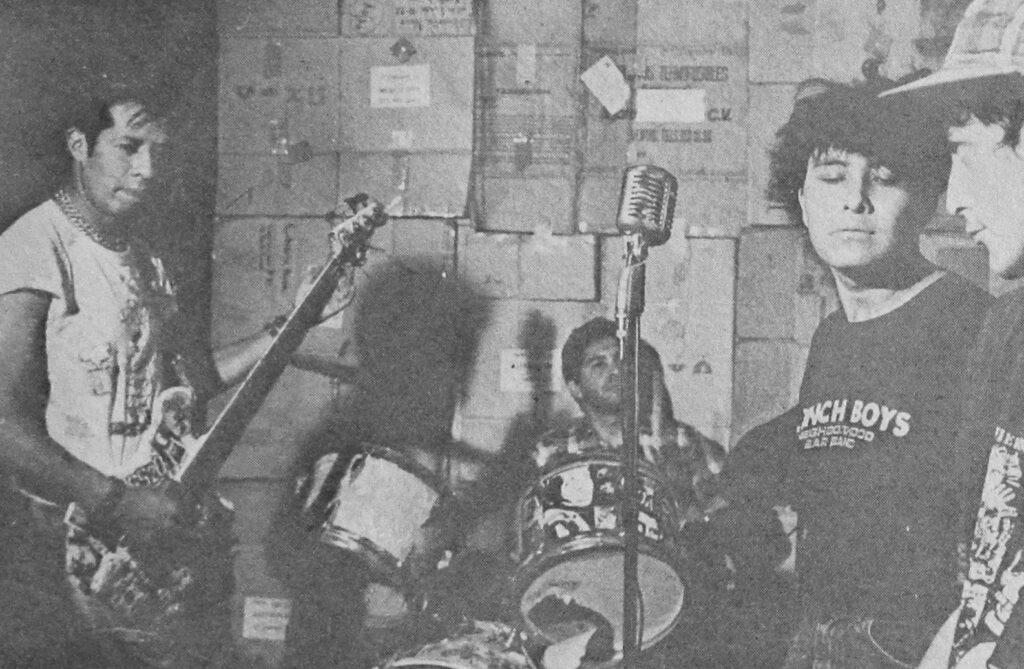
During that explosive period of the early 1980s, pre-punk later evolved into an increasingly visible Mexican punk movement. Bands such as Energía, Rebeld Punk, Descontrol, Crimen Social, and Sistema Negativo emerged. But alongside the bands were publications, spaces, collectives, and forms of organization that made punk more than just a musical genre.
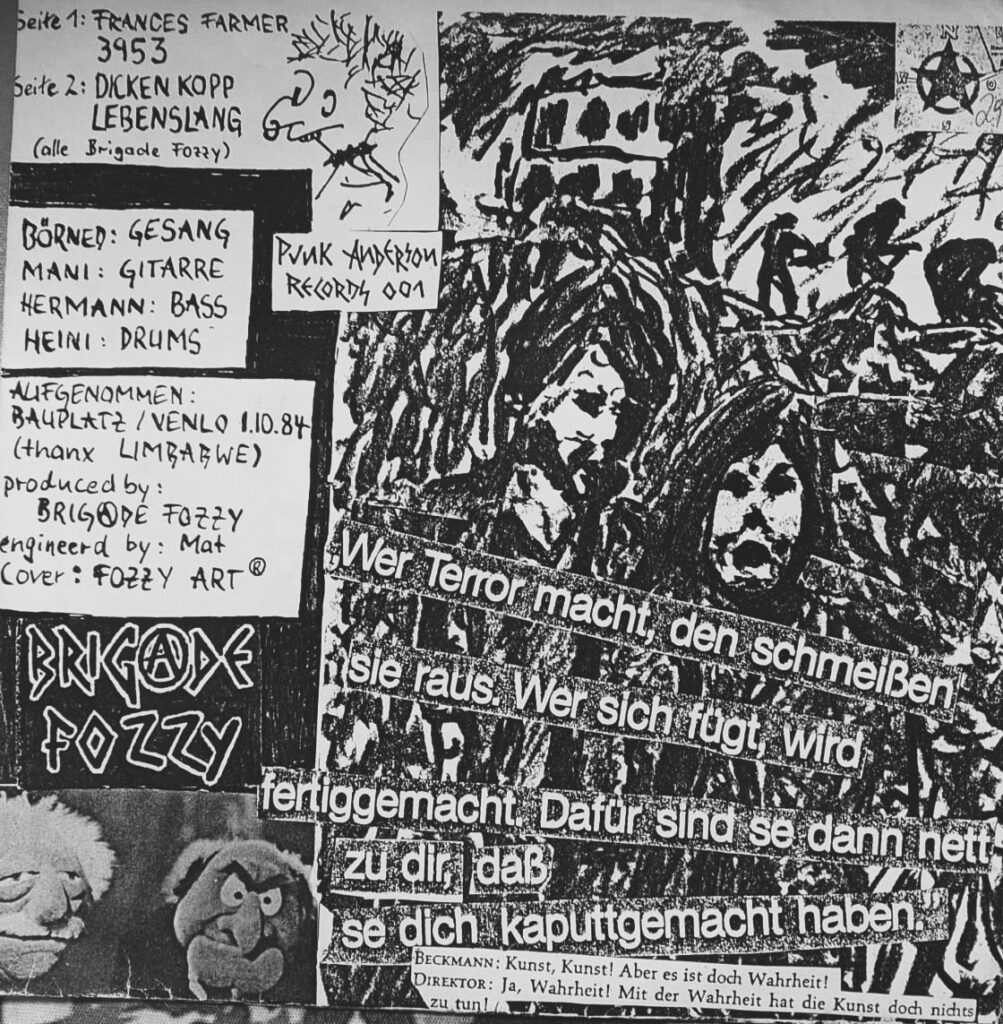
In 1986, the diskozine *Lebenslag*, by the Brigada Fozzy, arrived in Mexico by mail; through its music and lyrics, it offered counter-information, critiquing imperialism and calling for direct action.
1985: Solidarity Amid the Ruins
In Mexico’s“City of Smoke,” the September 1985 earthquakes accelerated anarchist and punk spontaneity through neighborhood-to-neighborhood solidarity and the coming together of groups and bands from different outlying areas. In this context, punk fanzines and anarchist publications served as channels for counter-information and the sharing of experiences.
Amid the ruins left by the earthquake, the magazine *Testimonios* published *La ola verde* (“The Green Wave”), a feature on the green and anti-nuclear movement in Mexico, as criticism of the Laguna Verde nuclear project grew. During those years, discussions also circulated about the relationship between youth, the economic crisis, punk, and autonomous organization.
In 1985, the UAM-Azcapotzalco dedicated issue 16 of its Revista A de Ciencias Sociales y Humanidades to “Crisis and Youth: The Dreams Are Over,” which I organized and to which I contributed an essay; however, here I wish to highlight the fanzines *El punk no es unamoda* by Alejandro Boonz and *Universo Suburbano* from Tijuana.
Since then, the participation of punk collectives in marches against the crisis, in support of workers’ strikes, in events opposing the Laguna Verde nuclear power plant, and in gatherings in public spaces organized by the editors of *Contraviolencia* proliferated, as did the creation of cultural spaces. This fanzine, which originated in Santa Fe, disseminated anarchist and libertarian ideas and eventually reached readers in Mexico, Spain, and Argentina.
From 1985 to 1990, the punk and anarchist band carried out self-managed projects, including the Self-Managed Community Center in the Maravillas neighborhood of Ciudad Nezahualcóyotl, in which Enrique Ácrata and the Contraviolencia collective participated; the Libertad Cultural Center, promoted by the Colectivo Caótico; and DxPxSxO (Dogma Personal Sin Orden), a squat initiated by the punk band from various neighborhoods in the Álvaro Obregón area. The Dogma Personal Sin Orden squat operated in Minas de Cristo, at the entrance to Barrio Norte.
In 1989, SS20 released an album featuring material shaped by the repression and other political conflicts of those years. Their only 12", *Secta Suicida Siglo 20*, was self-released in 1989; the discography later recovered also includes recordings from 1986 and 1987. Those fears were also part of the political imagination of a generation that had grown up under the threat of the Cold War.
Mexico and Germany: Affinities Rather Than a Single History
Mexico and Germany developed distinct scenes, shaped by their own social, political, and urban conditions. Affinities and connections can be traced between the two within the broader punk, anarchist, and countercultural networks.
In Germany, squatting, the anti-nuclear movement, the Autonomen, and various forms of punk converged in specific spaces and moments. In Mexico, urban struggles, anarchism, fanzines, and neighborhood self-management found other ways to intersect with punk.
These publications made it possible for parts of those stories to travel: fanzines, records, magazines, and letters from Europe and other countries reached Mexico, while Mexican publications circulated outside the country. Contraviolencia, for example, distributed copies in Spain and Argentina, and other fanzines published the addresses of collectives in Spain, Argentina, Brazil, and Peru to maintain correspondence and exchange materials. Germany emerges here as a point of affinity within these broader international networks, centered around anti-nuclear issues, squatting, anarchism, self-management, and punk.
While the autonomous movement in Germany underwent significant transformations during the second half of the 1980s, in Mexico the punk and libertarian scenes continued to grow and, during the 1990s, gave rise to a more clearly articulated anarcho-punk movement.
Fanzine publishers and collectives such as Brigada Subversiva, ZYNTOMA, Motín, CHAPS, and CCRFP were part of these networks alongside Contraviolencia. The Archivo Desobediente at the Museo Universitario del Chopo preserves materials related to this history of Mexican punk, while the relationship between Contraviolencia, CCRFP, and Brigada Subversiva is documented in research on self-management within the Mexican punk scene. In the years that followed, some of these forms of organization intersected with new squatter movements and with Zapatismo, which emerged publicly in 1994, as well as with movements against neoliberal globalization. Mexican expressions specifically identified with the Black Bloc would emerge later, within a history that had already accumulated years of punk, anarchism, fanzines, and self-management. The historiography of Mexican neo-anarchism traces the roots of this radicalization back to the 1999 UNAM strike and identifies 2012 as a moment of particular visibility for theBlack Bloc in Mexico.
Half a century after the emergence of punk, revisiting these histories allows us to observe something that gets lost when everything is reduced to a mohawk, a jacket, or an album: punk was also a way of creating spaces, publications, solidarity, and forms of organization from the margins.
There, between the City of Smoke and the German cities, amid fanzines, squats, noise, and self-management, the Sponks can still be traced.
Redacción
Pablo Gaytán Santiago
Pablo Gaytán Santiago holds a PhD in Social Sciences from UAMX and works as a filmmaker and creative activist. His work explores and documents punk and anarchist cultures, suburban movements, and social memory in Mexico. He has published books and essays and directed documentaries and videozines on counterculture and social movements.