

Who designed Daft Punk's helmets? The story behind their evolution
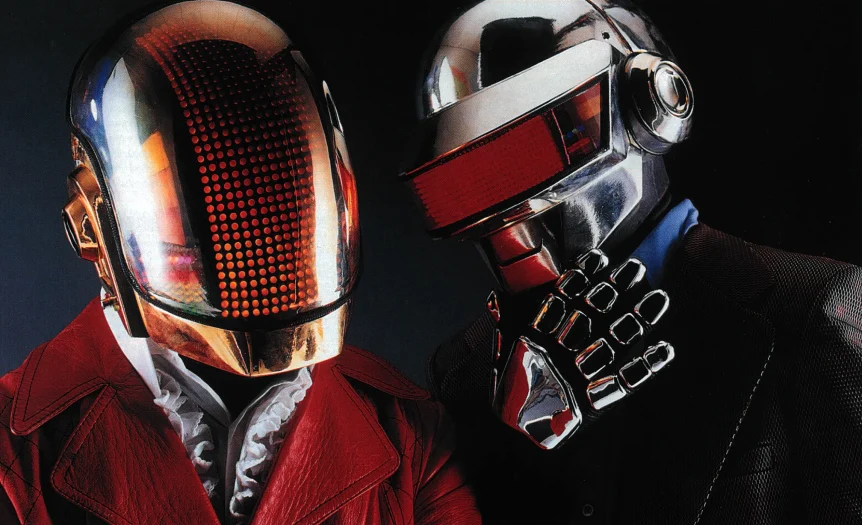

In 2014, on the Grammy stage, two robots were cheered without saying a word. It was enough for Daft Punk to simply be there for the audience to recognize those helmets and associate them with their music. During that ceremony, they first appeared in their iconic metallic helmets. Then they switched to white ones to perform “Get Lucky” alongside Pharrell Williams, Nile Rodgers, and Stevie Wonder.
But Daft Punk’s helmets weren’t the work of a single person. Alex Courtes and Martin Fougerol—known as Alex & Martin—contributed to the robots’ visual design. Tony Gardner and the team at Alterian Inc. brought those concepts to life and handled much of the manufacturing. In addition, other specialists contributed to the electronics and displays. Years later, José Fernández and Ironhead Studio created new versions for *TRON: Legacy*. Fernández also confirmed that he later produced several versions of the helmets and the full outfits the duo wore at the Grammys.
So answering the question of who designed the Daft Punk helmets involves discussing several stages and many people. The story of these two robots is woven from the work of directors, effects specialists, manufacturers, engineers, and designers. Together, they gradually shaped an image that ended up being as recognizable as the music itself.
Who designed Daft Punk’s original helmets?
In 1997, with their debut album *Homework* and songs like “Da Funk,” fame came to Guy-Manuel de Homem-Christo and Thomas Bangalter, two French musicians experimenting with electronic music. With the album’s release came interviews and photo shoots. Showing their faces never seemed particularly appealing to them. That’s why, during those early years, they turned to masks, costumes, and other ways to hide themselves.
With *Discovery*, they decided to take it much further. It was no longer enough to simply cover their faces: they needed characters capable of existing permanently. The initial visual concepts were developed in collaboration with Alex & Martin, who imagined versions of the robots that even had hair. They drew inspiration from science fiction and anime. Then Tony Gardner, founder of Alterian Inc., came on board; Spike Jonze had put him in touch with the duo. The Recording Academy summarizes this process by explaining that Daft Punk developed the robots’ design with Alex & Martin. They then turned to Tony Gardner and Alterian to turn them into real objects.
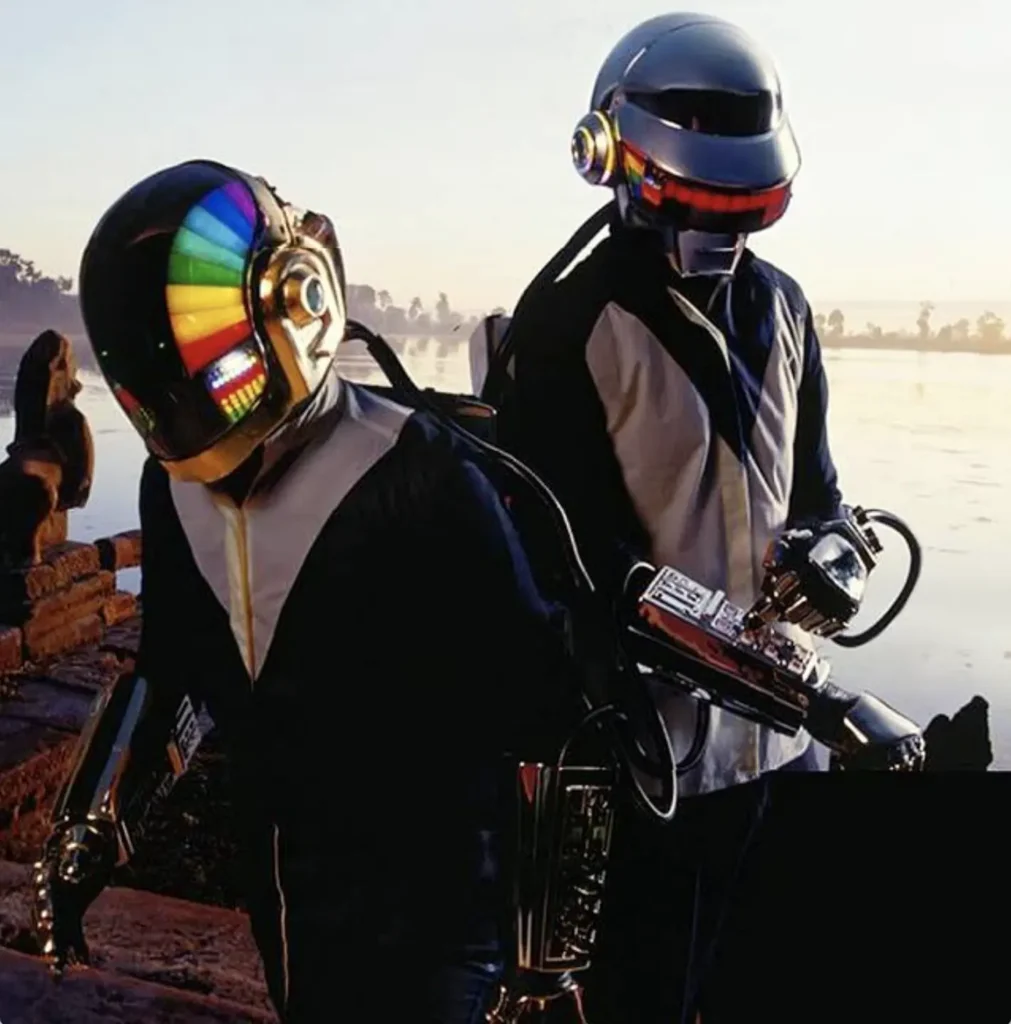
Thomas’s helmet drew inspiration in part from Gort, the robot from the 1951 film *The Day the Earth Stood Still*. Its horizontal visor allowed text to be displayed using LED lights. Guy-Manuel’s helmet—golden and with more vertical lines—resembled the look of old-fashioned space helmets. It also used the display to show figures and symbols instead of words. Those differences ultimately gave each robot its own personality.
Building them was another story. Alterian was used to working with makeup, prosthetics, and special effects, but the helmets required metallizing fiberglass, integrating circuits and LED screens, and concealing the face while still allowing those inside to see. Guy-Manuel’s visor was particularly complicated because the gold surface reflected cameras and everything in front of it. Tony Gardner explained that they used several layers and an inner mesh so that Guy-Manuel could see without being seen. In addition, they turned to outside specialists to handle the programming, screens, circuits, and other electronic components that Alterian wasn’t accustomed to manufacturing.
Part of that work involved people with experience in large displays and a company in Ohio that worked on visors for astronauts’ helmets. Alterian incorporated these solutions into components that, in addition to functioning properly, had to withstand photo shoots and public appearances.
The first helmets still relied on cables and external power systems. The screens were connected to backpacks hidden under their clothes, described as a sort of “spaceman backpack.” During the *The Face* photo shoot, it was even necessary to hide the cables behind the robots for some photographs.
And the helmets weren’t alone: metallic gloves, costume pieces, and a series of details completed the characters’ look. From that moment on, Daft Punk ceased to be simply a duo that hid their faces.
Discovery: When Daft Punk Became Robots
According to the legend created by the duo themselves, an accident occurred in their studio on September 9, 1999. While they were working, a sampler exploded, and after undergoing a supposed surgery, they woke up transformed into robots. Thomas Bangalter told that story to journalists during the promotion of *Discovery*, deliberately blurring the line between fiction and reality. The story of the accident on 9/9/99 was part of the narrative with which Daft Punk presented their robotic transformation.
The accident was never intended to serve as a literal explanation. Bangalter himself spoke of having visual fun and blending fiction with reality after years of wearing different masks. The helmets did just that: they replaced their faces with a character that could accompany them in interviews, photographs, videos, and concerts.
The robots made their public debut around the time of *Discovery* in a photo shoot in Los Angeles by Luis Sanchis for *The Face*. The images showed them doing completely everyday things: relaxing, playing instruments, sunbathing, and even sharing a scene with nudists. Sanchis photographed the new robots for the February 2001 issue of *The Face*. This presentation helped establish that identity with the public.
At the same time, *Discovery* was connected to another visual universe. Daft Punk collaborated with Leiji Matsumoto and director Kazuhisa Takenouchi on *Interstella 5555*, the animated film built around the album’s songs. It features an alien band that is abducted and brought to Earth.
It was difficult to separate one thing from the other: animated aliens, humans turned into robots, and two musicians whose real faces disappeared almost entirely from promotional material. As a result, the helmets ceased to function as mere accessories and became Daft Punk themselves.
How did the helmets evolve after *Discovery*?
The original models did not remain unchanged. As the years went by, the screens and external systems were simplified. Those large power packs disappeared, the number of lights was reduced, and the helmets took on a cleaner look that made them easier to use.
Tony Gardner and Alterian continued to collaborate with Daft Punk after *Discovery*. Their work extended to the videos for *Human After All*, an album released on March 14, 2005, and later to *Daft Punk’s Electroma*.
This phase deepened the robots’ presence, but *Human After All* and *Electroma* do not tell the same story, nor does the film serve as an explanation of the album. *Daft Punk’s Electroma*, released in 2006, follows two robots seeking to become human and does not feature any music by Daft Punk. The film was directed by Thomas Bangalter and Guy-Manuel de Homem-Christo, with Paul Hahn serving as producer.
Gardner once again contributed to the special effects and the construction of the robots for the film, including several helmets designed for the inhabitants of that world. The story placed the characters in an uncomfortable position: two machines trying to appear human. Daft Punk had already established a public identity through their helmets, and now they could use that same image to explore what happened when a robot wanted to shed that identity.
By the mid-2000s, that identity was already fully established. For Coachella 2006 and the tour that would eventually be associated with *Alive 2007*, the robots appeared atop the famous pyramid of lights and revealed a version of the helmets illuminated in red. The show extended that same technological logic to the entire stage: Thomas Bangalter explained that the overall concept was developed by the duo alongside Cédric Hervet and Paul Hahn, while Martin Phillips joined as lighting designer. By that point, no one needed to see their faces. Two metallic silhouettes atop a pyramid were enough.
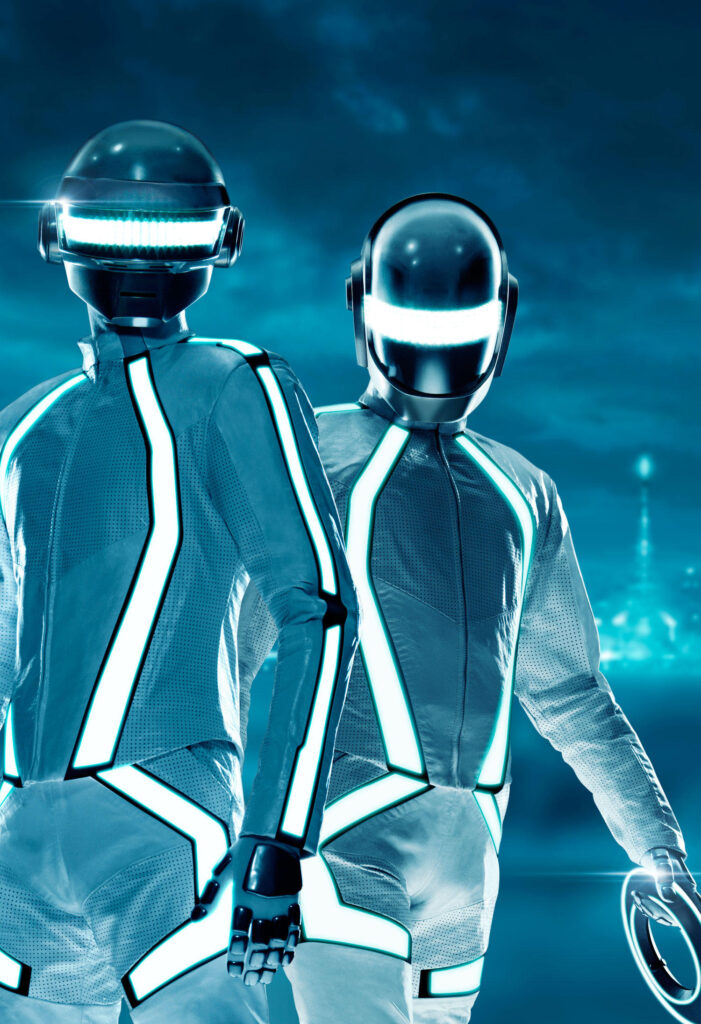
TRON: Legacy, José Fernández, and Ironhead Studio
The next major transformation came with TRON: Legacy. Daft Punk composed the film’s score and also made a brief appearance as the DJs at the End of Line club. Director Joseph Kosinski thought it made perfect sense to bring them into the TRON universe: they were two musicians who already presented themselves as robots, and whose image fit right into that digital world. For the film, they received new helmets and costumes adapted to the production’s luminous aesthetic.
This is where José Fernández, the designer and sculptor behind Ironhead Studio, comes in. His involvement came long after the first Discovery helmets were created. Fernández was working on the pieces for TRON: Legacy, and the Daft Punk helmets were part of the set of designs he was tasked with creating for the film.
Those new versions retained the silhouettes that made Thomas and Guy-Manuel recognizable, but they featured more polished finishes and were integrated into the film’s visual language. Ironhead Studio had experience in sculpture, character fabrication, costume design, and practical effects, and its portfolio still includes the helmets and pieces created for *TRON: Legacy*.
The collaboration didn’t end with the film. Fernández confirmed that he later created several versions of the helmets for Daft Punk, as well as the full outfits worn by the duo at the Grammys. This continuity explains why Ironhead Studio is associated with various subsequent incarnations of the robots, but not with the original Discovery design.
Therefore, when discussing José Fernández and the Daft Punk helmets, his role belongs to a second major phase. Alex & Martin, Tony Gardner, and Alterian had established the robotic identity a decade earlier; Ironhead took that already recognizable identity and produced new interpretations.
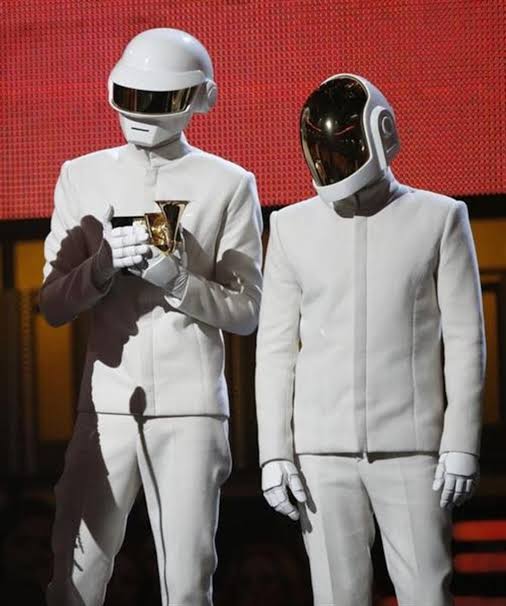
Daft Punk’s White Helmets at the Grammys
In 2014, Daft Punk returned to the Grammy stage, once again becoming the center of attention without saying practically a word. Daft Punk won four Grammys that night: two for *Random Access Memories* and two for “Get Lucky.”The Recording Academy recognized the duo’s wins in Album of the Year, Best Dance/Electronic Album, Record of the Year, and Best Pop Performance by a Duo or Group.
For the red carpet and the awards ceremony, they wore metallic versions of their helmets, but during their performance of “Get Lucky,” they appeared dressed in white, with helmets that were also white. Ironhead Studio lists the Daft Punk helmets used at the Grammys among its works, and Fernández confirmed that he created several versions of the helmets and the duo’s complete outfits for that performance.
That night, something Daft Punk had been doing for years happened again: two people could stand in front of millions of viewers, and yet the characters were more visible than the men behind them.
Who is José Fernández, and how did he end up designing for Daft Punk?
José Fernández came to Daft Punk from the world of film and practical effects. Before founding Ironhead Studio, he had worked for years creating characters, sculptures, helmets, prosthetics, and costumes for Hollywood productions. His specialty lies precisely at that point where a drawing must be transformed into an object that a person can actually wear.
His career includes work related to superheroes, science fiction, and characters built from rigid parts, masks, and armor. Ironhead Studio has contributed to films such as *Batman v Superman*, *Captain America: Civil War*, and *TRON: Legacy*. The studio itself showcases this expertise in crafting helmets and armor for film.
That experience helps explain why their collaboration with Daft Punk was such a success. The helmets already had a very defined visual language; the task was to create new versions that would preserve the robots’ identity while also fitting into a different context—first *TRON: Legacy* and then the Grammys.
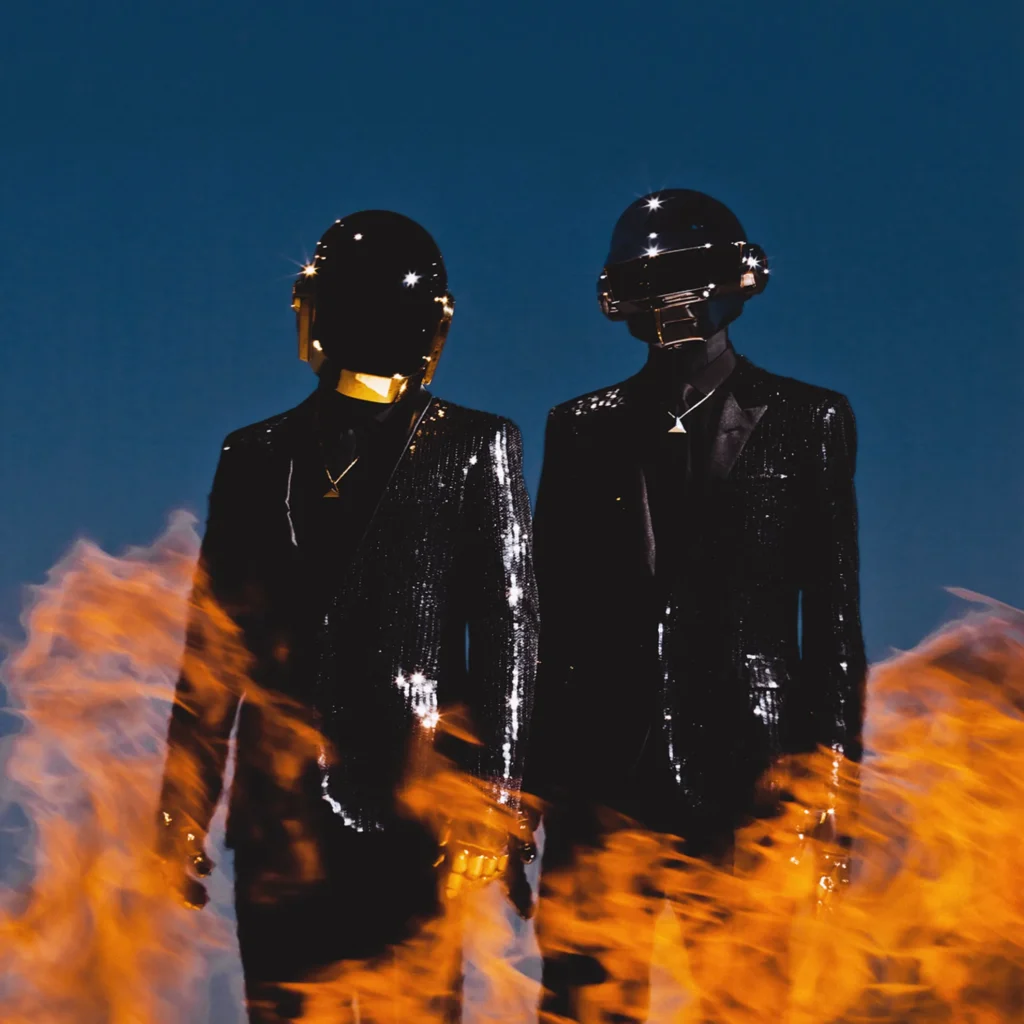
Why did Daft Punk’s helmets become iconic?
Back on the Grammy stage in 2014, Daft Punk handed the mic to Pharrell Williams as they accepted their awards. Thomas and Guy-Manuel remained behind their helmets, barely moving, as if it were completely normal for two robots to be receiving one of the music industry’s highest honors. The scene worked precisely because, after more than a decade, no one expected them to take off their helmets anymore.
That’s a key part of their appeal. The helmets allowed Thomas Bangalter and Guy-Manuel de Homem-Christo to separate their personal lives from their public personas without disappearing as artists. On the contrary: anonymity created an even more recognizable image. Instead of changing their appearance with every album, they were able to develop two evolving personas.
They also found a way to play with technology without hiding it. LED lights, visors, cables, circuits, and metallic surfaces were part of the early helmets; even their technical limitations contributed to the persona. Over time, the designs became simpler, but the idea remained the same: two human figures hidden inside machines.
The duo spoke openly about that relationship. In an interview during the release of *TRON: Legacy*, Guy-Manuel explained that the robots could come across as approachable yet unsettling at the same time, while Bangalter insisted that they preferred to create those characters rather than simply show their faces. Daft Punk described the robots as a more stimulating and entertaining way to present themselves to the public.
Consistency also played a role. Thomas remained recognizable by his silver, horizontal helmet; Guy-Manuel, by his gold one with its more rounded lines. They could change the lights, the color, the costumes, or the materials, but the silhouette remained the same. This allowed the robots to appear in photographs, animation, films, concerts, and ceremonies without losing their identity.
The Story Behind the Robots
Daft Punk’s helmets weren’t born fully formed, nor were they designed by a single person. Alex & Martin contributed to the concepts that shaped the first robots; Tony Gardner and Alterian Inc. turned those ideas into actual pieces and solved many of the manufacturing problems, while outside specialists helped with screens, circuits, and treatments that the studio didn’t typically handle.
Later, Daft Punk themselves continued to modify their characters. The large screens and backpacks from *Discovery* were simplified; *Human After All* and *Electroma* gave the robots a more austere appearance; and the *Alive* performances cemented those silhouettes on massive stages.
José Fernández and Ironhead Studio came on board later, around the time of *TRON: Legacy*. Their versions didn’t invent the robots, but they ushered in a new era for Daft Punk’s helmets; Fernández later confirmed several versions of the pieces and the complete looks created for the Grammys.
Perhaps that’s why the mystery held up for so long. Thomas and Guy-Manuel might or might not have been behind those helmets, and that uncertainty was part of the persona. The focus always ended up elsewhere: the lights, the robots, the stage, and, above all, the music.
Redacción
Ana Montoya
Ana Montoya holds a master’s degree in Literature and Culture from the Instituto Caro y Cuervo. She has worked as a journalist and researcher and has contributed to publications including Bacánika, Salsa sin Miseria, Contexto Media, Latinamerican Post and MEER. She is the author of the short story collection De uno y mil limbos and the poetry book Vitrina de postres, with a focus on culture, literature, art and fashion.
LinkedIn:Ana Montoya