

Between “Corazones de humo” and “Deveras me atrapaste”: From Sanfe to Cultisur, the Origins of Chilango (Counter)cultural Cinema

Author’s Note: Presentation given as part of the lecture series “The ’70s and ’80s: The Lost Decade of Mexican Cinema,” held on February 19, 2026, at ENAH. Organized by the research group “Encuentro de Cine Mexicano, Antropología e Historia.”
The Rotten Decade
For Latin American social scientists of the 1980s, the phrase “the lost decade” was intended to soften the effects of the economic crisis and its social consequences on the continent. On the contrary, those who best defined it were the punk collectives, who ironically referred to their existential conditions as “the rotten decade.” With no prospects—as they were part of a suburban proletariat plagued by unemployment, the inability to attend high school or college, and, for the immediate future, limited options beyond the informal economy or migrating to the United States—
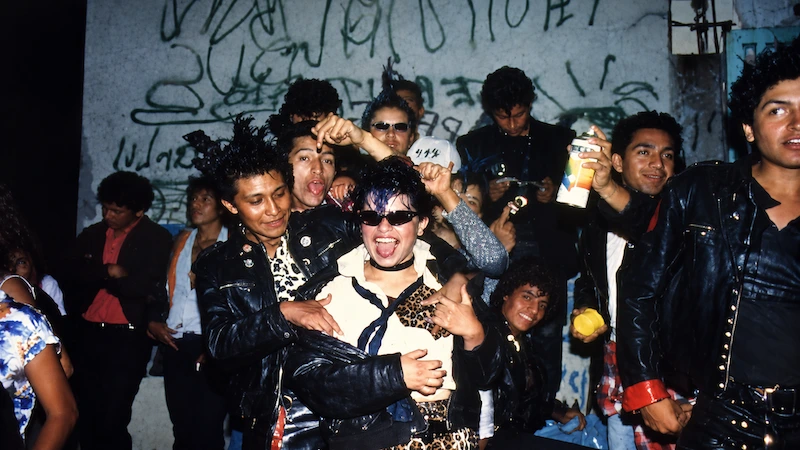
Thousands upon thousands of disaffected young people then joined gangs, drawing the attention of anthropologists and aspiring filmmakers. Thus, Juan Guerrero, from Cuequén, made the documentary *Funki* between 1982 and 1984, in which he chronicles and gives voice to the gang that attended the gigs at the now-defunct *Funki* venues… “Specifically, what does *Funki* present? Testimonies that flash by and snippets of a gig; more testimonies and more gigs in an alternation that could reach dizzying infinity…” It’s a documentary by a “naco” director, about “nacos,” and for “nacos,” according to Jorge Ayala Blanco.
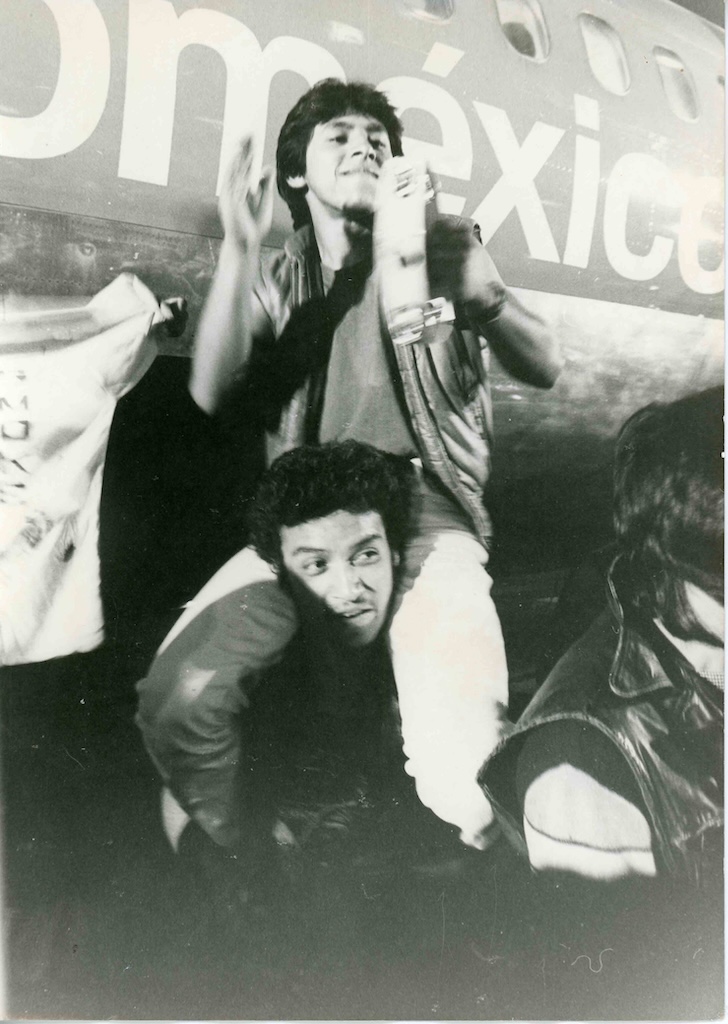
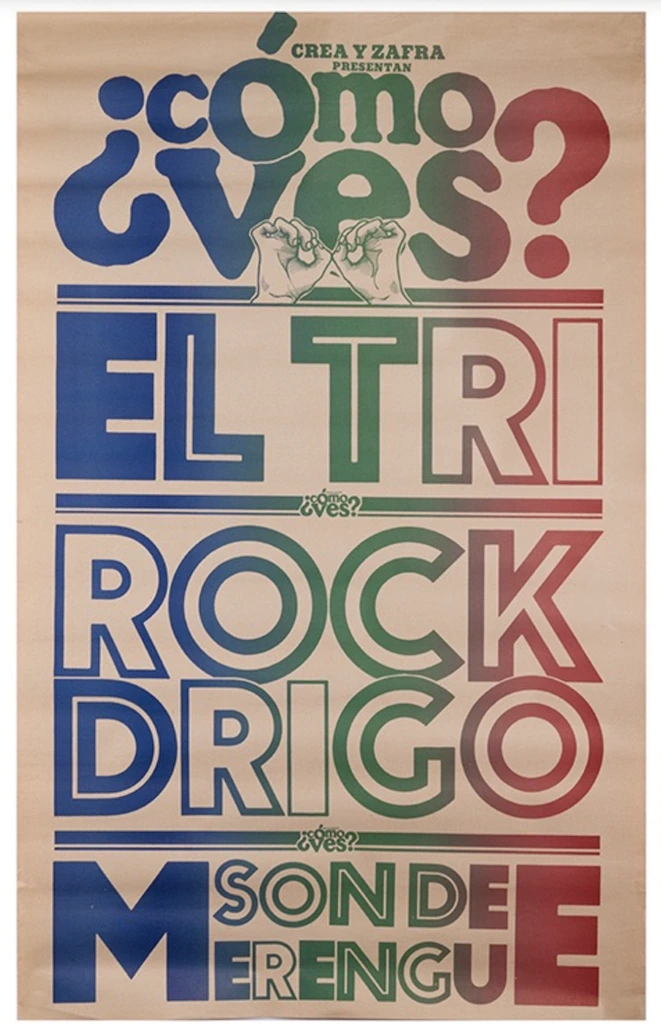
At the same time, the Jim Morrison collective from CUEC (Oscar Eguía, Eugenio González Casanova, César Taboada), “aims to conduct redemptive-political sociology with the Los Salvajes gang from Santa Fe, where ‘they would take patrols through forgotten cities and then promote the Youth People’s Council with the short film*Abuso de autoridad* (1983–1984); the latter, along with *Una larga experiencia* (1981) about the legendary *Three Souls in My Mind* directed by Sergio García and *¿Cómo ves?*, by Paul Leduc—filmed in 1985 and released on August 1, 1986—will contribute to the stereotyping of the “chavo-banda” figure, who surely enjoyed the music of El Tri. Official pro-government countercultural homogeneity. In fact, in *Deveras me atrapaste*, Tenoch Ramos, the film’s protagonist, rehashes a very Coyoacán-style *Abuso de autoridad* to recreate that “correct” image of Chilango counterculture.
At the same time, outside the government-backed Santafas and the mimetic “cultisur”; to the north, in the vicinity of the San Felipe de Jesús neighborhood, another group of up-and-coming filmmakers was arriving, this time led by Enrique Estevez from Gerardo Lara’s Toluca-based production group to begin filming *Corazones de humo*(1983).
From the Outskirts to the Center
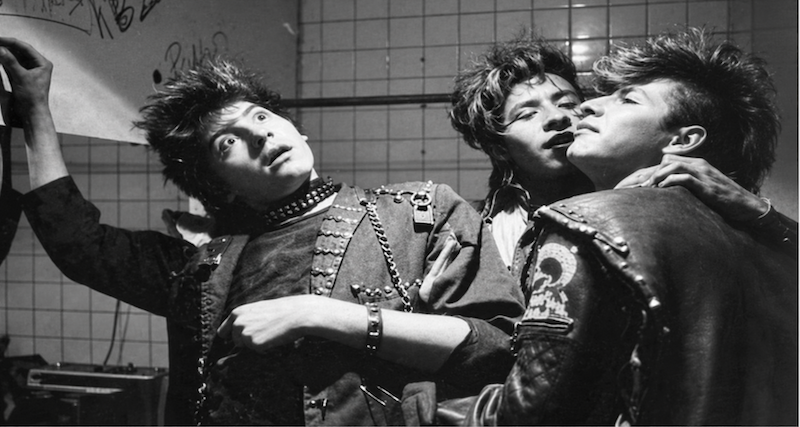
The five members of the founding collective Punk Never Died from the punk movement in northern Mexico City—Chucho, Ganzo, Cabezón, Koala, Silencioso—are projected onto the screen in 16-millimeter format to recreate the nomadic suburban punk journey. In these scene-like sequences, we see Cabezón emerging from the garbage dumps of Santa Cruz Meyehualco onto the streets of the San Felipe de Jesús, Aragón, and the Santa Anita–Martín Carrera metro line; in the background, we see the suburban road network and the economic crisis of the “rotten decade” of the 1980s. A suburban north shrouded in smog, predating the first environmental emergencies.
This collective’s journey into the unknown isn’t headed for an apartment or a concert in the city center, but rather the gig they absolutely have to make it to. El Silencioso, with his manual skills, steals a car to get to the gig. The band’s dynamic unfolds through banter, words, daydreams, jokes, and stories of what happens at their gigs.
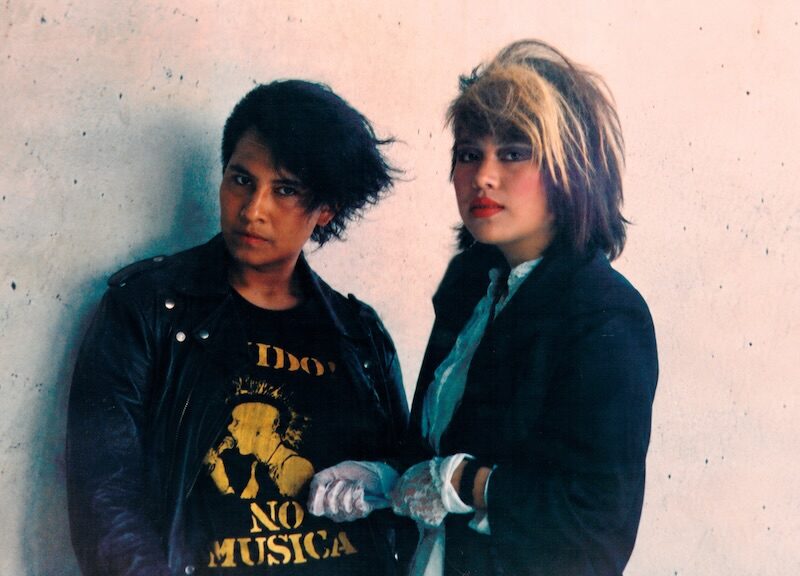
In the montage-collage, Koala appears working at a clandestine bottling plant for cleaning products, and as strange as it may seem for those years, Estevez, the director and screenwriter, attempted to make this young woman the central character of *Corazones de humo*. Koala dresses in a very punk style and buys spray paint to tag her punk slogans. She tags “Sex pitotes” on a sheet-metal fence; later, on a wall that has just been finished, she tries to tag it again, but the construction workers stop her. A scuffle breaks out between the “maistros” and the punks, and they decide to move on.
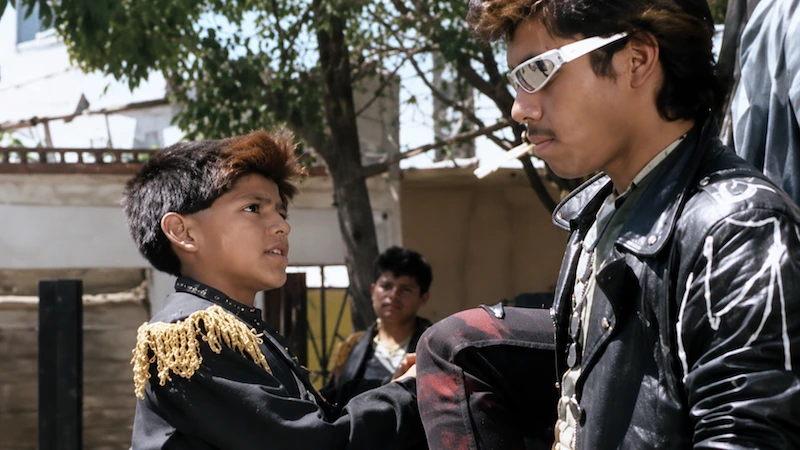
In a brief, gestural, and scenic road movie sequence, they arrive at dusk at the “tokín” in a suburb of provincial Toluca, where gangs from different parts of the suburbs gather. Some stake their claim to the territory, others try to score some drinks, while still others attempt to make a grand entrance. But the struggle to symbolically claim the territory prevails; a brawl breaks out between the gangs. The police arrive with their virile, government-backed presence and round up the PND members for being the strangest and most eccentric.
Yet another raid against the “delinquent” gang kids who were looking to find like-minded peers to exchange messages, fury, and rage against a state and a society in decline. The end of the short film is marked by prison bars, accompanied by a strident “No More Prisoners” by La Polla Records. And more than one punk from that era exclaims, “What a fucking messed-up ending.” Of course, because it doesn’t align with the punk stance of rebellion against state authority.
*Corazones de humo* avoids the victim-centered mythologizing of the band Los Salvajes portrayed in the short film *Abuso de autoridad* by the Jim Morrison collective, as well as the homogenized cultural interpretation the middle class applies to the band by automatically equating El Tri’s “new-old” music with the punk band itself. A vision perhaps derived from that Super 8 documentary *Una larga experiencia* (1981) about the legendary *Three Souls in My Mind*, directed by Sergio García, the creator of the “fourth cinema”—the countercultural movement.

Enrique Estevez, the 24-year-old director (1959–1987), with great sensitivity, guides the lens of cinematographer Eduardo Herrera to showcase in detail the emerging aesthetic of punk artist Ángel del Crimen, who was at that time a member of the Radiografía Urbana collective at ENAP. The clothing, modified in an original way, differs from the British punk aesthetic. Here, recycling, the “trash” aesthetic, neighborhood-punk slang, and the documentation of the attitude captured in the images and production stills—which become pieces of punk conceptual art—all come into play.
All these elements were quickly—not because of the film, but because of the movement—recreated, revisited, and given new meaning in the city throughout the 1980s. Featuring a Basque hardcore-punk-radical noise band and related acts—likely drawn from the tapes that reached the PND via mail: Kontuz Hi (Dejen paso libre), Iggy Pop (*Lust for Life*), Decibelios (*Dodot Is Not Dead*), La Polla Records (*No More Prisoners*).
This marks the audiovisual split, as the narrative stagnates in the youth-gangster style while the soundtrack leans toward imported punk radicalism. Nothing in common.
The aesthetic, thematic, and suburban countercultural approach of *Corazones de humo* reveals its clear affinity with the work of Gerardo Lara’s group of Toluca-based filmmakers. In the 1980s, Lara directed his classics *El Sheik del Calvario* (1983)—for which Estevez collaborated on the screenplay—*Diamante* (1985), and later *Un año perdido*(1993). Featuring marginalized neighborhood characters or the transformation of two young women following a university strike at the UAEM. Gerardo Lara was the producer, and the co-screenwriter was Juan Pablo Villaseñor, who in 1997 directed *Por si no te vuelvo a ver*. Enrique Estevez belonged to this group of filmmakers who view the world through the lens of their sub-metropolitan characters—or, as academia puts it, “from the periphery” or “the margins.” Nothing but his own youth played a trick on him.

The truth is that we can see the short film lacks a coherent edit and instead resembles a collage. There’s a reason for this. According to legend, Enrique was a skilled motorcyclist who rode almost daily from Toluca to the old Mexico City on his bike, until on September 9, 1987, he found his way to the afterlife. He died at the age of 28, like so many artists who have refused to grow old. Thus, the creator of *Corazones de humo* found himself on the same wavelength as Eugenio González (*Abuso de autoridad*), who died in the same way.
The official credits for *Corazones de humo* list Enrique Estevez as the director; however, we do not know whether he was actually the one who physically completed the editing or if one of the crew members produced this short film “almost in a documentary style,” which premiered in 1991 at the 6th Mexican Film Festival in Guadalajara. “*Corazones de humo* bears witness to a Mexico unknown and unfamiliar to the middle class: the sordid, contradictory, and painful world of punk,” as described in the synopsis. I have quoted this official synopsis to highlight the victimological interpretation of the film’s curators.
You can watch the short film on YouTube, where it bridges the old and new generations of punks. But it’s worth noting that the film didn’t receive any reviews at the time, nor did its director, Enrique Estevez, receive any recognition for having planted the seed of Mexican punk cinema in the audiovisual media. May this review serve as a tribute to him.
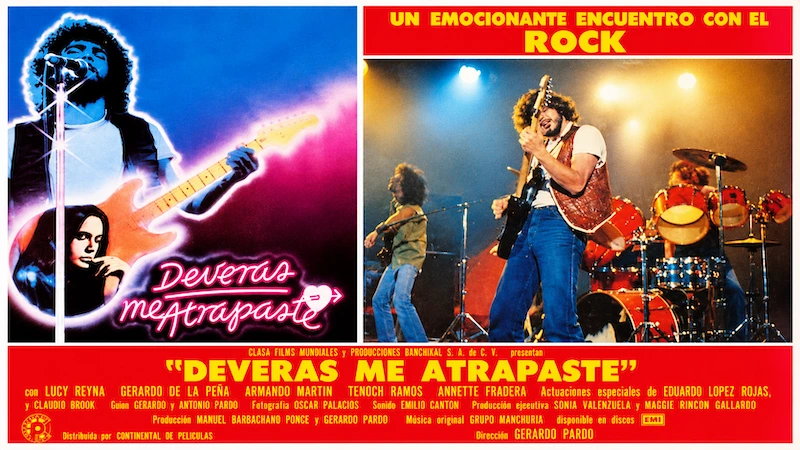
On cultisur: *Deveras me atrapaste*
The following year, in 1984—the year of the San Juanicazo and the May Day Molotov cocktails thrown at the National Palace—Gerardo Pardo’s *Deveras me atrapaste* (released in 1985) was filmed. Produced by Manchuria Producciones, it was later distributed by Manuel Barbachano Ponce for release in commercial theaters. The screenplay was written by Gerardo Pardo and Antonio Pardo, and the film premiered in 1985. The film stars Lucy Reina (Aida) and Gerardo de la Peña (Humo).
The film’s title oscillates between a reference to the song by The Kinks and a ridiculous love story, in this case starring a rock star from the south “who returns from beyond the grave to teach the snobby small-town girl how to do drugs and be replaced by her in a nefarious rock band (you really got to me)” (Ayala Blanco, dixit).
Aida, the daughter of a Tampico businessman (Claudio Brook), is engaged to a young politician from that city; despite her predetermined future, she decides (the audience won’t know what or who led her to make this decision) to flee the comfort of her parents’ home. Her friend Laura, who lives with Tenoch (a musician, member of the villainous band Newspaper, and a communications student at UAM-X), finds her an apartment. Aida joins their group of friends, through whom she is introduced to the countercultural rock ’n’ roll scene. The parties, the drug “binge sessions,” and the concerts—always held indoors—showcase the southern countercultural social scene within four walls, rather than in public spaces or on the street.
Aida’s sleepwalking existence unfolds amid her nocturnal psychotic journeys, her abstinence from drugs, and her clinging to her small reality. In her psychosis, she falls in love with Humo, the archetypal guitarist of a rock band called Manchuria. Thus, caught between her psychotic, surreal dream and the reality of the patriarchal police cordon trying to return her home, as well as the flow of middle-class counterculture, Aida experiences the city’s illuminated modernity: video games, video art, neon aesthetics, science fiction cinema—“Iti, go home”—, literary imagination, the stridency of rock ’n’ roll, and the “cultisur” language that finds its source in “la onda” literature.
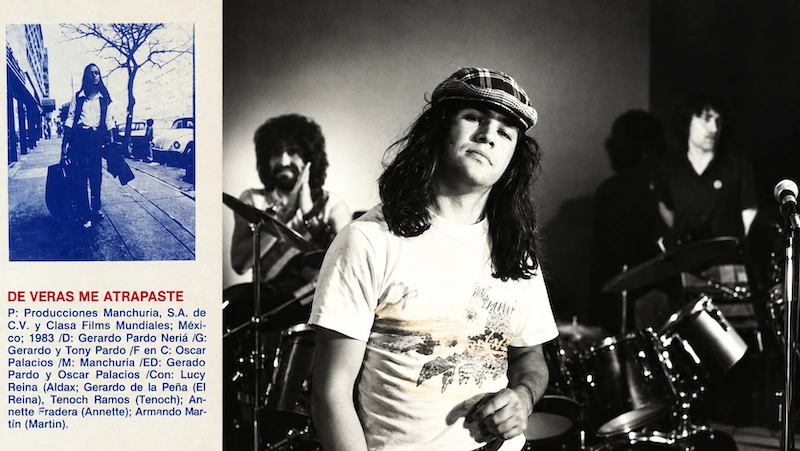
These southern countercultural currents find their way into the literature of José Agustín. Incidentally, we won’t see Aida reading the “saint” of Cultisur counterculture; what will remain for posterity, however, is that sequence where she speaks knowledgeably about the work of Parménides García Saldaña, who died in 1982 without a media funeral or anything of the sort.
To create “Deveras me atrofiaste” (Ayala Blanco, dixit), the Pardo brothers adapted the short story “Miriam” by René Avilés Fabila—included in the book *Lejos del Edén, la Tierra*.
“In a nutshell (to quote René Avilés Fabila), my text is about a novelist (Juan Pablo) who died prematurely and is allowed to return to complete his literary masterpiece. The relationship is complex and begins with encounters at the house where he lived five years ago, now inhabited by Miriam. He falls in love with the young woman, who returns his feelings. More than a ghostly encounter, it is poetic. The agreement is not to ask questions; they must simply love one another and carry out their respective tasks so as not to break the spell.”
Unlike in the short story, the male ghost in the film is a rock ’n’ roll musician, not a writer. This change gave the Pardo brothers’ story its identity against the backdrop of the emergence of so-called “rock en español,” which oscillated between rock imported from Spain and Argentina but coincided with the proliferation of local bands aspiring to break into the music industry. It’s worth noting that Avilés Fabila, the “onderista” writer, was a mentor to brothers Gerardo and Antonio Pardo, who also formed the progressive-experimental rock band Manchuria: Gerardo on drums and Tony on lead guitar. The brothers, who were also film students at the CCC, wrote the screenplay, directed the film, and composed its score. It could be said that, as a cinematic work, *Deveras me atrapaste* was intended to be a total work of countercultural art.
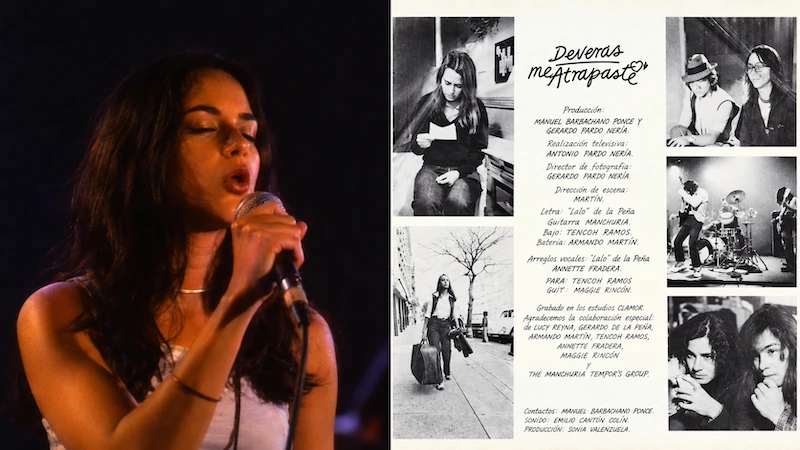
Produced independently in 16-millimeter format, it was eventually transferred to 35-millimeter by CLASA FILMS and Barbachano Ponce for commercial release. This allowed the general public to learn the story of Humo, the archetypal, imaginary guitarist from any rock band, who died tragically in a motorcycle accident—once again, the accidental death of the countercultural artist—and who chooses Aida to introduce her to the countercultural world.
At first, Aida resists, until—caught up in her family dilemmas—she decides not to return to her patriarchal home, instead embarking on the psychoactive journeys of transformation as prescribed by countercultural initiation rites, and returning to the real world as a rock-and-roll singer.
The plot depicts young rockers being harassed and assaulted by the police under the stigma of being “drug addicts,” “gang members,” and “criminals”—but only because they are friends with Aida, the daughter of a politician. Although, unlike suburban rock ’n’ rollers and punks, punk bands were able to play at middle and high schools, or middle-class clubs, as well as on programs produced by COMROCK (promoted by Ricardo Ochoa of the band Náhuatl). Despite that forced sequence depicting a university official’s countercultural misunderstanding.
In the words of Gerardo Pardo, the director: “The film attempts to empathize with this spirit (that of Mexican rock bands) and distances itself from the paternalistic narratives of the youth films made by Enrique Guzmán and César Costa, since in this case we’re not interested in offering advice on ‘healthy youth’ or approaching rock through left- or right-wing ideologies. We believe rock can be seen as a banner for many causes without making it too political. It doesn’t need the blessing of intellectuals or the applause of officials; it’s a way of life that encompasses everything.” At the Ariel Awards, *Deveras me atrapaste*received nominations, including Best Film and Best Director.
Regarding the 2016 adaptation of René Avilés Fabila’s short story for the screen, after watching his former students’ film at the Cineteca Nacional, the writer wrote in his column “Between Literature and Cinema,” published in Excélsior: “At the Cineteca, as the film was ending, Gerardo Pardo approached me and asked if my tears were from emotion. No,” I replied, “they’re the result of seeing my most beautiful love story torn apart. Fortunately, Juan Pablo (the character in Avilés Fabila’s story) returned to his enigmatic place of origin, and Miriam committed suicide to follow him. Neither of them will see the film—perhaps they won’t even read the story in which I created them.”
Anyway. In *Deveras me atrapaste*, Aida joined the rock-and-roll counterculture movement and let *Humo* return to Mictlán, to the niche of the dead youth—a myth that fuels new generations of rockers in this rotten decade.
Conclusion
*Corazones de humo* and *Deveras me atrapaste* are a pair of films made in the midst of economic crises, under an authoritarian, oppressive, and repressive regime that defined the “Rotten Decade” for young proletarians and the middle class. They are two worlds apart, with no connection at that time. But there was great inequality in terms of how their voices were heard. It is significant that Gerardo Pardo’s film enjoyed class-based visibility: it was screened at the Cineteca Nacional, was nominated for an Ariel Award, and was invited to participate in separate independent film series at the Palacio de Bellas Artes and the CREA.
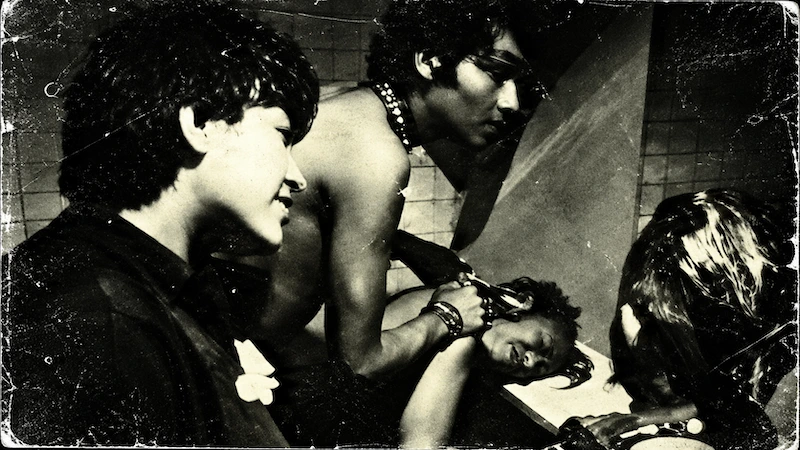
The film by Enrique Estevez, who died prematurely, was forgotten but is now widely viewed on YouTube. Even so, it has not been reviewed by critics or historians. Perhaps this is because specialists from the southern part of the city do not want to acknowledge that a Chilango filmmaker made the first punk film; other productions followed—widely viewed and even award-winning—but they fail to capture that synergy between filmmaker and natural actors.
To conclude, I’d like to highlight that, in an imaginative and punk way, *Corazones de humo* connects with *Submetropolitanos*. This video essay was directed by myself, Guadalupe Ochoa, and Chucho Punk between 1985 and 1990. Coincidentally, we premiered it in February 1990 at the National Museum of Popular Cultures, where it was very well received by the punk collectives. *Submetropolitanos* begins precisely with a collage of images from the production of *Corazones de humo* and jumps to the present to also bear witness to the creative spirit of that punk era.
Redacción
Pablo Gaytán Santiago
Pablo Gaytán Santiago holds a PhD in Social Sciences from UAMX and works as a filmmaker and creative activist. His work explores and documents punk and anarchist cultures, suburban movements, and social memory in Mexico. He has published books and essays and directed documentaries and videozines on counterculture and social movements.