

How to Set Up an Altar for the Dead: Elements, Levels, and the Meaning of the Offering
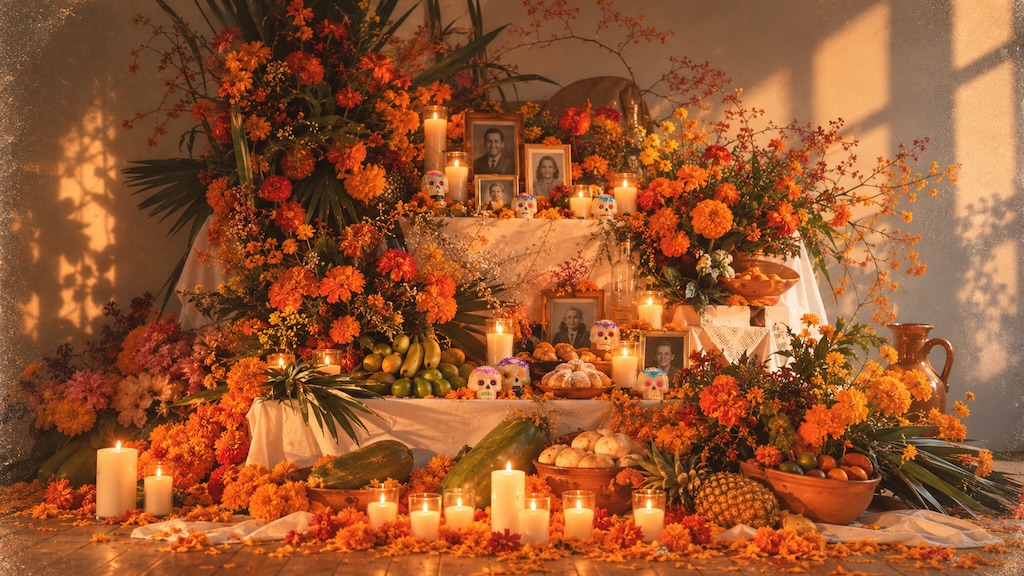

Setting up an altar for the dead can be as simple as arranging a table with a photograph, water, candles, flowers, and the deceased person’s favorite foods. It can also be as elaborate as creating a multi-tiered offering. Customs vary across regions, communities, and families in Mexico. Additionally, the dates, foods, and the way each item is arranged differ.
A Day of the Dead offering brings together objects intended to symbolically welcome the deceased: light to guide their way, water and food for their arrival, flowers and fragrances, photographs, mementos, and, in many homes, religious images. To set one up at home, it’s best to start by deciding on the space and the number of levels. Next, prepare a sturdy base and arrange the components according to each family’s customs.
What is a Day of the Dead offering?
The home altar is part of the celebrations dedicated to the dead that take place in many parts of Mexico between late October and early November. Families place food, flowers, candles, and objects related to the deceased. In various communities, offerings are also taken to cemeteries, and paths of flower petals are laid out between the graves and the homes. The indigenous festivals dedicated to the dead were inscribed in 2008 on the Representative List of the Intangible Cultural Heritage of Humanity and include practices that vary from community to community.
The current Mexican celebration took shape over several centuries. In Mesoamerica, there were funeral rites, offerings, and distinct conceptions of death. On the other hand, during the New Spain period, the Catholic festivities of All Saints’ Day and All Souls’ Day were established. Indigenous practices that continued after the Conquest were incorporated into these dates. For this reason, the contemporary Day of the Dead brings together elements that developed at different points in history.
For this reason, Mictlán belongs to a specific context and does not serve as a general explanation for all current offerings. Among the ancient Nahuas, the fate of the dead depended on how they had died: Ichan Tonatiuh Ilhuícatl was the destination, among others, for warriors killed in battle and women who died during their first childbirth. Those who had died from water-related causes went to Tlalocan. In addition, infants who died during infancy went to Chichihualcuauhco. Finally, the majority of the dead were destined for Mictlán.
According to this same Nahua belief, after death, four years had to pass before the teyolía could embark on its journey to the underworld. Mictlán consisted of nine levels in which the dead had to overcome various obstacles before reaching Chiucnauhmictlan, ruled by Mictlantecuhtli and Mictecacíhuatl. These beliefs are part of the pre-Hispanic Nahua worldview. However, they should not be confused with the contemporary idea that the souls return each Day of the Dead to visit family altars.
When is the Day of the Dead altar set up?
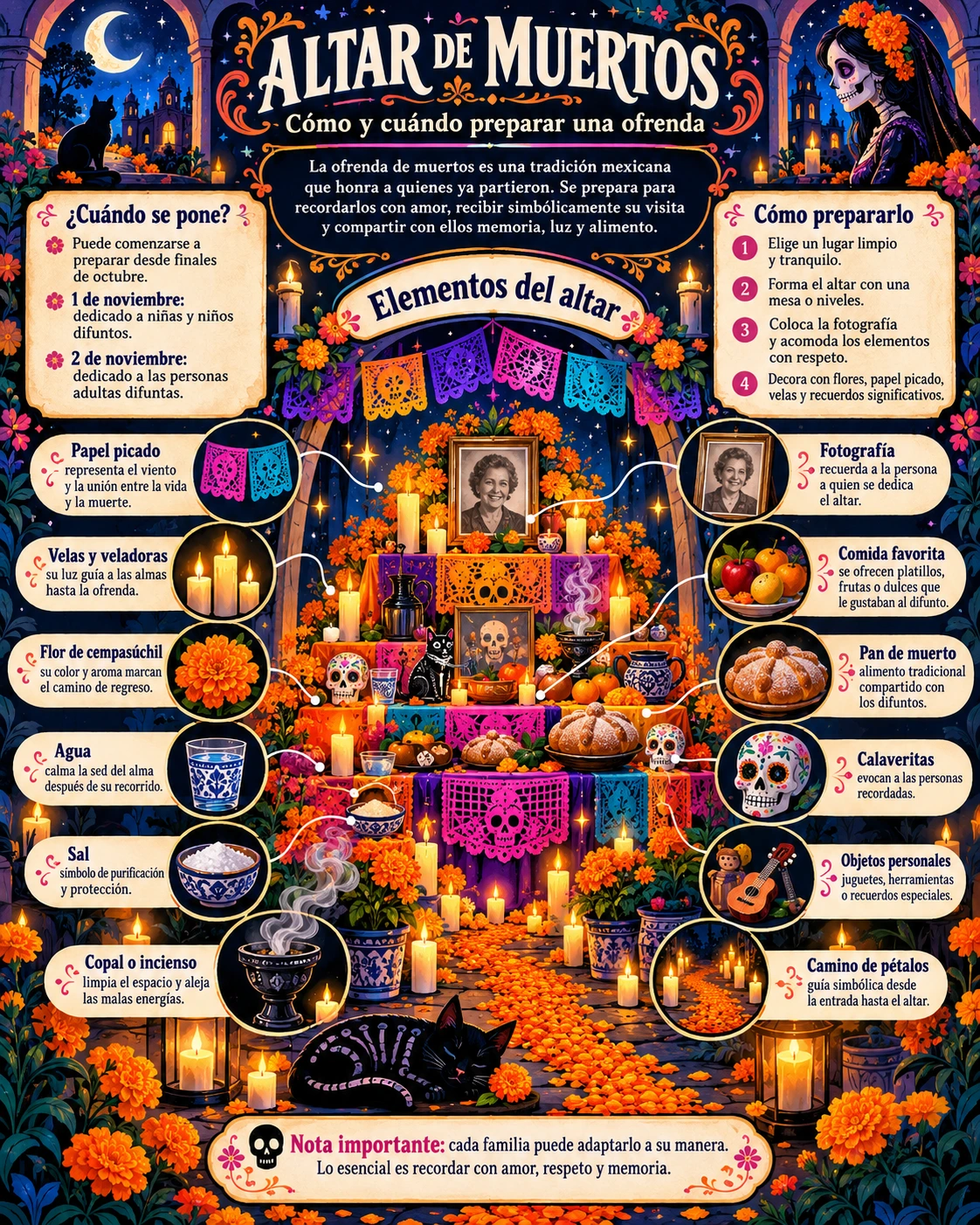
For a home altar, a practical option is to begin setting it up during the last days of October and have it ready for November 1 and 2. These dates correspond to All Saints’ Day and All Souls’ Day on the Catholic calendar. However, Mexican celebrations may begin earlier or follow each community’s own calendar. The incorporation of these two days into New Spain occurred in a context distinct from the ancient Mesoamerican ceremonies dedicated to the dead.
In many communities, November 1 is associated with deceased children, or “little angels,” and November 2 with adults. In others, specific dates are set aside for people who died from particular causes, at certain ages, or under other circumstances. The division of the calendar, the times for welcoming the souls, and the duration of the celebration depend on community and family practices.
So, if you’re looking for a specific answer on when to set up the Day of the Dead altar at home, you can start during the last days of October and have it ready for the main days of November 1 and 2. When a family follows its own calendar, that tradition determines the dates for their offering.
How many levels should an altar for the dead have?
Some altars are set up on a single table, while others are built with two, three, or seven levels. The tiers allow for the arrangement of photographs, food, flowers, candles, and other objects, but they also carry symbolic meanings that vary depending on the tradition followed.
Two-Tier Altar
One documented interpretation links the two levels to heaven and earth. It is a simple structure for a home offering because it can be built using a table and a second elevated surface created by a sturdy box, a bench, or some other stable base.
A photograph can be placed on the upper level for greater visibility, while food, water, bread, fruit, and other objects can be arranged throughout the rest of the space.
Three-tiered altar
A common interpretation associates its levels with heaven, earth, and the underworld; another interpretation identifies them with the Holy Trinity. In practice, three tiers provide enough space to separate photographs or religious images, flowers, and candles from the food and drinks placed on the larger surfaces.
Seven-tiered altar
Seven-tiered altars are associated with the seven places the soul must pass through before reaching its final rest. This interpretation does not correspond to the automatic association of the tiers with the seven deadly sins.
The arrangement of objects varies from one tradition to another. In a home offering, the upper levels may be used for photographs, crosses, or religious images when the family uses them, while flowers, candles, food, drinks, bread, and personal items occupy the rest of the structure.
To build any multi-tiered altar, the steps must be sturdy. They can be made from sturdy boxes, crates, benches, or wooden structures. A piece of fabric, a tablecloth, a mat, or paper can cover the base, depending on available materials and family custom.
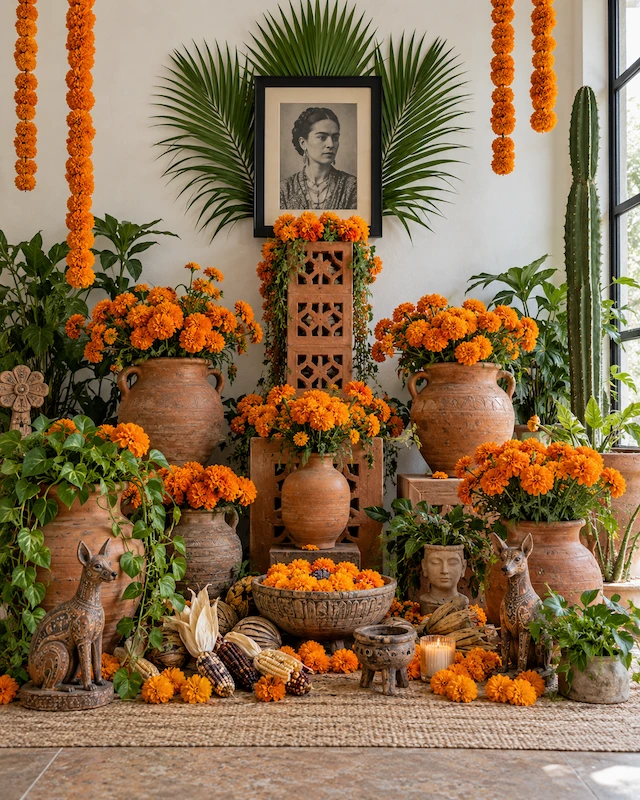
How to Set Up a Day of the Dead Altar, Step by Step
Before gathering the items for the offering, choose a spot where it can remain for several days without blocking the way and where the candles can be used safely. A table against a wall makes it easier to arrange photographs, flowers, and papel picado, and also allows you to build up different levels.
Next, decide how many tiers it will have. For a small home altar, a table or a two-tiered structure is sufficient; if you have more space, you can build three or seven tiers. Use boxes or sturdy bases and avoid structures that might tip over under the weight of plates, vases, or containers filled with water. Cover the surface with a tablecloth, a mat, paper, or fabric.
Next, place the portrait of the person to whom the offering is dedicated. Flowers and personal items can be arranged around it. Candles require stable surfaces and must be kept a safe distance from confetti, fabrics, and dried flower petals; if there are children or pets at home, electric lights can be used to reduce the risk of fire.
Water and salt are usually placed in small containers. Flowers, copal or incense, pan de muerto, fruits, sweets, stews, and beverages chosen for the deceased can then be added.
Finally, papel picado, small skull figurines, and toys (if the offering is dedicated to a child) are added, along with religious images in families that traditionally use them and mementos associated with the deceased’s life. Marigold petals may also be arranged to form a path leading to the altar, a practice documented in various Mexican communities.
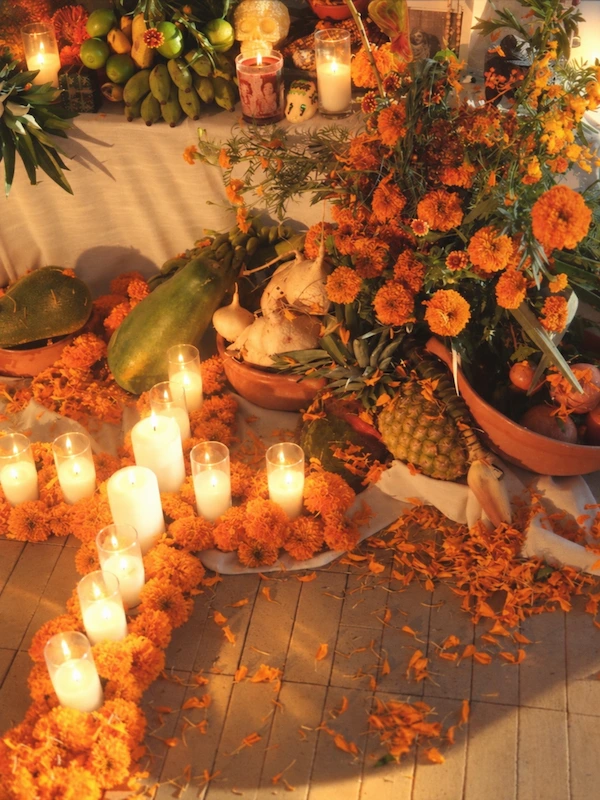
What does a Day of the Dead altar include, and what does each element mean?
The components vary from one offering to another, although water, salt, candles, flowers, food, bread, portraits, and personal items appear frequently. Their presence combines practical functions within the altar with religious and communal meanings that have evolved over different times and in different places.
Water
Water is usually offered to quench the souls’ thirst after their journey, and in some traditions it also symbolizes purity. It can be placed in a glass, pitcher, or other container on any surface of the altar.
Salt
Salt is associated with purification and with the preservation of the body during the soul’s symbolic journey. It is usually presented on a plate or in a small container, and some families use it to form crosses or other shapes.
Candles
The flame serves as a light and guide for the souls. In some communities, each candle represents a deceased person; there is also a custom of arranging four candles in the shape of a cross to represent the cardinal directions and mark the path home.
In addition to its symbolic significance within the offering, there is a practical consideration: it is important to keep the flames away from paper, fabric, dried flowers, and other flammable materials.
Marigold Flowers
The cempasúchil is closely associated with the Day of the Dead celebrations in Mexico. The flowers can be scattered across the altar, placed in vases, or their petals used to form paths connecting the entrance of the home to the offering.
Their presence in Mexican ceremonies has indigenous roots, but modern offerings also include other flowers depending on the region. Nube, wallflowers, velvet flowers, and various local varieties may accompany or replace the cempasúchil.
Copal and Incense
Aromatic smoke is a common feature of the offerings. Copal was already used by indigenous peoples as a ritual offering before the arrival of the Spanish, while incense was incorporated later. In traditional explanations of the offering, both are associated with the ritual cleansing of the space and with the scents intended to welcome the souls.
At home, they can be used occasionally on heat-resistant containers. It is not necessary to keep them burning for the entire time the offering is set up.
Pan de muerto
Pan de muerto is part of a long history of culinary exchanges. In Mesoamerica, there were ritual preparations made with corn or amaranth, but wheat arrived with the Spanish, and during the viceregal period, breads began to be developed that were eventually incorporated into celebrations for the deceased.
Today, there are numerous variations. The round loaf covered in sugar and decorated with strips of dough shaped like bones is common in central Mexico, while other regions prepare egg-yolk breads, human and animal figures, and varieties based on their own recipes.
Food and Beverages
The food establishes a direct connection between the offering and the person to whom it is dedicated. Families typically prepare dishes that the deceased enjoyed during their lifetime: mole, tamales, fruit, tortillas, sweets, coffee, chocolate, or other recipes linked to their tastes and local cuisine.
Beverages follow the same logic. Water, coffee, chocolate, soft drinks, and other options may accompany the dishes; in offerings for adults, some families include alcoholic beverages that the person used to drink.
Portrait
The photograph identifies the person to whom the offering is dedicated and usually occupies a prominent place on the altar. When commemorating several people, different portraits may be placed alongside objects, flowers, or foods associated with each individual.
Their presence also reveals how the offerings have changed over time: the photograph is a relatively recent addition compared to other, older components and now occupies a central place on many family altars.
Papel picado
Papel picado adds color and movement and is often symbolically associated with the air. It can be placed on the wall, around the steps, or suspended above the offering. Because it is made of thin paper, it is important to keep it at a safe distance from candles, copal burners, and lit incense.
Crosses and Religious Images
Crosses, saints, the Virgin Mary, and other Catholic images are part of many Mexican offerings and represent religious elements incorporated during and after the colonial period. Some families place crucifixes and devotional images; others form crosses with flowers, salt, or ash.
Among the documented interpretations is the large cross made of ashes, which is believed to symbolize the soul’s ability to atone for unresolved sins. This is a specific practice within a broader repertoire of religious elements.
Personal Belongings
Personal items tailor the offering to the story of the deceased. They may include books, tools, toys, musical instruments, clothing, photographs, records, travel souvenirs, or any item associated with the person’s activities and tastes.
A camera might refer to someone who enjoyed photography; a musical instrument, to someone who played music; a toy might be part of an offering dedicated to a child. These objects allow a family altar to tell the story of a specific person and not just the shared symbols of the celebration.
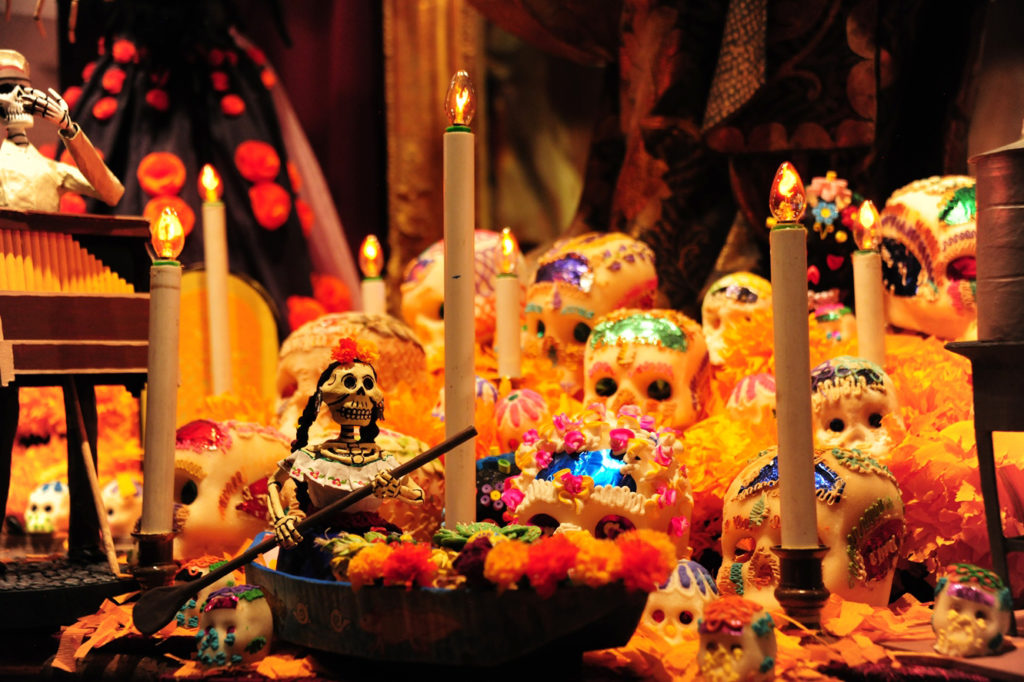
Other items that may appear in an offering
Sugar, chocolate, or amaranth “calaveritas,” seasonal fruits, petates, flower arches, dog figurines, candies, toys, and clay objects appear on various Mexican altars. Some have specific regional uses, while others are found in offerings throughout much of the country.
The arch can symbolically mark the entrance to the offering space, and in certain traditions, the petate serves as a place where food is placed or where the soul symbolically rests. In some contexts, the dog figurines refer to Mesoamerican beliefs about these animals as companions of the dead.
How to Arrange an Offering
If you’re looking for a simple guide, place the photograph in a visible spot and arrange the candles, leaving enough space around them. Water and salt can be placed in containers on a stable surface; flowers are arranged around the portrait, between the levels, or forming a path of petals. Plates, beverages, bread, and fruit are usually placed on the largest surfaces to prevent spills and make them easier to arrange.
Then add the person’s personal items and elements specific to family or regional customs. A small offering may include a portrait, water, candles, flowers, food, and a personal memento; a larger altar may feature multiple levels, papel picado, religious images, copal, small skull figurines, regional breads, and a wider variety of foods.
The Day of the Dead brings together very different practices across Mexico. The size of the altar, its levels, the dates, and the chosen objects may vary from one community to another, while the offering retains its domestic and ritual function: to prepare a space to symbolically welcome the deceased through food, flowers, light, scents, and objects related to those being remembered.