

Satoshi Kon: Perfect Blue, Paprika, and His Influence on Nolan and Aronofsky
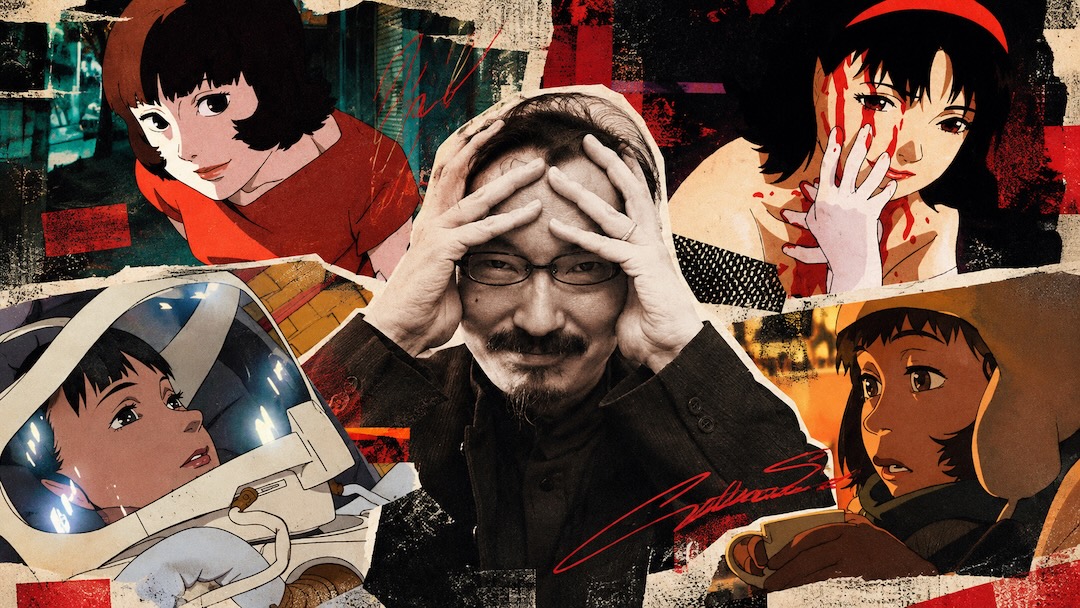

When people talk about anime, there are still those who think—disdainfully—that anime is just cartoons aimed at children. Of the many examples that could be cited to counter that idea, *Perfect Blue* (1997) and *Paprika* (2006) are exceptional cases that completely overturn that view. Best of all: both films were created by the same artist, Satoshi Kon.
Satoshi Kon, the acclaimed animation director, screenwriter, and mangaka, is the mastermind behind these films. His filmography, though brief, holds a special place within Japanese animation. This is due to the way he translated themes such as identity and media representation into images. Furthermore, he explored dreams and the difficulty of distinguishing a dream experience from the fiction that surrounds it. Additionally, scholarly research on his films has emphasized the importance of point of view, editing, and the alteration of characters’ identities in constructing his narratives.
In 2026, *Paprika* will mark the 20th anniversary of its world premiere at the Venice Film Festival, where it competed for the Golden Lion. This anniversary is a good excuse to take a journey into the universe of Satoshi Kon. However, it is not the only reason to revisit his work. Both *Perfect Blue* and *Paprika* are suitable vehicles for this purpose. This is because they articulate themes, techniques, and obsessions that the director explored throughout his body of work. Furthermore, both films open the door to a discussion that continues to surround his work: its parallels with later films by Darren Aronofsky and Christopher Nolan.
Who was Satoshi Kon?
Born in Hokkaido, Japan, on October 12, 1963, Satoshi Kon studied at Musashino Art University, from which he graduated in 1987. While still a student, he made his debut as a manga artist with *Toriko* in 1985. He later published his first collected volume, Return to the Sea (Kaikisen, 1990), and worked as an assistant to Katsuhiro Ōtomo, the author of Akira. Furthermore, Kon’s own official archive records his debut as a mangaka in 1985. It also documents his graduation in 1987 and his first professional jobs in animation.
On *Rōjin Z*, he contributed to the art direction, one of his first experiences in an animated production. He later wrote the screenplay for *Magnetic Rose*, a segment directed by Kōji Morimoto as part of the anthology film *Memories* (1995), based on works by Ōtomo. Already evident there is one of the themes Kon would go on to explore most vigorously: the blurring of the lines between a seemingly stable reality and the images, memories, or fictions capable of replacing it. Meanwhile, Studio 4°C credits Kon as the screenwriter for that episode.
Another major figure in anime with whom he worked was Mamoru Oshii, director of *Ghost in the Shell* (1995). The two collaborated on the unfinished manga *Seraphim: 266613336 Wings*, originally published between 1994 and 1995. In that work, Oshii was in charge of the story and Kon of the artwork.
Satoshi Kon’s filmography as a director comprises just four feature films—*Perfect Blue* (1997), *Millennium Actress* (2001), *Tokyo Godfathers* (2003), and *Paprika* (2006)—as well as the series *Paranoia Agent* (2004). In addition to these works, he had previously contributed to manga and animation. Among these, his screenplay for *Magnetic Rose* stands out.
What was the reason for such a short body of work? The filmmaker and mangaka passed away on August 24, 2010, at the age of 46, from pancreatic cancer. *Dreaming Machine* (*Yume-Miru Kikai*) was the project he was working on when, in May of that same year, he received his terminal diagnosis. The film remained unfinished.
“My greatest regret is the film *Dreaming Machine*. I’m concerned not only about the film itself, but also about the team I was able to work with,” Kon wrote in the moving farewell letter published posthumously on his website.
For the anime industry, this director’s passing meant more than just the loss of an influential figure. It also marked the loss of a creator who drew attention from outside Japan. This was achieved through films that demanded to be viewed and discussed as cinema in their own right, regardless of the fact that they were animated.
What Are the Key Elements of Satoshi Kon’s Cinema?
Those who explore Satoshi Kon’s films can easily recognize characteristic elements of his cinema. Without attempting to create a crude formula, it can be said that his work deliberately subverts the notions of reality and fiction. Apparent reality blurs and fades, often giving way to the dominance of the world of dreams, memories, or illusions. The loss or alteration of identity is another recurring theme.
Kon explained that in *Perfect Blue* he was interested in showing how, for someone living through a subjective experience, dreams, cinematic fiction, and reality can all feel equally true. His narrative intention was precisely to place the viewer within that difficulty of distinguishing one layer from another.
The techniques he uses to generate doubt, confusion, and unease include ellipses, transitions that link different times and spaces, deliberate breaks in continuity, repetitions with slight variations, and abrupt shifts between what a character experiences, remembers, imagines, or interprets. Kon explained that repeating scenes with slight modifications allowed him to express both the passage of time and the emotional transformations of his characters. He used this technique in *Perfect Blue*, *Millennium Actress*, and *Paprika*.
Mise en abyme, mirrors, doubles, and metacinema—the film within a film—round out this repertoire.
Kon’s films also emphasize the psychological depth of his characters. Research on his filmography has shown that the protagonists’ identities shape a significant portion of his narratives. Consequently, their personal crises do not run parallel to the narrative but can alter the way the story’s reality itself is presented to us.
The filmmaker stated that he found female characters easier to write. As a man, he explained, he felt he knew the negative aspects of a male character all too well. With a female protagonist, on the other hand, he could project his own obsessions and develop the aspects he wished to explore with greater freedom.
All of this creates connections throughout his body of work. His films are in constant dialogue with one another and feature references to Japanese and Western cinematic traditions as well as pop culture.
Film historian Laura Montero Plata has studied the dissolution of the boundaries of reality as one of Kon’s central traits. She has also analyzed the way his films construct different narrative layers that ultimately overlap.
Why is “Perfect Blue” a landmark psychological thriller?
Perfect Blue (1997), Satoshi Kon’s debut feature, brought the director into the public eye and captured international interest. The film is based on the novel *Perfect Blue: Complete Metamorphosis* by Yoshikazu Takeuchi, although the adaptation strayed significantly from the source material. Kon explained that his interest lay far less in the figure of the stalker than in constructing a story where the objective gaze and subjective experience produced different images of the same event.
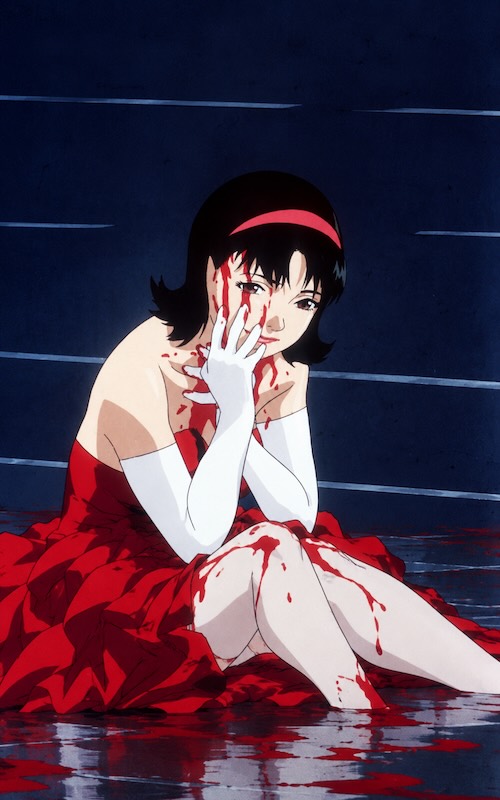
Blending horror, mystery, and psychological suspense, *Perfect Blue* depicts Mima Kirigoe’s transition as she makes the career leap from pop idol to actress. In the process, Mima finds herself hounded by those who view this career change as a “betrayal,” receiving anonymous calls and threatening messages.
She even discovers a website—“Mima’s Room”—that describes specific aspects of her life, the precision of the details of which baffles her. The site constructs a parallel version of Mima who seems to know her life better than she does herself.
While she is filming her first project as an actress, a series of murders linked to the production takes place. The film interweaves scenes where we see Mima off-camera with others featuring the character she plays in the series she is filming. Those of us watching from behind the screen—and, especially, Mima herself—begin to lose confidence about the nature of what is happening. Her character’s line of dialogue—“Excuse me, who are you?”—thus becomes the story’s central thread.
Therein lies one of the reasons why *Perfect Blue* continues to hold a special place within the psychological thriller genre. The film does not merely show that Mima is losing her sense of certainty; it manipulates the available information to force us to reconstruct it. A study by Antonio Loriguillo-López, José Antonio Palao-Errando, and Javier Marzal-Felici analyzes precisely this complex narrative and how the film shifts its point of view, manages information, and exploits the viewer’s preconceptions to conceal crucial details until the dénouement. The researchers link it both to slasher conventions and to what would later be called the “puzzle film”—films whose understanding requires us to continually reevaluate what we believed to be true.
This approach is particularly significant because Kon employed it within an animated film that insists on recognizable settings: small apartments, television studios, streets, trains, offices, supermarkets, and a Tokyo devoid of fantastical worlds that would signal when we’re entering unsafe territory. The extraordinary occurs within the everyday.
Nor does the film use animation as a mere substitute for what could have been filmed with actors. As the narrative unfolds, the cuts allow a scene from the show Mima is filming to blend into her everyday life, for an action to seem to repeat itself and then reveal that it belongs to another moment, or for an apparition of her former self to occupy the same space as her. This formal uncertainty forces us to question not only Mima’s perceptions, but our own as well.
Some analyses have also linked the film to the giallo genre, where murder, mystery, eroticism, and altered perception coexist. Richard Corliss himself, writing about Kon for *Time*, linked *Perfect Blue* to Dario Argento’s giallo melodramas.
But reducing the significance of *Perfect Blue* to its narrative puzzle would be insufficient. The film was released when home internet access was still a novelty for many of its viewers and placed at the center of the story a website capable of appropriating a person’s public and private identity. Mima not only discovers that someone is watching her—she discovers a version of herself written by another and legitimized in the eyes of her fans.
That is why its critique of the entertainment industry, the cult of celebrity, fan surveillance, and the transformation of a young woman into a commodity continues to be uncomfortably recognizable. The same study on the complex narrative of *Perfect Blue* links these techniques to its critical commentary on the representation of Japanese idols and the state of the audiovisual industry.
A reading that has been inferred from between the lines of this film thus consists of a critique of consumer society, the alienation resulting from virtual interaction through the nascent internet, and the entertainment industry, which, with dubious promises, manipulates young people in search of fame and glory, forcing them to navigate their stardom under the scrutiny of their private lives, the harassment of fanatics, and the media. Kon himself, however, clarified that his primary intention was not to denounce the idol system, but rather to depict the journey of a young woman whose value system crumbles as she matures.
Ultimately, the success of *Perfect Blue* lies in its treatment of its characters, its narrative structure, and the way in which shots, framing, and cuts transform Mima’s psychological state into an experience for the viewer. He didn’t need to abandon realism to demonstrate what adult animation was capable of: he found the unsettling elements right within it.
Paprika: Dreams Before “Inception”
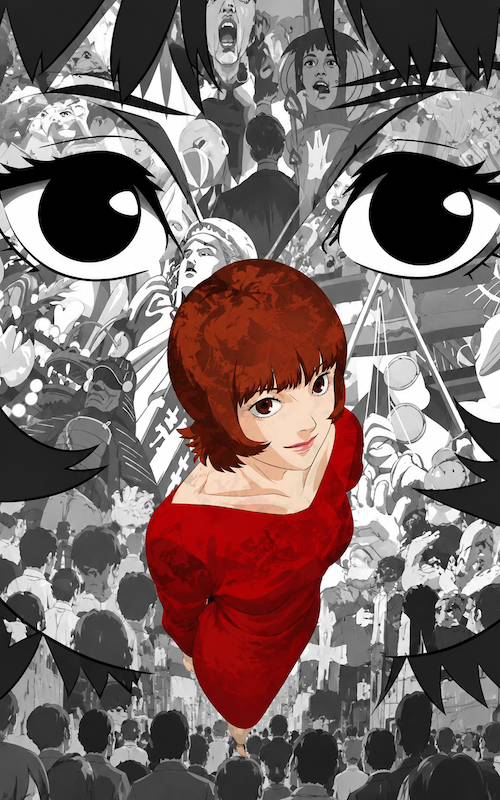
Paprika had its world premiere in 2006 in the competition section of the Venice International Film Festival, a recognition that reflected the international prestige Satoshi Kon had accumulated by then.
The creation of the feature film was inspired by the author of the original work, the renowned writer Yasutaka Tsutsui. Kon had been a fan of the novel for years and had considered adapting it after *Perfect Blue*, but that first attempt fell through due to the bankruptcy of Rex Entertainment. Years later, after meeting Tsutsui in person and receiving his approval, he resumed the project.
The plot of *Paprika* cannot be reduced to a simple storyline due to its narrative structure. On the one hand, it centers on the theft of a device, the DC Mini, which allows access to the world of dreams. In the wrong hands, the device can invade other people’s minds; therefore, finding the person responsible becomes imperative.
On the other hand, as we follow this investigation, we—the audience—are immersed in the realm of dreams, where all logic loses its meaning. On this journey, the charismatic Paprika—Dr. Atsuko Chiba’s alter ego and the polar opposite of her personality—guides us through sequences where space-time warps and the characters, along with us, lose any point of reference to hold onto.
The same actions are repeated from different perspectives. Reality and dreams become inseparable. Continuity is broken. In a matter of seconds, we might find ourselves in a circus and suddenly be transported to the jungle, watching the protagonists cling to a vine like Tarzan and Jane, or shift to settings filled with suspense, romance, noir, or detective film atmospheres. And just when we think the characters are finally waking up, new discoveries emerge.
The favorable reception of *Paprika* cemented the director’s career. Although he had already earned recognition from his peers and fans of his films, the movie was selected for the official competition at the Venice Film Festival and subsequently toured international film festivals. There, Kon brought together techniques he had developed in his previous projects.
From the opening credits, *Paprika* unfolds some of its most memorable moments. Among them is the sequence where Paprika traverses the city, leaping between billboards, screens, and urban surfaces as if the entire reality were a cinematic backdrop.
Did Paprika inspire Inception?
The comparison with Christopher Nolan emerged after the release of *Inception* (2010). Both films use technologies that allow characters to enter others’ dreams, explore levels of consciousness, and transform seemingly solid spaces into realms governed by the rules of the mind.
However, there is no verifiable public statement in which Christopher Nolan directly acknowledges *Paprika* as a source for *Inception*. In interviews about the development of his film, Nolan has explained that he had been working on the idea for about a decade and has cited heist films, James Bond, film noir, labyrinths, and his lifelong interest in dreams as components of the project.
That does not rule out the parallels.
The British Film Institute has pointed out specific visual similarities between the two films, such as the elevator associated with different levels of the subconscious and the image of a setting that cracks and shatters like glass when dreams and reality begin to blend.
Researcher Elena Gil Escudier has also compared *Paprika* and *Inception* based on their visual and narrative connections, examining how both transform dream worlds into spaces where the viewer must continually reconstruct the rules of what they see.
The comparison, then, remains valid and productive without the need to assert that Nolan “copied” Satoshi Kon. It suffices to observe what the films themselves allow us to contrast.
Satoshi Kon’s Influence on Modern Cinema
Satoshi Kon’s work has been a source of comparisons and references for filmmakers both inside and outside Japan. Two names come up with particular frequency: Darren Aronofsky and Christopher Nolan. However, not all of these connections can be lumped together under the same label. In Aronofsky’s case, there is a direct documentary connection to *Perfect Blue*.
When Satoshi Kon met with him in Japan on January 18, 2001, he had heard that the American had purchased the rights to make a live-action version. The story was only partially accurate. Kon himself wrote after the meeting that Aronofsky had seriously attempted to bring the adaptation to fruition and that a price had even been negotiated, but the agreement was never signed. Among the reasons he mentions is that the condition that no one other than Aronofsky could direct the film could not be included in the contract. In that same account, Kon recounts that he questioned the director about scenes in *Requiem for a Dream* (2000) that bore a strong resemblance to *Perfect Blue*. Aronofsky replied that they were a tribute.
Kon specifically highlighted the bathtub sequence—the overhead shot followed by the underwater shot—and added that, during their conversation, the red dress in *Requiem for a Dream* also came up in relation to Rumi’s outfit toward the end of *Perfect Blue*.
The difference regarding the rights may seem minor, but it changes the narrative: Aronofsky seriously negotiated for the rights to a live-action adaptation but ultimately did not acquire them.
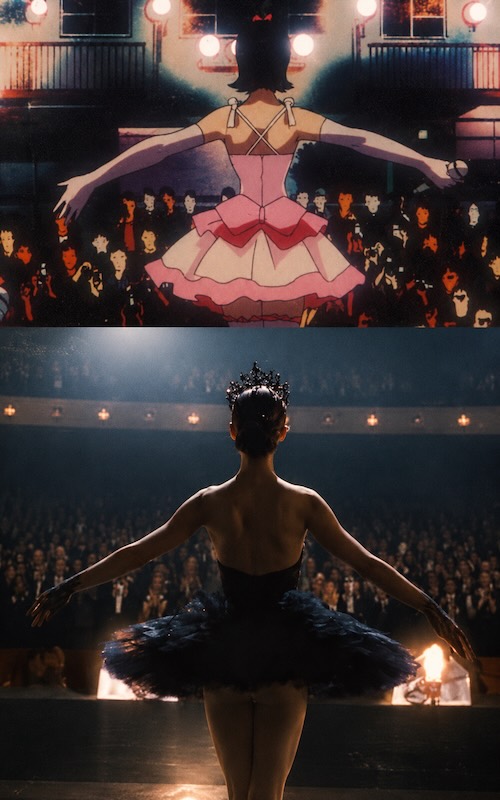
With *Black Swan* (2010), the situation is different. Aronofsky denied that *Perfect Blue* had been a direct influence on the film. When questioned publicly about it, he acknowledged that there were similarities, but said the project stemmed from his interest in dramatizing *Swan Lake*.
But his denial does not render any comparisons meaningless. Elena Gil Escudier, among other authors, has pointed out the similarities between *Black Swan* and *Perfect Blue*: two young artists subjected to intense professional pressures. In addition, there is the identity crisis. There is also the presence of doubles. Another element is the mirrors. Furthermore, there is a figure who seems to embody another version of the protagonist. And, finally, the growing confusion between what is actually happening and what the mind conjures up.
The similarities even extend to details that have repeatedly caught the attention of critics and viewers: Mima/Nina, the professional transformation of both, and the relationship between the body, the external gaze, and an identity that no longer seems stable.
This allows us to maintain the comparison without attributing to Aronofsky a confession he never made. *Black Swan* can be viewed alongside *Perfect Blue*, and it is difficult to ignore their similarities. However, it is another matter entirely to claim that we know with certainty the causal process that led from one film to the other.
Something similar occurs with *Paprika* and *Inception*. Visual and narrative comparisons exist and have been studied, but there has not yet been a direct statement from Nolan that would allow us to present Kon’s film as a recognized source for *Inception*.
Nor did this debate begin with Satoshi Kon. The circulation of imagery between anime and Western cinema has much better-documented examples. For instance, the Wachowskis have acknowledged the influence of anime on the conception of *The Matrix*. That is why comparisons with *Ghost in the Shell* have been part of that conversation since the film’s release.
This example helps explain why it’s important to distinguish between homage, acknowledged influence, parallels, and appropriation before lumping everything together under the term “plagiarism.” With Kon, specifically, some connections are well-documented, while others remain in the realm of critical comparison.
Where should you start when watching Satoshi Kon’s films?
If this overview has piqued your curiosity, there’s no single “correct” way to approach Satoshi Kon’s work.
*Perfect Blue* remains the most direct starting point for anyone looking for a psychological thriller, horror, crime, and a story where identity unravels before our eyes. Furthermore, even from his very first film, it allows us to recognize several of the themes that Kon would revisit later.
Paprika is perhaps the most immediate entry point for those who prefer science fiction, wild dreams, and a film that uses animation to leap between spaces without asking permission.
Millennium Actress, on the other hand, transforms the relationship between memory, cinema, and reality into a more emotional story. Kon described Perfect Blue and Millennium Actress as two sides of the same coin because of the relationship both films establish between admirer and idol. However, he acknowledged that the former had become progressively darker, while the latter ventured into different territory.
*Tokyo Godfathers* showcases another facet: a Christmas comedy-drama much more grounded in the streets of Tokyo. It also features three marginalized characters who form an unlikely family.
And anyone who wants to delve deeper into the director’s obsessions can turn to *Paranoia Agent*. In this series, private problems end up intertwining with collective fears, and reality, rumor, and fantasy once again become intertwined.
But if you have to start with just two, *Perfect Blue* and *Paprika* remain ideal extremes of his filmography. One traps the viewer inside a mind that loses its bearings; the other lets the dream spill over until it swallows the world.
Satoshi Kon: The Magician and Illusionist of Anime
Satoshi Kon’s untimely death helped forge an aura of admiration and prestige around him. Visionary, genius, innovator, and illusionist are just some of the epithets that have been bestowed upon him. It is up to those who delve into his work to determine whether these are exaggerations or not. There are, however, concrete reasons why a filmography consisting of only four feature films continues to command such critical attention.
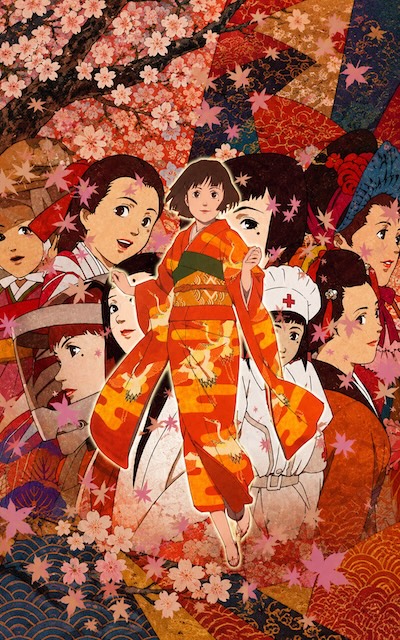
Kon understood editing not merely as a way to string scenes together, but as a tool capable of altering our relationship with time, memories, and identity. For example, in *Perfect Blue*, the cuts make it seem as though a scene continues into Mima’s life. Meanwhile, in *Millennium Actress*, an interview spans decades of history and films without pausing to explain each transition. Finally, in *Paprika*, shifts in space reflect the unpredictable freedom of dreams.
This use of animation continues to be a subject of research. Studies of his work have analyzed the relationship between identity and point of view, editing techniques, narrative complexity, and the constant interplay between reality and fiction. In reviewing his filmography, it has also been noted how Kon took advantage of the visual fluidity and editing techniques characteristic of animation. In this way, he was able to expand the possibilities for narrating adult and subjective experiences.
His ability to examine media culture without treating it as mere decoration also remains evident. *Perfect Blue* asks who owns a celebrity’s image; *Millennium Actress* blurs the lines between personal life and the films that construct memory; *Paranoia Agent* examines how a collective explanation can become a shared reality; *Paprika* turns the intimacy of dreams into territory susceptible to invasion.
That is why comparisons with later films matter less as a contest to determine who “invented” a particular scene. Rather, they are proof that the techniques employed by Kon became part of a much broader cinematic conversation. This conversation extends far beyond the anime market. Following the director’s death, *Sight and Sound* specifically highlighted his ability to use animation to bring dreams, memories, and inner monologues to life. He achieved this without anchoring them to a completely reliable reality.
It is heartening to discover that new generations are engaging with Satoshi Kon’s creations—not only his audiovisual works but also his written ones. Moreover, they experience a wealth of emotions that leave them anything but indifferent.
Being provoked and challenged by a text, song, film, painting, or any other work of art is—for this writer—a beautiful way to remind us of our humanity and the possibilities we have to connect with one another. This is true even when the emotions and feelings they evoke are not entirely pleasant.
Redacción
Richart Rosiles
Richart Rosiles holds a degree in Creative Writing from UACM and specializes in Hispanic American narrative. He has worked as a video reporter and writer for El Universal and has also contributed to its cultural supplement, Confabulario. He writes about literature, film, music, and cultural phenomena from a critical and analytical perspective.
Author profile at El Universal:Richart Rosiles