

How to Understand a John Galliano Collection: The Historical, Literary, and Cinematic References Behind His Work
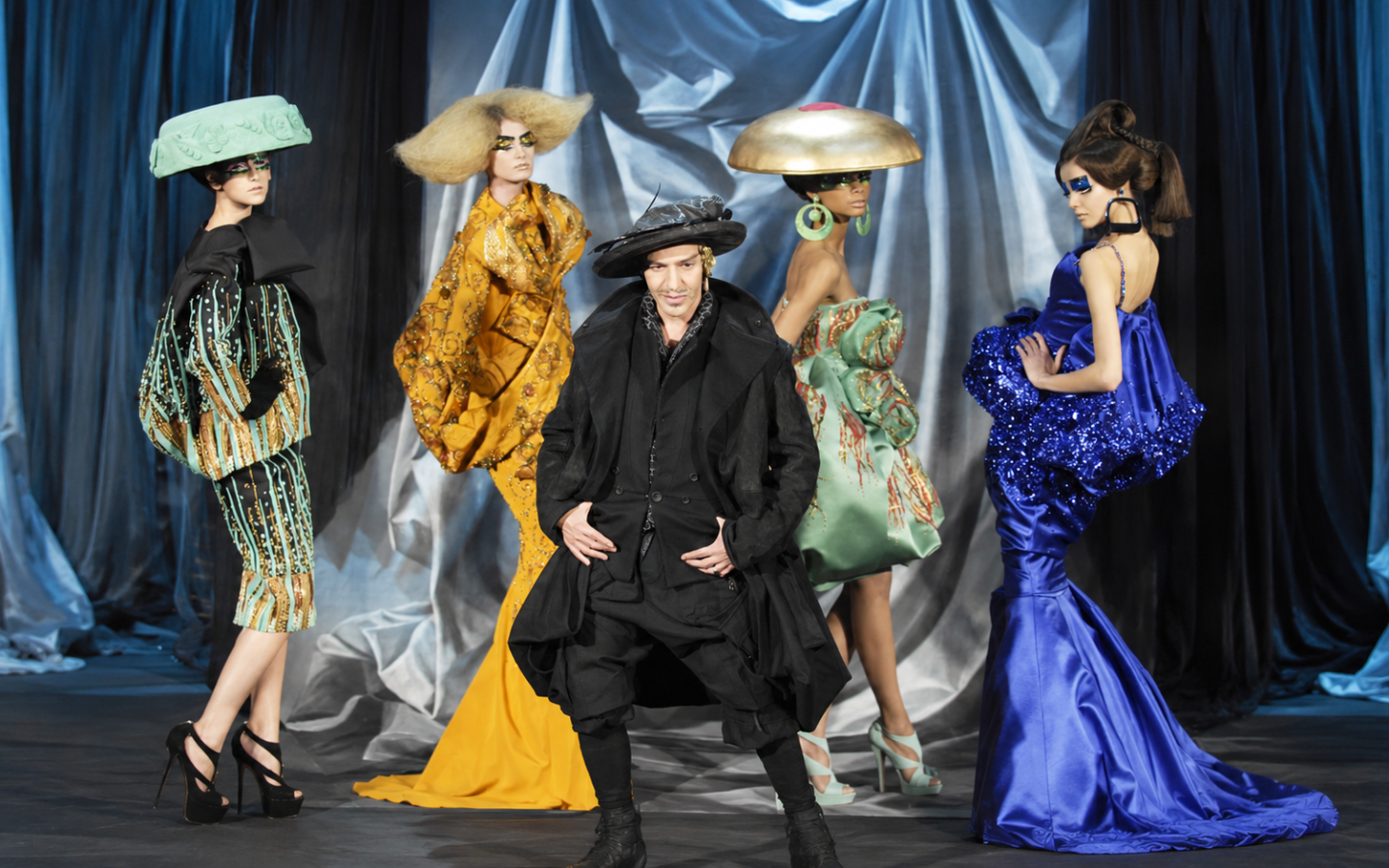

Watching a John Galliano collection can feel like stepping into a play or watching a movie. In his fashion shows, the garments aren’t merely pieces designed to set trends: they’re part of worlds built around characters, settings, and references drawn from history, literature, painting, film, theater, and the history of fashion itself.
Throughout his career, Galliano has drawn on worlds as diverse as post-Revolutionary France, old Hollywood, Imperial Russia, and the works of writers and artists. A historical silhouette might end up being made from a different fabric, a literary character might blend with a film, and a 19th-century woman might share a collection with a 20th-century pop culture figure. Recognizing these connections brings us closer to a question that runs through all his work: How can I look at a John Galliano collection and understand what I’m seeing?
Why do John Galliano’s collections tell stories?
One of the keys to understanding Galliano’s work is to start with the character. Before looking at a single dress, it’s worth asking who the woman—or man—standing before us is, where she comes from, how she moves, and what story she seems to have.
The material at the Palais Galliera dedicated to the collaboration between Galliano and Stephen Jones explains that his collections follow narratives built on extensive historical research and sharply defined characters. Jones even recounted that Galliano would first explain to him what each woman was doing within that story; from there, hats, hair, makeup, shoes, and clothing would bring the character to life.
That process is clearly evident in the Fall/Winter 1996–97 collection from his own label. Galliano described his protagonist as a blend of the Duchess of Windsor and Hopi influences: on the one hand, a woman associated with 20th-century aristocratic elegance; on the other, elements drawn from specific Native American cultures.
The fusion also extended to the garments. The Costume Institute’s analysis of this collection identifies coats that alluded to Navajo blankets with geometric patterns. Galliano transferred those motifs to prints on felt that, in turn, were visually reminiscent of Central Asian ikat textiles.
The fashion show rounded out the character. It took place on a track used for training polo horses in Paris, featuring sand, bales of hay, feathers, barrels, tires, and other objects. A horse appeared at the beginning of the show, and contemporary coverage also noted a large, teepee-like structure within the set design. References to Hopi, Navajo, and other Indigenous traditions are documented in contemporary sources and museum studies, although they belong to distinct cultures and should not be treated as a single entity. On the runway, clothing, space, movement, and characterization were ultimately integrated into the protagonist imagined by Galliano.
The Story: Galliano Doesn’t Need to Stick to a Single Era
Historical references have appeared since the beginning of his career, but they rarely stand alone. Galliano can take a silhouette, a style of dress, or a character from the past and place it alongside references from another era.
Les Incroyables: Looking at the Past from the Present
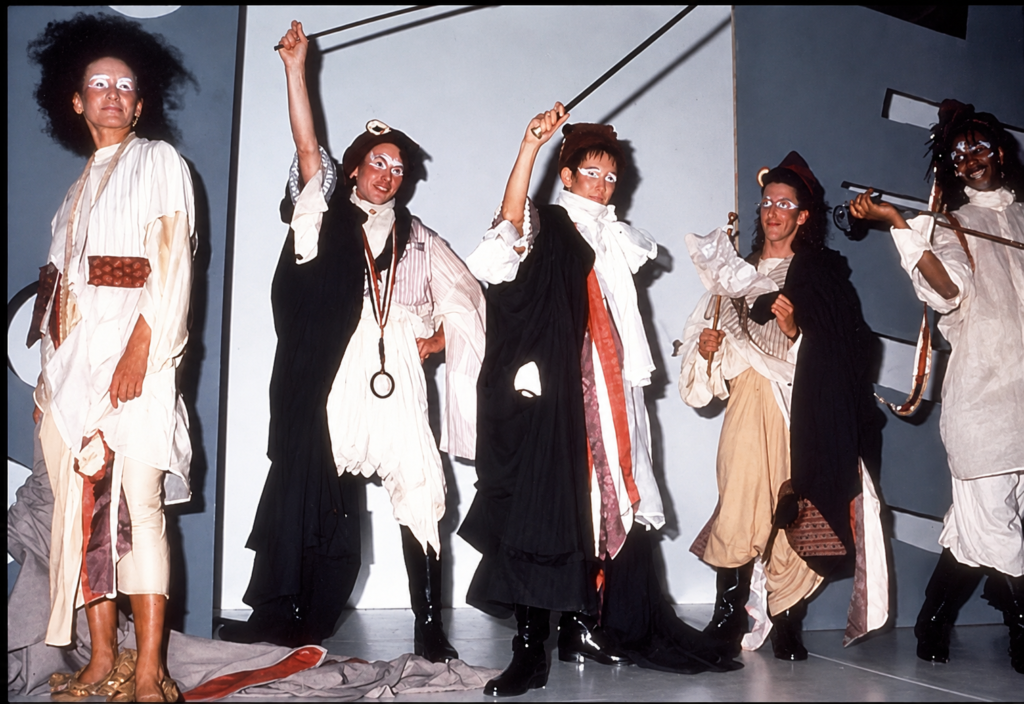
In 1984, Galliano presented his graduation collection, Les Incroyables, at Saint Martins. The starting point was the Incroyables and Merveilleuses, groups associated with the French Directory who became known for their exaggerated style of dress following the French Revolution.
High collars, distorted proportions, vests, and a penchant for a deliberately flashy appearance provided historical inspiration for the collection’s eight silhouettes. At the same time, The Met’sanalysis of *Les Incroyables* explains that Galliano connected those young French people with the London New Romantics of his own era: the club-going generation of the early 1980s that used clothing, makeup, and theatricality to construct identities.
Les Incroyables did not attempt to pass off 1790s clothing as 1984 fashion. Galliano found a connection between two groups separated by nearly two centuries, yet united by an exaggerated and conscious approach to appearance. He even turned to fabrics typically used for upholstery and manual dyeing processes.
When a Galliano collection seems historical, it’s also worth looking at what was happening around the designer at the time he created it.
Luisa Casati: When the Character Also Shapes the Setting
Another example appears in Christian Dior’s Spring/Summer 1998 haute couture collection. The central muse was the Marquise Luisa Casati, known for turning her own appearance and social life into a spectacle during the early decades of the 20th century.
Galliano built the fashion show around Casati and held the presentation at the Opéra Garnier in Paris. Vogue’s review of Dior’s Spring/Summer 1998 collection notes velvet dresses, lace, opera coats, oversized hats, and visual references to Art Nouveau.
The models took over the staircases, balconies, and halls of the Palais Garnier, so that the building itself became part of the protagonist’s world. In a later conversation about that show, Galliano explained that the first look directly introduced “the life of the Marquise Casati.” The silhouette, fabrics, hats, makeup, gait, and setting all revolved around that same character.
Edie Sedgwick + Josefina: Two Eras Create a Third Image
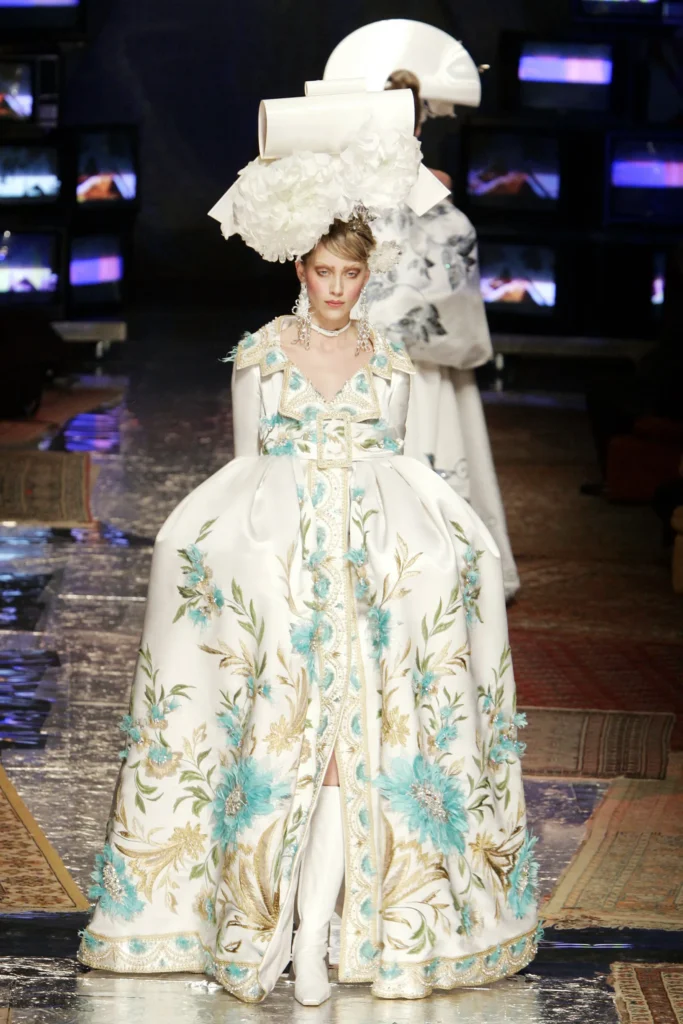
Christian Dior’s Spring/Summer 2005 haute couture collection showcases another way of working with history. Galliano started with an unlikely combination: Edie Sedgwick, a figure from Andy Warhol’s Factory during the 1960s, and Empress Josephine, associated with the Directory and the Napoleonic Empire.
Vogue’s review of the Spring/Summer 2005 show notes Empire silhouettes, high-waisted dresses, organza associated with the Directory, Napoleonic coats, flat knee-high boots, and Mod references. The setting, featuring televisions, musicians, and casually arranged furniture, evoked Warhol’s Factory.
A waistline below the bust, embroidery, and coats inspired by the Napoleonic era coexisted with flat boots, minidresses, black, stripes, and a leading figure associated with 1960s New York. Josephine and Edie Sedgwick thus shared the same collection without losing the elements that made them recognizable.
Literature: From Reference to Character
Books also feature in Galliano’s work, though a literary reference can make its way onto the runway in various ways: through a character, an atmosphere, an idea, or even the construction of the garments.
Princess Lucretia: Romanov, Tolstoy, cinema, and Vionnet in a single woman
Princess Lucretia, from the Spring/Summer 1994 collection, is one of the clearest examples.
The collection brought together references to the Romanov imperial family and the story of Anastasia, Leo Tolstoy’s *Anna Karenina*, Jane Campion’s film *The Piano*, and the work of Madeleine Vionnet. The Met’s entry on a piece from the Princess Lucretia collection confirms both the Spring/Summer 1994 season and these references.
The Romanovs and Anastasia evoke an image of lost aristocracy and an imperial past; Anna Karenina brings the romantic and tragic world of 19th-century Russia; *The Piano* introduces another woman from an era marked by desire, repression, and landscapes where the dress contributes to the character; and Vionnet provides a concrete tool for translating that imagery into clothing: the bias cut.
Vionnet functions here as a technical influence, not as a reference to ballet. The bias cut takes advantage of the fabric’s diagonal grain so that the fabric gains elasticity and can drape and move differently over the body. The Met identifies this technique as a recurring influence of Vionnet on Galliano since the late 1980s.
In *Princess Lucretia*, these historical, literary, cinematic, and technical references ultimately come together to shape a single protagonist.
The Forgotten Innocents: a story can also be woven into the pattern
In Fall/Winter 1986–87, he presented *The Forgotten Innocents*. The Costume Institute preserves a dress from the collection and documents its connection to crime stories from Victorian England, including their victims.
In the so-called “Pouch Dress,” Galliano drew on circular tailoring techniques from Savile Row and exaggerated them to the point of altering the traditional way the garment drapes on the body. The combination of muslins, heavier fabrics, and distorted shapes carried part of that imagery into the very construction of the clothing. In this collection, the narrative also appears in the cut.
À rebours: How does decadence become clothing?
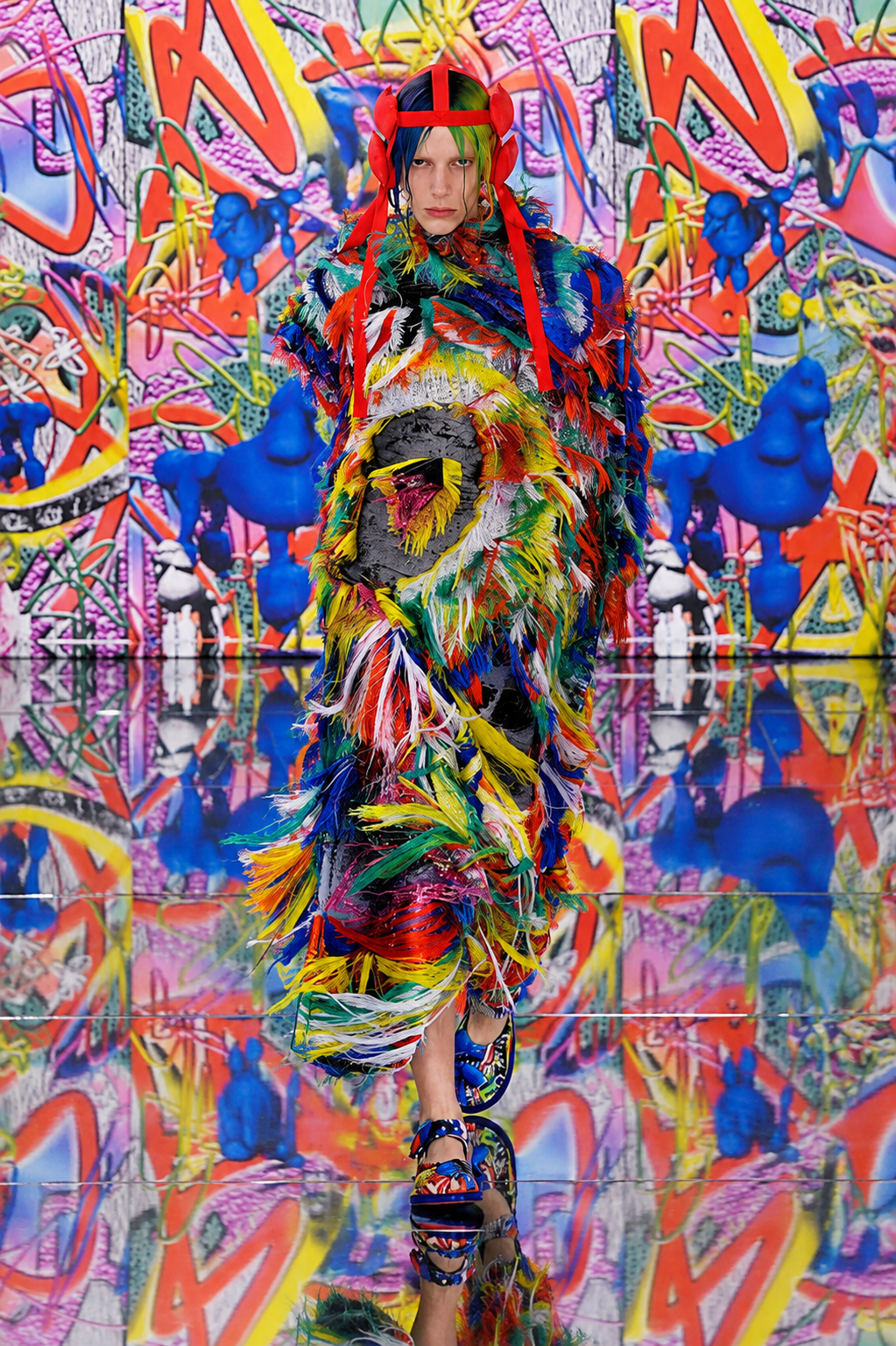
Decades later, for Maison Margiela Artisanal Spring 2019, Galliano worked explicitly with decadence.
Among his references was *À rebours*—“Against the Grain”—the novel by Joris-Karl Huysmans published in 1884, along with Charles Baudelaire and Robert de Montesquiou. For that collection, Galliano explained decadence through three ideas: excess, artifice, and decay. Vogue’s review of the Maison Margiela Artisanal Spring 2019 collection documents both these references and the way they were translated into the garments.
There were reflective surfaces, embroidery, feathers, visually saturated prints, menswear pieces reimagined in unexpected ways, and conventional tailoring elements transformed into something else: waistbands that ended as collars, transformed lapels, and coats reworked with strategic cuts. In this case, literature provided an idea—decadence—that Galliano translated into materials, volumes, and construction.
Film, Theater, and Painting in Galliano’s Creative Universe
In “Princess Lucretia,” *The Piano* is woven into a romantic protagonist shaped by Tolstoy, the Romanovs, and Vionnet’s technical craftsmanship. The reference is evident in the fluidity of the dresses, in the image of a woman from another era, and in the significance her movement takes on.
Painting appears in a different light in the Spring/Summer 1996 collection, when Galliano took ballet as one of his themes. *Vogue* directly links the collection to Edgar Degas and the Parisian Crazy Horse: minimalist tutus, bodies in motion, and references to the show all intersected in a single presentation. Galliano did not literally transpose a Degas painting onto a dress, but rather incorporated elements associated with ballerinas, rehearsal, body posture, and the representation of movement.
Theater can be recognized in the way collections are presented. At Dior’s Spring/Summer 1998 show, the Opéra Garnier was part of the set design for Luisa Casati. In Fall/Winter 1996–97, the polo field and the horse helped introduce another protagonist. And in Dior’s Spring/Summer 2005 collection, the setting—reminiscent of Warhol’s Factory—placed Edie Sedgwick within a collection that also drew inspiration from Josephine. In these fashion shows, the stage provides context for the characters and the garments; it does not function merely as decoration.
How to Interpret a John Galliano Collection
You don’t need to know fashion history by heart to get started. You have to learn to ask questions about what appears on screen or on the runway.
1. Who is the character?
Before identifying an era, observe the model. Does she look like an aristocrat, a ballerina, a movie star, or a woman from the 1960s?
In Fall/Winter 1996–97, Galliano imagined a protagonist inspired by the Duchess of Windsor and Hopi references. In “Princess Lucretia,” he crafted another woman by blending elements of Anastasia, Anna Karenina, and *The Piano*.
The character is usually the point where these references begin to converge.
2. What era or imagination does she come from?
Then look for recognizable elements: an Empire waist, a corset, a hat, a military coat, a tutu, or a particular style of makeup.
You don’t have to pinpoint a specific date right away. First, identify the reference, and then observe what other elements it’s associated with.
3. Which historical silhouette is being reimagined?
In Dior’s Spring/Summer 2005 collection, the Empire waist evokes the early 19th century, but Galliano pairs it with flat boots and mod references associated with Edie Sedgwick.
The silhouette retains a hint of the past while the rest of the look offers a new interpretation.
4. What materials or techniques alter the reference?
Fabrics also tell part of the story.
In Fall/Winter 1996–97, motifs inspired by Navajo blankets were translated into prints on felt. In Princess Lucretia, the bias-cut technique learned from Vionnet allowed for a much more fluid relationship between the dress and the body.
5. What do the makeup and hairstyles convey?
Galliano uses both to alter the models’ identities.
A hairstyle can transport them to a specific decade; a heavily made-up face can distance them from any everyday look. Makeup, hair, and clothing work best when viewed as part of the same character.
6. What does the setting contribute?
The Opéra Garnier helps us interpret Luisa Casati. The polo field transforms the Fall/Winter 1996–97 collection. Warhol’s Factory makes Edie Sedgwick’s presence understandable in a collection full of Napoleonic references.
A specific space can offer as many clues about the collection as the garments themselves.
7. How does the model use her body?
Walking, running, swaying, or striking a specific pose transforms the dress.
This is especially clear when Galliano works with bias-cut fabrics, tutus, or crinolines. Clothing isn’t understood the same way when it’s still as when it’s in motion.
8. What references are being blended, and to what end?
Les Incroyables connects post-Revolutionary France with the New Romantics. Dior 2005 brings together Josephine and Edie Sedgwick. Princess Lucretia constructs its protagonist through references to Anastasia, Tolstoy, Jane Campion, and Vionnet.
When a combination seems strange, looking for the element that its references share often reveals the logic behind the collection.
Why does John Galliano remain an icon of contemporary fashion?
Interest in Galliano isn’t limited to his collections from the 1990s and 2000s. His tenure at Dior has found a new audience among people who are rediscovering archival images, garments, and accessories from those years. Vogue España has documented the interest of younger generations in Galliano’s Dior, evident both on social media and in the vintage market, as well as in the revival of items associated with that period.
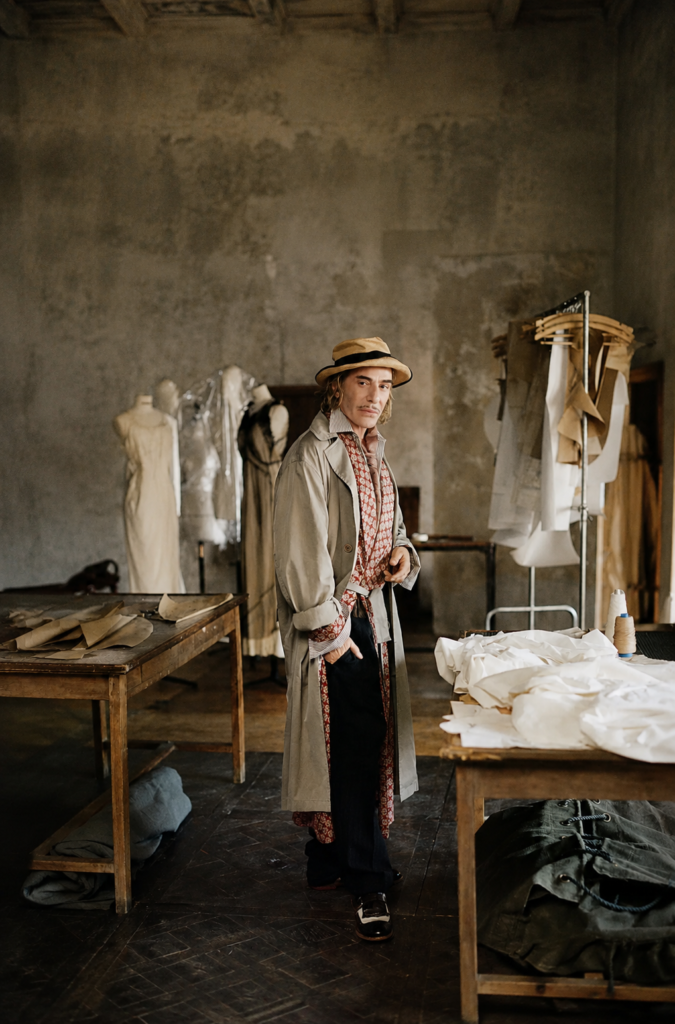
His work at Maison Margiela opened another chapter. Galliano led the house from 2014 to 2024, where he worked with techniques related to the deconstruction and reuse of garments, in addition to developing a unique vocabulary within the brand with terms such as “décortiqué” and “Recicla.” Maison Margiela’s official description of the décortiqué technique and Recicla pieces shows how the former reveals the layers and components of a garment’s construction, while Recicla pieces reuse existing materials or items and preserve information about their provenance.
His latest Artisanal runway show for Margiela, presented in January 2024, once again brought together various elements that have been present in his work for decades: characters, extreme historical silhouettes, makeup, movement, and a staging crafted down to the last detail. Vogue’s review of Maison Margiela Artisanal Spring 2024 described a universe populated by characters in nocturnal Paris, with corsetry, padded hips, sheer fabrics, and hair and makeup integrated into the narrative.
The institutional significance of his work was further reinforced by the announcement of *John Galliano: Horizons*, the solo exhibition that the Costume Institute at the Metropolitan Museum of Art will dedicate to the designer in 2027. The exhibition will open on May 9, 2027, and will trace his career from Les Incroyables to Maison Margiela. It will be only the third monographic exhibition at The Met dedicated to a living designer, following those of Yves Saint Laurent and Rei Kawakubo. Vogue documented this milestone in the history of the Costume Institute’s exhibitions.
Amid renewed interest in his time at Dior, his ten years at Margiela, and the upcoming Costume Institute retrospective, Galliano continues to occupy a prominent place in the conversation about contemporary fashion.
A collection is best understood when you start asking questions
Looking at John Galliano becomes more interesting when we stop viewing the runway as a succession of extraordinary looks and start looking for connections.
Who is the character? What era is reflected in the silhouette? What has changed in the fabric? Why is the model walking that way? What is that set doing there? What do two references that seem to come from completely different worlds have in common?
Once you’ve identified the character, era, silhouette, materials, and staging, a Galliano collection ceases to be seen merely as a succession of garments and begins to reveal the story that structures the show.