


What is the absurd according to Albert Camus? The philosophy that continues to explain the world today


According to the 20th-century French philosopher, writer, and essayist Albert Camus, the absurd arises from the clash between the human need to find meaning and a universe that offers no definitive answers. This idea remains relevant when we think about the situations we go through that seem to have no clear explanation.
Camus does not simply assert that life is absurd in and of itself, nor that it lacks value. Absurdity arises from the confrontation between our desire to find ultimate meaning and a world that remains indifferent to that search. His philosophy proposes that we reflect on this tension without resorting to false certainties or, as a result, abandoning the value of life.
What is the absurd according to Albert Camus?
We’ve all experienced at some point the feeling of waking up to face another routine day and asking ourselves why we do it. Camus says that this is not a distant feeling; it is “the sensation of absurdity just around the corner” (1995, p. 25) that any person can feel and that deserves reflection.
The absurd arises when we desperately seek a logical explanation, an order, or an ultimate purpose for existence and are met only with silence. Camus explains this in *The Myth of Sisyphus* through the lens of daily routine:
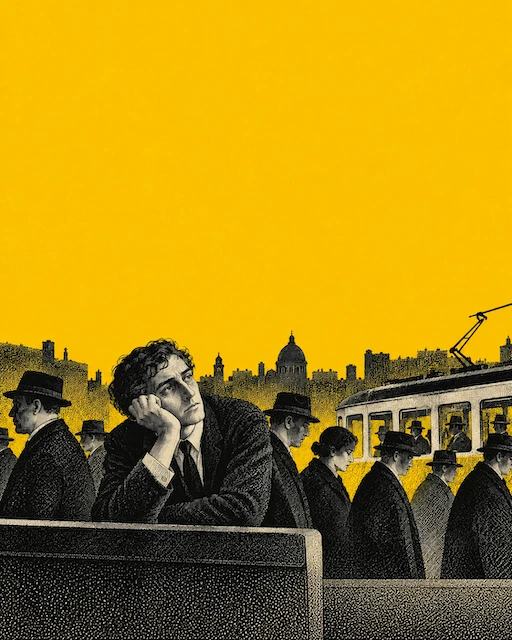
“Getting up, taking the tram, four hours at the office or factory, lunch, the tram, four hours of work, dinner, sleep, and Monday, Tuesday, Wednesday, Thursday, Friday, and Saturday—all following the same rhythm—is a routine that is easily maintained most of the time. But one day the ‘why’ arises, and everything begins with that weariness tinged with wonder” (p. 27).
That “why” marks an awakening. Routine ceases to seem automatic, and the need to understand the meaning of what we do emerges. In Camus, the absurd arises precisely from that confrontation between the human search for clarity and a world that does not respond to that demand.
As Málishev Krasnova (2000) argues, awareness of the absurd alters the human being’s relationship with their own existence. However, recognizing this lack of a definitive answer does not mean succumbing to pessimism or concluding that nothing matters. For Camus, the absence of ultimate meaning does not negate the value of acting, loving, committing oneself, or experiencing; his proposal is to live without pretending that a transcendent explanation has resolved the contradiction.

The Myth of Sisyphus: The Book in Which Camus Developed His Idea
Albert Camus published *The Myth of Sisyphus* in 1942 to develop his idea of the absurd, drawing on the classic myth of Sisyphus as a way to reflect on the human condition in the face of an existence that offers no definitive answers.
The essay appeared during World War II, in the midst of the German occupation of France and a period of profound uncertainty in Europe. However, Camus’s philosophical concerns predated this: he had already been working on *The Stranger*, *The Myth of Sisyphus*, and *Caligula* as part of the same cycle, and the manuscript of the essay had been sent to his publisher in 1941 before it was published in 1942. The war forms part of the context of its publication, but it is not the book’s central theme.
The question is broader: if we cannot find an ultimate and guaranteed meaning for existence, is life worth living? Camus answers in the affirmative and rejects both physical suicide and what he calls “philosophical suicide”: escaping contradiction by appealing to a transcendent certainty that would eliminate it.
Myth as a Metaphor for the Human Condition
According to Greek mythology, Sisyphus was punished by the gods and condemned to push an enormous boulder to the top of a mountain. Every time he reached the top, the boulder would roll back down, and he would have to start all over again, in a cycle that would repeat itself for all eternity.
Camus saw in this punishment a metaphor for the human condition. Sisyphus may be the man who wakes up every day, performs a repetitive task, wonders if there is any ultimate meaning to it, and finds no answer from the universe.
“We must imagine Sisyphus happy”
The essay’s great revelation comes when Camus asserts that we must imagine Sisyphus happy. Every time he goes down to fetch the rock, Sisyphus knows his fate: he knows it will roll back down, and that there is no final reward capable of ending his condemnation.
Consciousness changes his relationship with that punishment. Sisyphus does not delude himself nor does he expect a solution from the gods; he faces his condition knowing exactly what it is. “We must imagine Sisyphus happy” does not mean that the task is pleasant or that there is a hidden reward. The idea is to consciously confront a situation that cannot be resolved and to continue living without false consolations.

Is the absurd the same as nihilism?
Absurdity is not the same as nihilism, although both may stem from a concern related to the absence of obvious meaning or absolute foundations. Nor is there a single form of nihilism understood as a homogeneous doctrine: political, moral, epistemological, and existential forms can be distinguished. Here we are speaking primarily of existential nihilism, understood as the idea that life lacks meaning or intrinsic value, as distinguished by the Internet Encyclopedia of Philosophy in its entry on nihilism.
Camus shares with some forms of nihilism the disappearance of transcendent answers, but he does not accept that this absence compels the conclusion that living, acting, or committing oneself is without value. His response is rebellion: to continue living and acting without inventing a definitive solution to the absurd. In *The Rebel*, this idea extends to dignity, limits, and solidarity with others.
Jean-Paul Sartre also reflected on freedom, responsibility, and the absence of prior foundations, but he took a different path. Sartre places particular emphasis on freedom and human responsibility in the construction of meaning, while Camus insists on keeping open the tension between our need for meaning and the silence of the world. Sartre’s existential philosophy stems precisely from radical freedom and the absence of a prior foundation that determines the human being.
Camus also distances himself from Søren Kierkegaard. Although both begin with experiences of contradiction, Kierkegaard finds an answer in faith. Camus believes that resolving the absurd through this leap toward the transcendent entails abandoning the tension initially acknowledged, and he includes this within what he calls “philosophical suicide”; his criticism is directed precisely at those thinkers who start from the world’s lack of meaning and end up finding a transcendent answer within it.
Why does the philosophy of the absurd remain relevant?
Although historical circumstances have changed, the question remains familiar: How can one live when existence seems to offer no definitive meaning and the world provides no conclusive answer?
Expectations regarding work, studies, relationships, or the future can fuel this need to find a clear direction. Social media, moreover, constantly presents models of success and seemingly correct ways to lead one’s life. None of these experiences is universal, but they serve to prompt a question akin to Camus’s: what happens when the available answers fail to resolve what we hope to understand?
Added to this is information overload. Today we have access to enormous amounts of explanations, opinions, and answers, but having more information does not guarantee that we can resolve questions such as the purpose of existence, death, suffering, or how we want to live.
Therein lies the problem Camus raised: we need to understand, but we have no guarantee of finding a definitive explanation capable of satisfying that need. The philosophy of the absurd does not eliminate this difficulty; it proposes facing it with clarity.
Where should you start when reading Albert Camus?
The Myth of Sisyphus (1942): This is the starting point for understanding the philosophy of the absurd. The essay explores ideas such as lucidity, freedom, and rebellion in the face of an existence without any guaranteed ultimate meaning.
The Stranger (1942): This novel addresses, through literature, various concerns related to the absurd. Its protagonist, Meursault, lives in Algeria and maintains a distant relationship with many of the social conventions around him.
The Plague (1947): This novel recounts an epidemic in the city of Oran and shifts the focus to human responses in the face of collective misfortune. It raises questions such as suffering, responsibility, and solidarity.
The Rebel (1951): explores the idea of rebellion and analyzes how to respond to injustice and the absence of absolute foundations. It is particularly useful after reading The Myth of Sisyphus, which introduces the concept of the absurd.
Living with Clarity in an Uncertain World
The philosophy of the absurd does not invite us to renounce life or adopt a passive attitude. Camus begins with the absence of a ultimate explanation capable of resolving our existence, but that does not render our actions, relationships, or commitments meaningless: experience, solidarity, and rebellion can retain their value without relying on a transcendent certainty.
Decades after his death, Albert Camus continues to spark interest because the questions he raised remain open. His philosophy does not promise a formula for eliminating uncertainty; it proposes maintaining clarity and continuing to live and act even when the world does not offer the definitive answers we seek.