

Why Fashion Keeps Borrowing From Workwear: A History of Utility Style

Workwear That Took the Runways by Storm
Many of the garments that are trending in fashion today originated outside the runways. They were originally designed for long workdays in workshops, mines, factories, or fields. These pieces were created to protect the body, be durable, and allow for ease of movement.
Before becoming what they represent today, sturdy boots, for example, protected the feet of those who performed heavy labor or faced harsh conditions in the fields, factories, or on construction sites. Over time, many of these garments ceased to be the exclusive domain of workers. Consequently, they began to circulate among other social classes and communities.
This is one of the paradoxes of workwear: the further it is from the workshops or mines that originally inspired its designs, the more interest it sparks in the collective imagination.
Why do we still wear clothes that were created for work? The answer is much deeper and goes beyond nostalgia or comfort. It also relates to functionality and the new cultural meanings a garment can take on.
What is workwear, and why is it so appealing to the fashion industry?
Workwear refers to clothing originally created to provide protection, durability, and freedom of movement for workers in factories, fields, workshops, mines, or on railroads. In other words, these garments were created to meet a specific need. However, over time, they have also acquired cultural value.
This happens because clothing does not necessarily retain the same meaning it had when it first appeared. It can change across communities, eras, and contexts, and with that, what it represents also changes. Cultural theorist Dick Hebdige studied precisely how subcultures take existing objects and ways of dressing and attribute different meanings to them.
In the specific case of workwear, garments created to withstand long workdays and protect workers ended up becoming, in other settings, symbols of identity.
Perhaps this is the greatest appeal of workwear, as the fashion industry is always searching for something that can remain relevant. However, the sturdiness of a pair of boots, a pair of worn-out pants, or the pockets of a jacket offer something even more fascinating: a story of hard work and everyday life.
In contrast to fleeting trends, these garments offer a look that prioritizes functionality and isn’t necessarily tied to a specific season. They also establish a connection to the imagery of the working class and physical labor. Furthermore, they blend seamlessly with athletic wear, streetwear, and even formal attire.
On the other hand, workwear has historically been linked to certain ideals of masculinity. Sociologist Raewyn Connell has studied how models of masculinity are social constructs that change over time and across communities. In this case, codes such as physical strength, manual labor, and sturdy clothing were associated for decades with the image of men performing heavy tasks. However, none of these codes are exclusive to men nor are they fixed.
The truth is that functionality eventually came to be valued as a sign of authenticity. Subcultures and streetwear took existing garments and kept them in circulation in new contexts. Simplicity, industrial nostalgia, durability, and utility outlived their original function and turned clothing created for specific tasks into cultural icons.
How Workwear Became a Fashion Icon
Not all of these garments made the leap from factories and work environments directly into the world of fashion. Some took very different paths. However, they had one thing in common: they came from environments where clothing had to be durable, long-lasting, protective, or allow for ease of movement. Moreover, it was those very characteristics that later caught the attention of new generations.
When Durability Took on a New Meaning
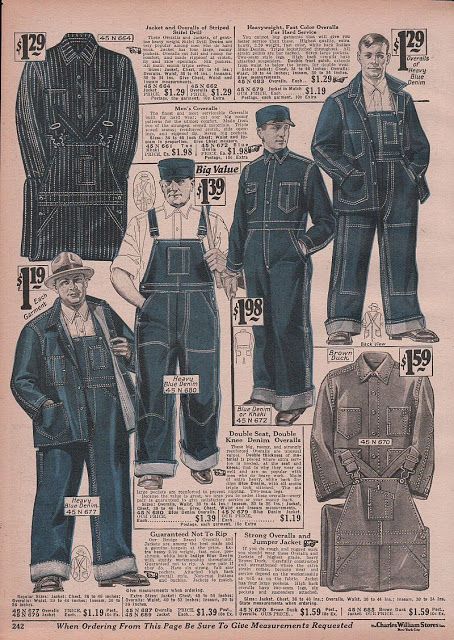
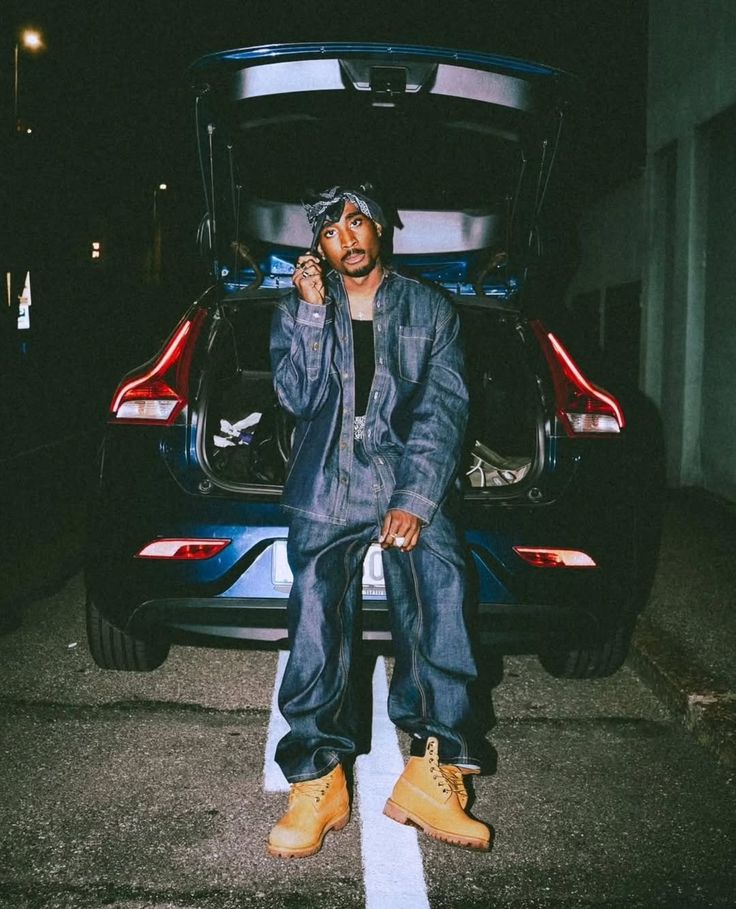
Jeans are perhaps the best example of how a feature designed for functionality ended up acquiring cultural value. Denim became popular as workwear because of its durability. However, the history of riveted jeans began when tailor Jacob Davis sought a solution to reinforce the areas where pants tended to tear.
Davis placed metal rivets in high-stress areas, such as the corners of the pockets, and proposed to his fabric supplier, Levi Strauss, that they patent the idea together. On May 20, 1873, Jacob Davis and Levi Strauss were granted a U.S. patent for reinforcing work pants with rivets—a date associated with the birth of the modern blue jean.
Later, jeans gradually shed their exclusive association with work. They made their way into Westerns, cinema, and youth cultures until they came to symbolize independence and rebellion. The durability that had originally justified the rivets remained, but the pants no longer spoke solely of physical labor.
Something similar happened with the denim jacket. The garment we know today underwent several transformations within Levi’s: the Type I, then called a “blouse,” appeared in 1905, while the Type II came later, and in 1967 the Type III was designated as Lot 70505, the direct predecessor of today’s Trucker Jacket. Its sturdy construction, pockets, and the denim’s ability to withstand wear and tear helped the jacket move beyond the workplace. It also found its place in rock music, youth subcultures, and streetwear.
These new scenes changed the meaning of a garment
The history of workwear began to take on a particularly interesting turn when these pieces were adopted by people who no longer needed them for the purposes for which they had been created. Youth subcultures found more than just functionality: a boot could convey toughness, a hoodie could become a symbol of urban culture, and a workwear garment could express a sense of belonging.
In the case of the hooded sweatshirt, the hoodie emerged at Champion in the 1930s as a garment designed to warm athletes and protect them from the cold. Over time, its use spread among college students and later found an important place in New York hip-hop, graffiti, breakdancing, and skateboarding. Today it is an everyday garment and no longer needs to be associated with sports to have meaning.
Another notable example is Dr. Martens, whose history does not exactly begin with the British brand we know today. In postwar Germany, Klaus Maertens and Herbert Funck developed an air-cushioned sole. In the late 1950s, Bill Griggs acquired the license for that technology and adapted it for a boot designed for British workers: the first Dr. Martens 1460 rolled off the production line on April 1, 1960—the date from which it took its name.
In its early years, it was a work boot worn by miners, mail carriers, and healthcare workers, among others. It later made its way into the music scene, and various British subcultures—from ska and punk to goth—adopted it as a symbol of identity. Durability was no longer its only selling point: the boot could also signal what kind of music you listened to or which group you identified with.
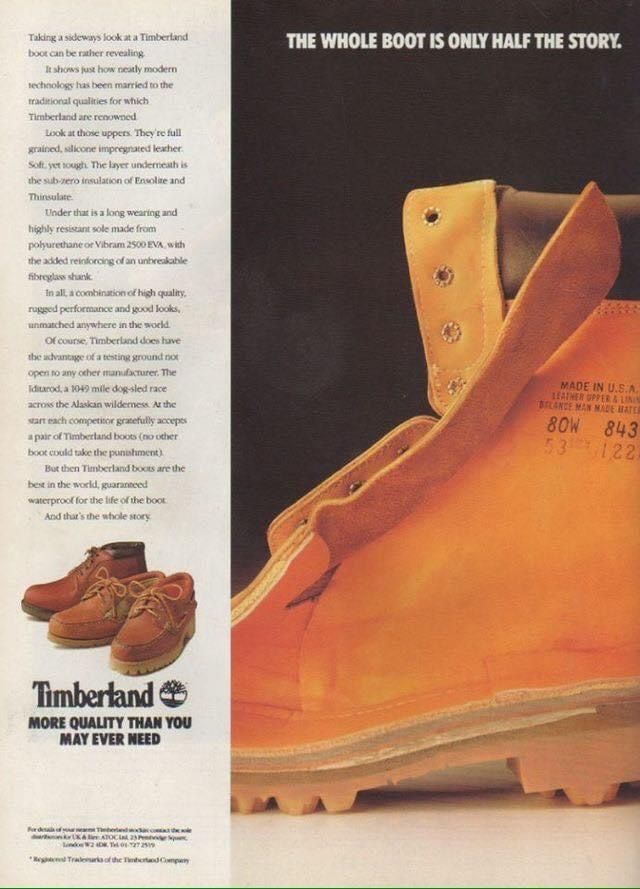
Decades later, something similar happened with Timberland. The company’s history begins with Nathan Swartz, who joined the Abington Shoe Company and later brought his sons into the business. The family moved production to New Hampshire, a region where the climate demanded footwear capable of withstanding rain, snow, and sudden temperature changes. Nathan Swartz took control of the company in 1955, and his sons later joined the family business.
In 1973, the original Timberland boot was introduced, designed with New England’s weather conditions and outdoor work in mind. Its waterproof leather and sturdy construction met a practical need, but over the years, the same boot found a very different audience. The 1973 Original Timberland Boot set new standards for waterproofing in a leather boot and was later embraced by urban culture and hip-hop, especially during the 1980s and 1990s.
In 2023, the Nieuwe Instituut in Rotterdam dedicated the exhibition *Workwear: A Different Kind of Fashion* to this evolution of clothing: garments originally created as protective gear that made the transition from factories, workshops, and military settings to the streets, museums, and runways. Even codes like M-65 or 501 are enough today to evoke specific garments.
The uniform became an identity
Overalls and chore coats were also created to make work easier and protect the clothing of railroad workers, farmers, and other laborers. However, they ceased to function strictly as uniforms and began to represent community, trade, and a sense of belonging.
The evolution of the overalls also reminds us that the history of workwear does not belong solely to men. Women wore pants, overalls, and one-piece garments in various industrial jobs. During World War II, this shift became particularly evident in the United States. There, millions of women took on industrial jobs while a significant portion of men were serving in the Armed Forces.
Clothing had to adapt to this reality. In 1940, the Clothing and Textiles Division of the U.S. Department of Agriculture’s Bureau of Home Economics introduced garments for the new female industrial workers. By 1941, designs for overalls, pants, and one-piece suits were already in circulation; these reduced risks associated with skirts or loose sleeves and added pockets useful for the workday. The Smithsonian preserves these clothing designs created for women entering factories and other industrial jobs.
The chore coat, meanwhile, has its roots in 19th-century European workwear. Its loose fit, front closure, and roomy pockets addressed very specific needs of farmers, railroad workers, and manual laborers: covering their regular clothes, moving with ease, and keeping tools or small items within reach.
Within this history, Carhartt forged its own path. In 1992, Carhartt clothing gained popularity among rappers, graffiti artists, and young people in street culture, who were drawn to its durability and utilitarian look. Later, the skateboarding and BMX scenes also adopted the brand’s pieces, bringing clothing associated with physical labor into a new cultural sphere.
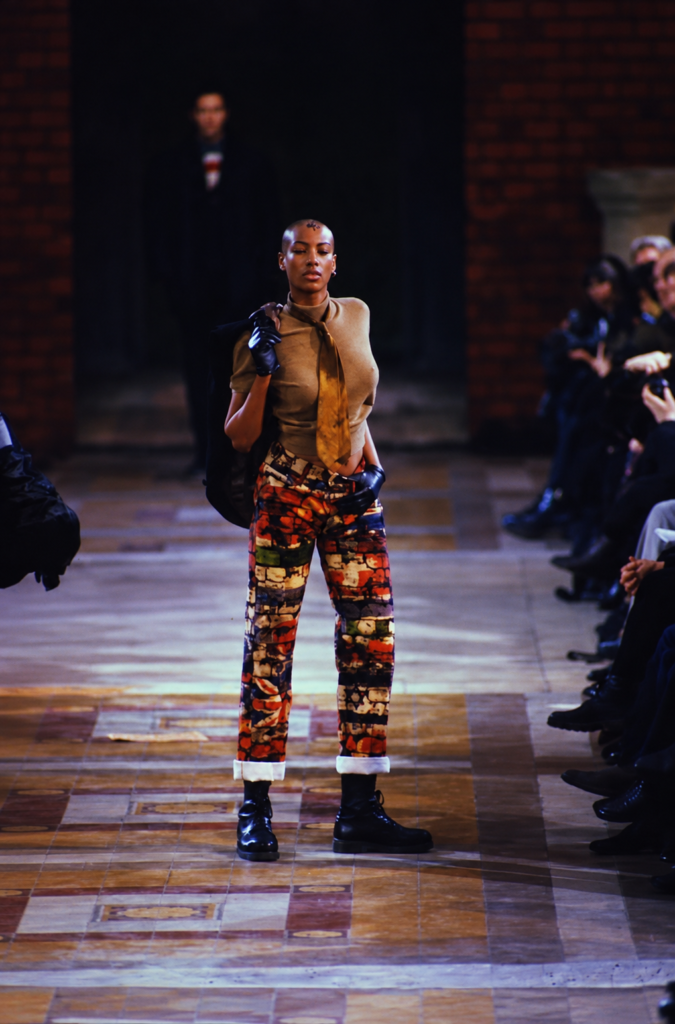
Cargo pants were born out of an equally practical need: to keep objects and equipment within easy reach. Their large side pockets were linked to military uniforms, and that feature ultimately survived the shift in context. By the 1990s, cargo pants had already established themselves outside the realm of uniforms. Furthermore, Jean Paul Gaultier used military-inspired cargo pants in a 1994 ensemble now housed at the Metropolitan Museum of Art. The pockets remained, though their function had come to be as much about aesthetics as it was about practicality.
From Factories to Runways: Workwear, Streetwear, and Luxury
The leap from factories to the runways wasn’t direct. Between these two worlds lay subcultures, music, and later, streetwear. Consequently, it was these communities that first separated many garments from their work-related functions and discovered that their durability, roominess, or pockets could also express identity.
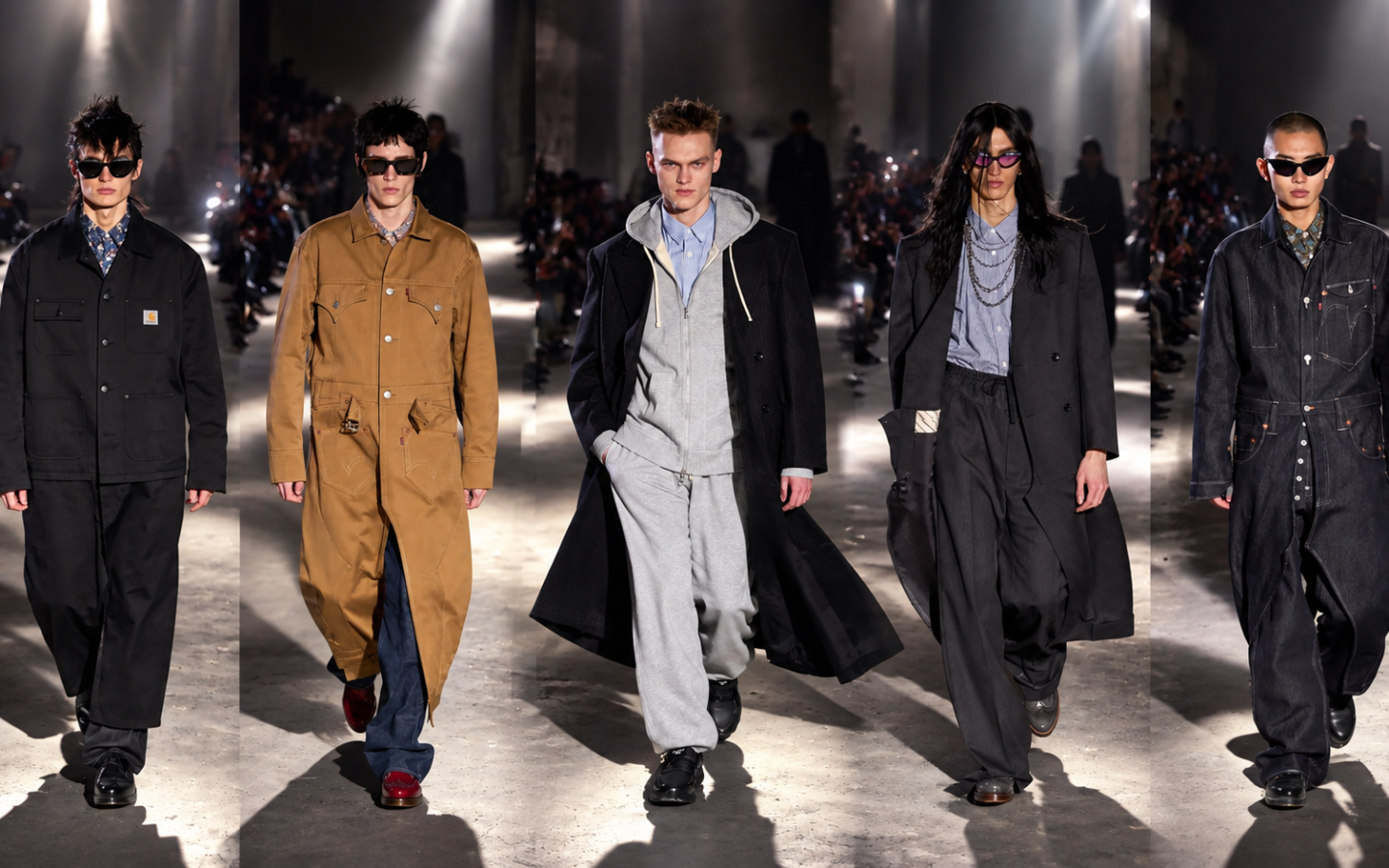
That’s why, when designers and luxury brands began looking to workwear, they found fabrics capable of withstanding wear and tear. They also discovered silhouettes that allowed for movement, pockets born of real needs, visible seams, sturdy fasteners, and surfaces that changed with wear.
Massimo Osti brought many of these characteristics into urban fashion. His interest in military and utilitarian clothing centered on the construction of the garments, the materials, and their finishes. In 1982, he created Tela Stella for Stone Island, a military-inspired canvas that underwent treatments to alter its appearance. However, it retained that feel of a durable material ready for use.
Elsa Schiaparelli had explored another possibility decades earlier. In her “Cash and Carry” collection, presented in the winter of 1939, she incorporated large pockets that allowed for carrying objects without relying on a handbag. A practical solution rooted in the context of war found its way into haute couture.
Long before a luxury brand presented heavy boots, work jackets, or cargo pants on a runway, musicians, skaters, graffiti artists, and young people had already stripped many of these garments of their work-related connotations. On the other hand, streetwear allowed these garments to retain traces of their origins while they began to represent other communities.
Pierre Bourdieu linked taste and everyday choices to social position. From this perspective, a work jacket can go from being part of a worker’s tools to being consumed by another group. Consequently, it now has a different price, materials, and context. The garment may remain recognizable, but its social value changes.
Subcultures also reshape these meanings, as Hebdige documented. A pair of jeans, a pair of boots, or a hoodie doesn’t convey the same message in every setting. It depends on who wears them, how they’re styled, and which community adopts them. That’s why the history of workwear is also interwoven with class, music, gender, street culture, and consumerism.
Why does workwear keep coming back into fashion?
After this journey, we can better understand why fashion keeps returning to workers’ clothing. There are elements that today’s garments try to replicate—durability, comfort, utility, roominess—but which appeared in workwear because someone actually needed them.
A pocket exists because someone once needed to store something while working. The fabric is durable because the environment could be harsh and demanded garments capable of withstanding the workday. Even the wear and tear that is artificially replicated today was, for a long time, a consequence of actual use.
That history can still be seen and felt in heavy denim, canvas, leather, roomy pockets, rivets, reinforced seams, and boots built to last.
These garments still embody industrial nostalgia, durability, sturdy materials, authenticity, and the ability to mix and match them with streetwear or formal attire. Compared to garments designed for a short season, utilitarian clothing retains a rather simple advantage: many of the solutions for which it was created still work.