

Diego Rivera: 10 Works That Help Us Understand Why Mexican Art Changed
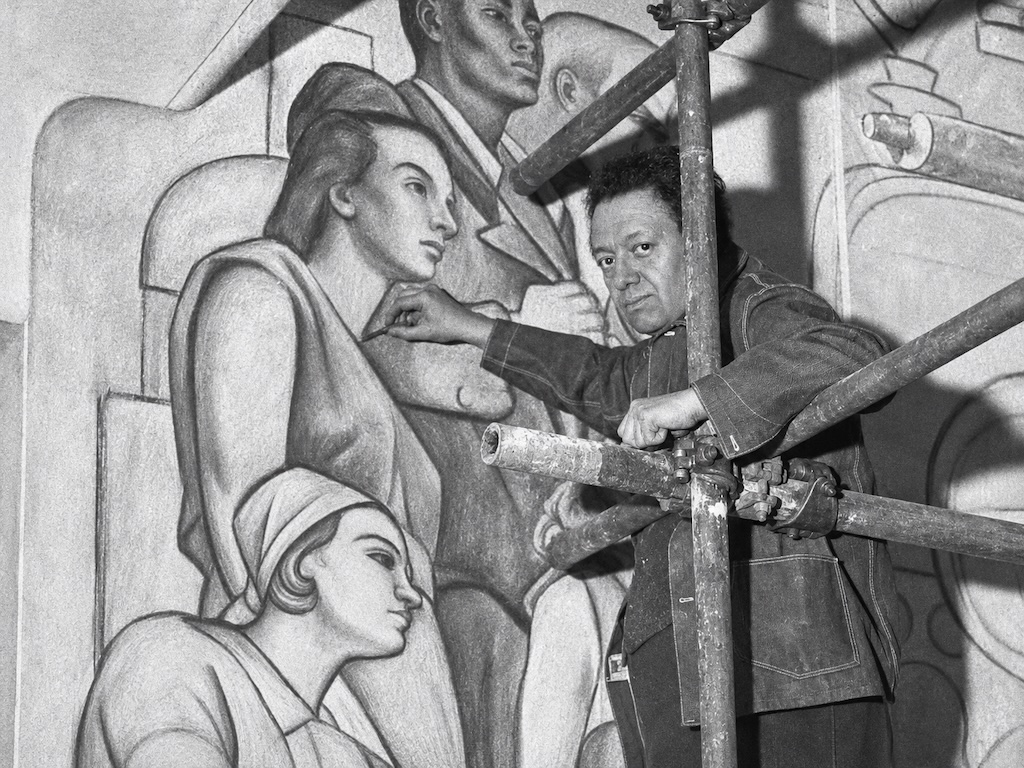

Diego Rivera’s art evolved in terms of technique, scale, audience, and context at different times. His paintings transcended the confines of the canvas to take their place in public buildings. Furthermore, they tell the story of Mexico, with peasants, workers, and indigenous communities as the protagonists.
The transformation evident in Diego Rivera’s artistic output did not occur suddenly. Rather, it was preceded by his experimentation with the European avant-garde movements and a different conception of art. The year 2026 marks the 140th anniversary of his birth, which occurred on December 8, 1886. These ten works allow us to explore his body of work and attempt to understand how Mexican painting changed. They also show how his image was projected on the international stage.
Before the murals: Diego Rivera was also a Cubist
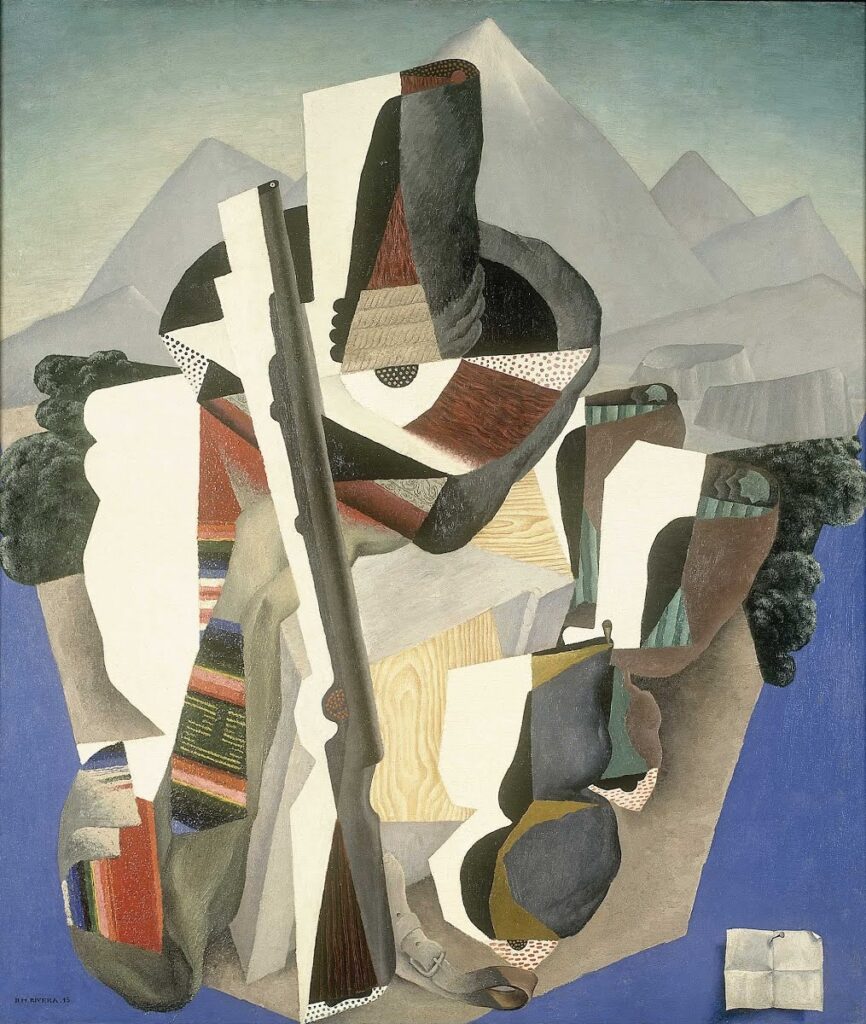
1. Zapatista Landscape (The Guerrilla) — 1915
Diego Rivera spent time in Europe and experimented with the avant-garde movements, particularly during his stay in Paris. In *Zapatista Landscape* (1915), there is a combination of synthetic Cubism with symbols of the Mexican Revolution. The prominent elements are the hat, the rifle, a sarape, and a belt with ammunition.
In this work, the geometric figures and fragmented planes resemble the styles of Picasso and Braque. However, the subject matter is essentially Mexican. This piece demonstrates how Rivera sought to integrate elements from other countries with his own national identity. This occurred long before he made the leap to murals.
The painting, originally titled *El guerrillero*, is part of the collection of the National Museum of Art (MUNAL). It has a unique feature: Rivera reused a canvas on the reverse side of which he had painted *La mujer del pozo* in 1913. Both works offer insight into his experimentation with Cubism before returning to Mexico.
The Moment the Wall Took Center Stage
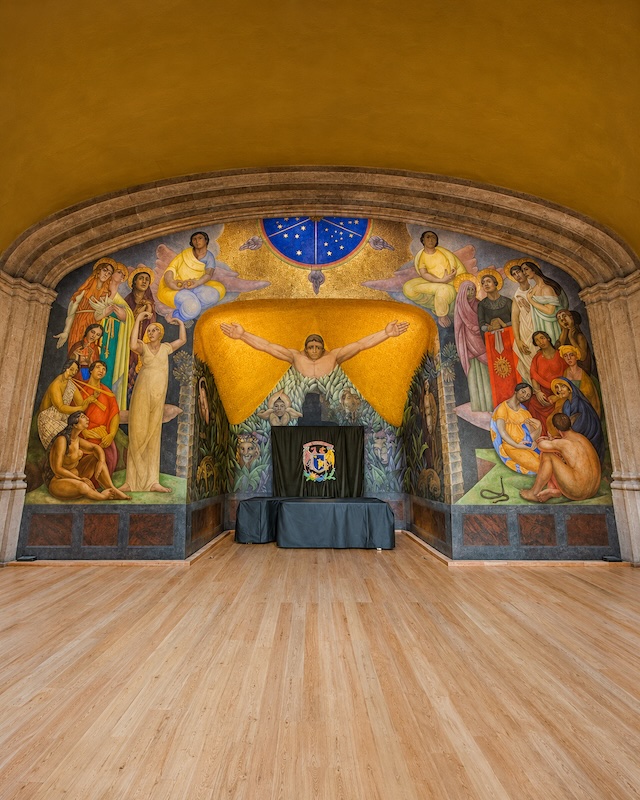
2. The Creation — 1922–1923
*La creación* was painted between 1922 and 1923, commissioned by José Vasconcelos. Although Rivera had experimented with Cubism, it is generally believed that by 1917 he had already distanced himself from this movement. Furthermore, he was more interested in spatial dimensions within a two-dimensional plane. A trip to Italy allowed him to observe and study examples of mural painting.
Upon arriving in Mexico in 1921, he became fully involved in Vasconcelos’s project. He began painting the Simón Bolívar Amphitheater at the National Preparatory School, located in the Old College of San Ildefonso. In *The Creation*, Rivera employed the technique known as encaustic, which uses pigments mixed with wax. He also created allegories of the arts, knowledge, and virtues, representing them through human figures.
This work embodies Rivera’s artistic exploration, which did not yet possess the social and narrative character of his later murals. It also incorporates the philosophical vision of José Vasconcelos. According to UNAM, the composition also incorporated a geometric scheme related to the golden ratio. Through this technique, Rivera sought to integrate the painting with the architectural space.
It was his first major mural in Mexico and a starting point for the collaborative work he would later develop with other painters.
3. Murals of the Ministry of Public Education — 1923–1928
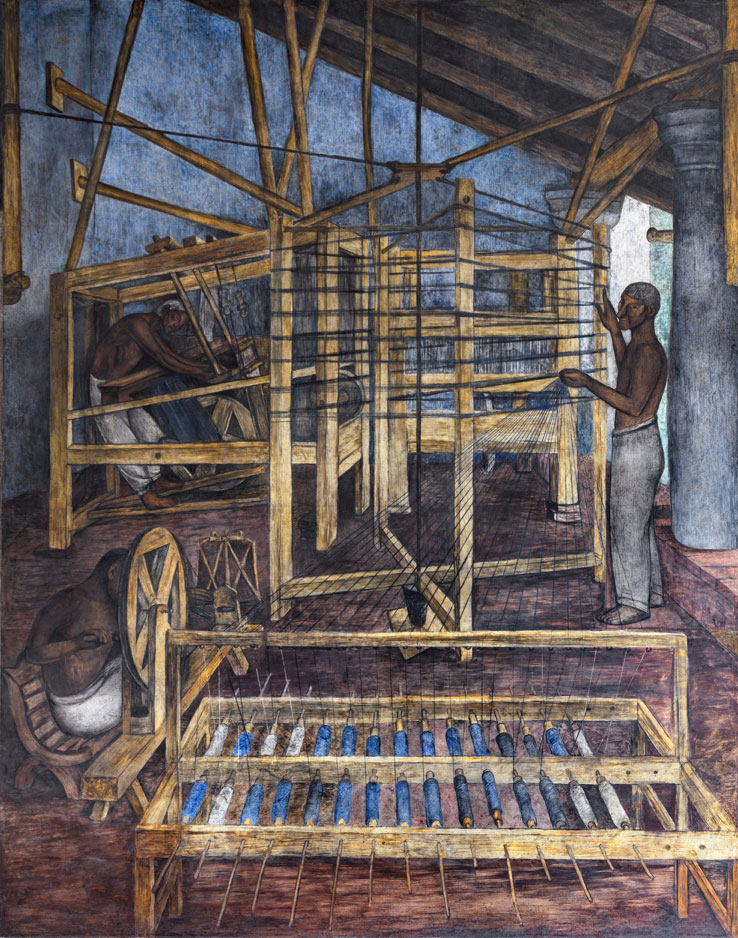
José Vasconcelos spearheaded the creation of the murals and commissioned Diego Rivera to carry out the project. Thus, the painter transformed the courtyards of the Ministry of Public Education into a vast visual narrative of Mexican society.
In the Patio del Trabajo, he depicted workers and peasants. Meanwhile, in the Patio de las Fiestas, he captured popular celebrations, traditions, and other forms of collective organization.
Diego Rivera’s conception of “work” was not limited to physical labor but also included intellectual work, the arts, and science. Heroes of labor were featured, as were scenes related to the Mexican Revolution.
According to the SEP’s mural catalog, the Patio del Trabajo depicts productive activities on the ground floor. In addition, it depicts intellectual work on the first level and pays homage to the arts, national heroes, and national ideals on the second. This layout allows us to observe how Rivera organized various human activities within a single pictorial ensemble.
The location and scale of the murals transformed the relationship between art and the viewer. Indeed, painting moved beyond museum galleries to occupy public buildings and become part of everyday life. Thus, it portrays society itself and the ideas of labor, identity, and education.
Painting the Land, Workers, and Revolution
4. Murals of the Riverian Chapel in Chapingo — 1924–1927
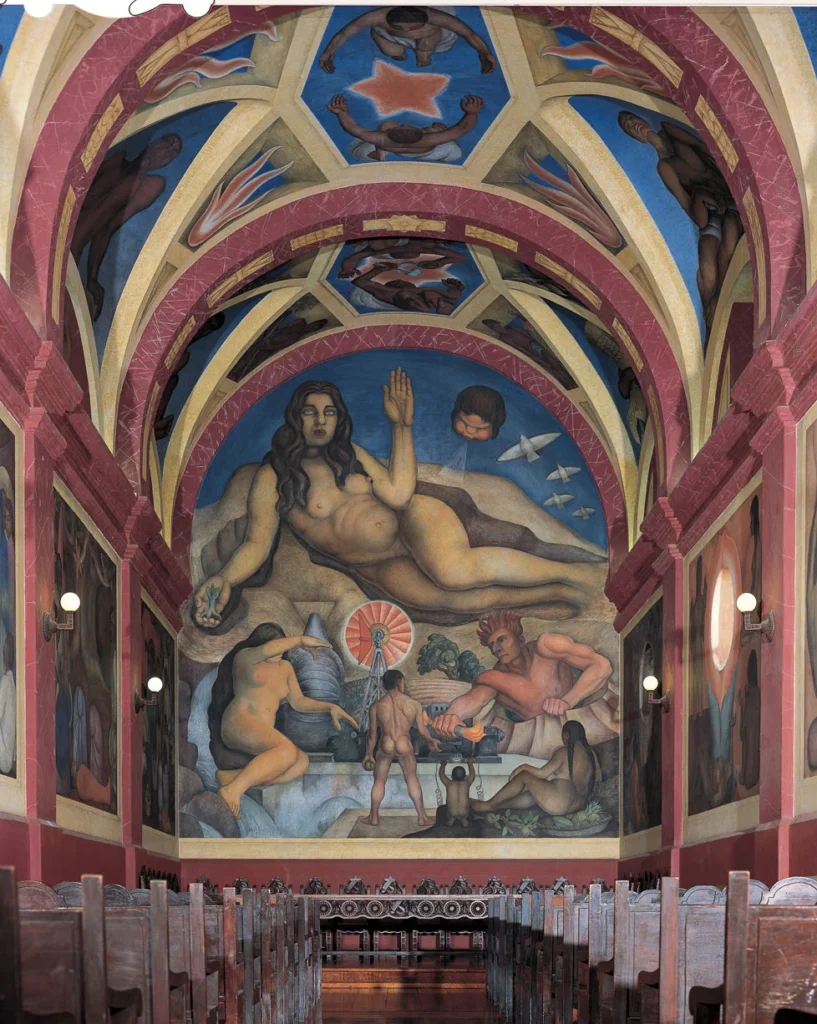
The Riverian Chapel refers to a series of murals located in the former National School of Agriculture in Chapingo, now the Autonomous University of Chapingo. The site is often compared to Michelangelo’s Sistine Chapel. However, the comparison is made from a perspective related to the land, agriculture, and the Mexican Revolution.
The then-director of the National School of Agriculture, engineer Marte R. Gómez, invited Diego Rivera to participate in decorating the institution’s new headquarters. The project began with work on the main building, including the lobby, staircases, and other spaces. Later, the work extended to the old chapel.
Rivera painted the murals of the Riveriana Chapel between 1924 and 1927. This space features 24 murals and panels dedicated to the transformation of nature, agricultural development, and revolutionary ideals. The complex is part of a broader mural decoration project carried out in Chapingo, which was not limited exclusively to the chapel.
In *La Jornada*, the history of the Riveriana Chapel is linked to the invitation from Marte R. Gómez and to the various scenes that adorn its walls, including *The Blood of the Agrarian Martyrs*, dedicated to Emiliano Zapata and Otilio Montaño.
In *The Fertile Land*, Rivera not only depicts an economic activity but also transforms the land into a symbol of life and a key element in Mexico’s social transformation. The human figures, agricultural scenes, and vegetation highlight the connection between nature and labor.
An important interpretation is that the land is also presented as a means of political advocacy. This is because, after the Mexican Revolution, access to and distribution of land became central issues in the lives of peasants. Thus, they became symbols of social justice and hope for the country.
The frescoes are not isolated paintings: the vaults, walls, and architectural elements form a narrative whole that celebrates the land and its workers. The integration of these spaces explains why the Riveriana Chapel is considered a central work within Diego Rivera’s mural oeuvre.
When Rivera Sought to Paint the Complete History of Mexico
5. Epic of the Mexican People / History of Mexico — National Palace, 1929–1951
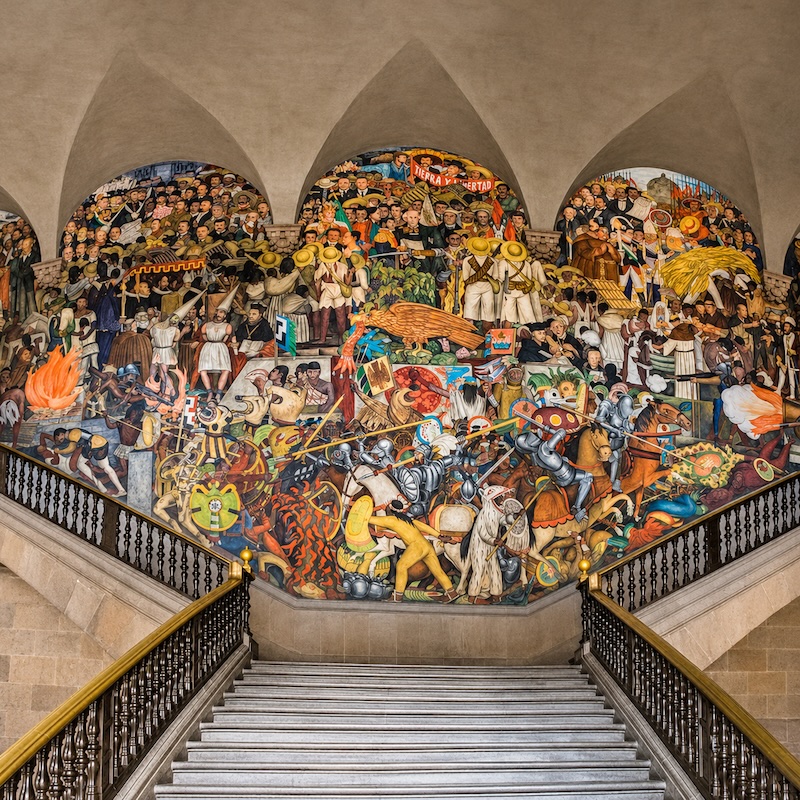
On the walls of the main staircase of the National Palace, one can see a visual narrative of Mexico’s history. This work is an ambitious project that began in 1929, with the first phase completed in 1935. After a hiatus, it continued between 1942 and 1951.
The project as a whole chronicles Mexican history from the pre-Hispanic period, covering events from the Conquest through Independence. It then continues with the Reform and the Revolution.
The narrative presents an interpretation of history from Rivera’s perspective. Indigenous peoples, peasants, and workers take center stage, intertwining the struggles of the past and the present. The painter selected characters and events that allowed him to highlight social and political conflicts. He also conveyed his vision of the transformations the country needed.
According to INBAL’s documentation on *The Epic of the Mexican People*, Rivera emphasized the pre-Hispanic past and linked the Revolution to his ideas about Mexico’s future. For this reason, the murals also demonstrate that depicting history involves deciding who appears in it. Furthermore, they reveal the perspective from which events are recounted.
Moreover, the location where this mural was painted is quite significant. The National Palace stands on a site associated with the ancient government complex of Mexico-Tenochtitlan, where Moctezuma II’s Casas Nuevas were located.
After the Conquest, the property passed into the hands of Hernán Cortés and later became the seat of the viceregal government. With Independence and the subsequent political transformations, the building remained linked to the exercise of power in Mexico.
Thus, the murals not only depict historical events; they also occupy a building whose own history is linked to the processes depicted.
Diego Rivera Conquers the United States
6. Detroit Industry Murals — 1932–1933
This is a series of 27 panels created between 1932 and 1933, following Rivera’s visits to the Ford River Rouge plant. This work was commissioned by the Detroit Institute of Arts, under the direction of Wilhelm Valentiner, and funded by Edsel Ford.
The project took place in a city battered by the Great Depression and marked by labor tensions. On March 7, 1932, workers participating in a march toward the Ford River Rouge plant were attacked by Dearborn police and Ford security personnel in an incident known as the Ford Hunger March, as documented in the archives of Wayne State University.
In this context, Rivera was commissioned to paint a series dedicated to the automotive industry. The participation of a Communist artist in a project funded by Edsel Ford was particularly significant, although the content of the murals cannot be reduced to that contradiction alone.
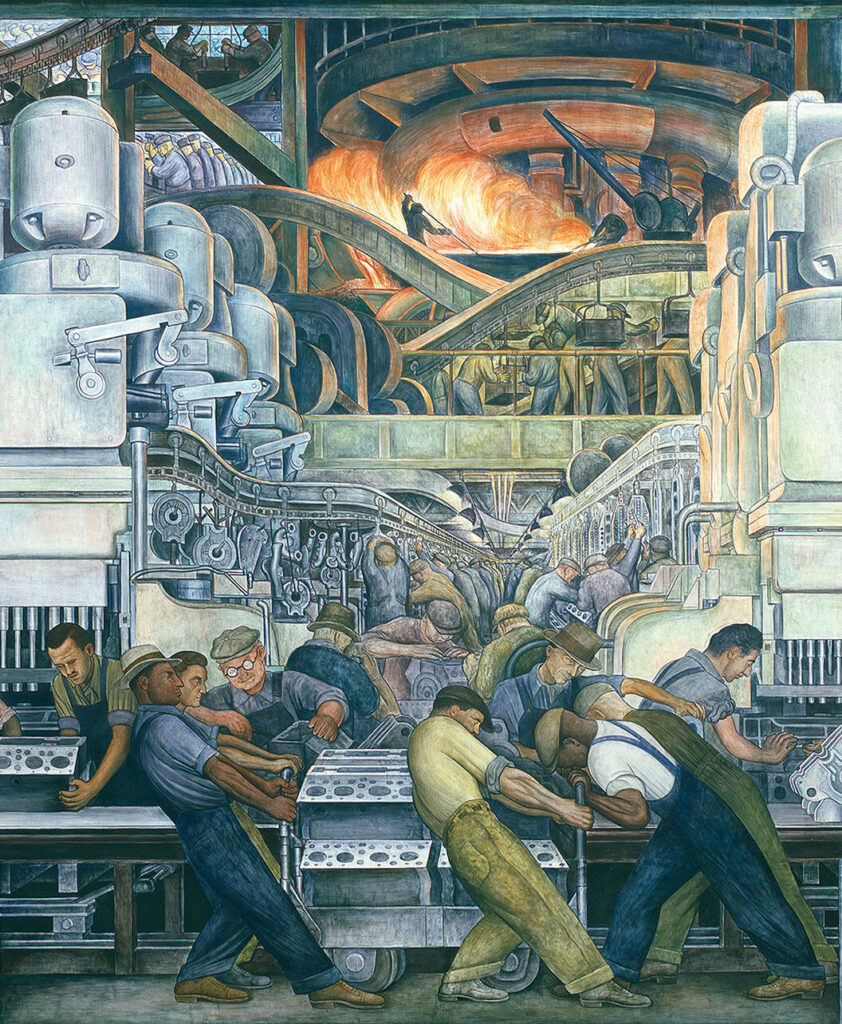
During his visit, Rivera observed the manufacturing processes and depicted machines, workers, and assembly lines in his murals, celebrating technological capability on the one hand, while also highlighting its risks.
In the series preserved by the Detroit Institute of Arts, the large panels on the north and south walls depict different stages of automobile manufacturing. The work of the people takes center stage, while the machines take on monumental proportions.
Rivera saw the factory as a symbol of modernity and an expression of the labor performed by the workers. In addition to automobile production, he incorporated references to nature, science, and the destructive potential of technology.
However, this work proved controversial because some sectors considered it to contain inappropriate religious and political references. There were those who opposed its presence in the museum and even requested that it be removed.
The controversy garnered international attention, with Rivera at its center, and helped expand his recognition beyond Mexico. At the same time, the murals demonstrated that industry and its workers could occupy a place in monumental painting comparable to that previously held by religious or historical figures.
The mural Rockefeller ordered to be destroyed
7. Man at the Crossroads and The Man Who Controls the Universe — 1933–1934
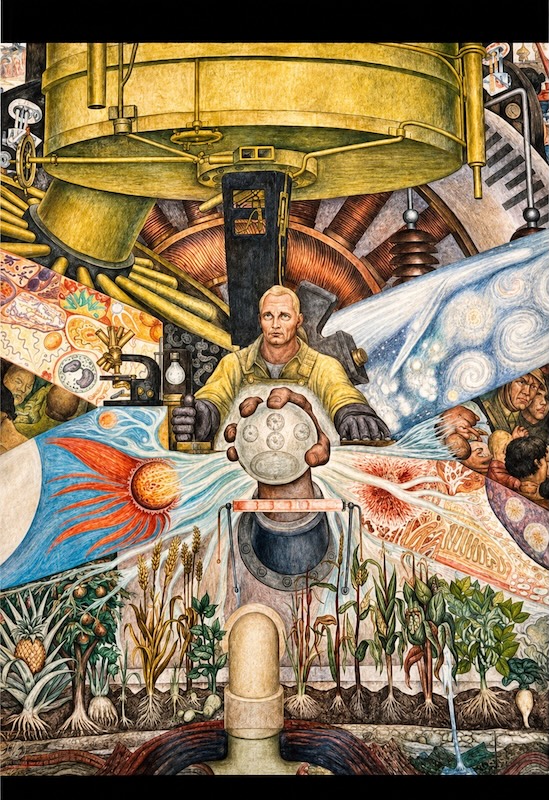
In 1933, Diego Rivera was commissioned to paint *Man at the Crossroads* at Rockefeller Center in New York. In this work, he would depict a worker standing before a machine, surrounded by images alluding to communism, capitalism, and science.
After presenting the sketches and reviewing the project, Rivera began work on the painting. The theme of *Man at the Crossroads* conveyed an optimistic vision and hope for a better future, though it also explored different possibilities for the development of society.
However, before finishing, he added the face of Vladimir Ilyich Lenin, as well as other figures associated with socialism. Nelson Rockefeller asked that Lenin’s face be replaced with an anonymous one, a request that Rivera refused.
The conflict led to the artist’s removal from the project in May 1933. The building’s management ordered the mural to be covered, and it remained hidden until its destruction in February 1934.
The Museum of Modern Art (MoMA)’s chronology documents Rockefeller’s request, Rivera’s refusal, and the building management’s decision to halt his work. The episode highlighted the tensions that could arise when an artist’s political ideas clashed with those who financed a work.
Although the original mural disappeared, some drawings and photographs preserved part of its composition. In 1934, Rivera painted *The Man Who Controls the Universe* at the Palacio de Bellas Artes in Mexico City, revisiting the New York project and incorporating modifications.
The version preserved at the Palace of Fine Arts depicts a worker standing before the controls of a machine, accompanied by scenes related to scientific knowledge and conflicts between different political systems.
This second work was not the original mural moved from Rockefeller Center, but a new creation. Its existence allowed the public to see the composition that had sparked one of the most well-known confrontations between Rivera and his patrons.
Rivera Turned Mexican History into a Dream
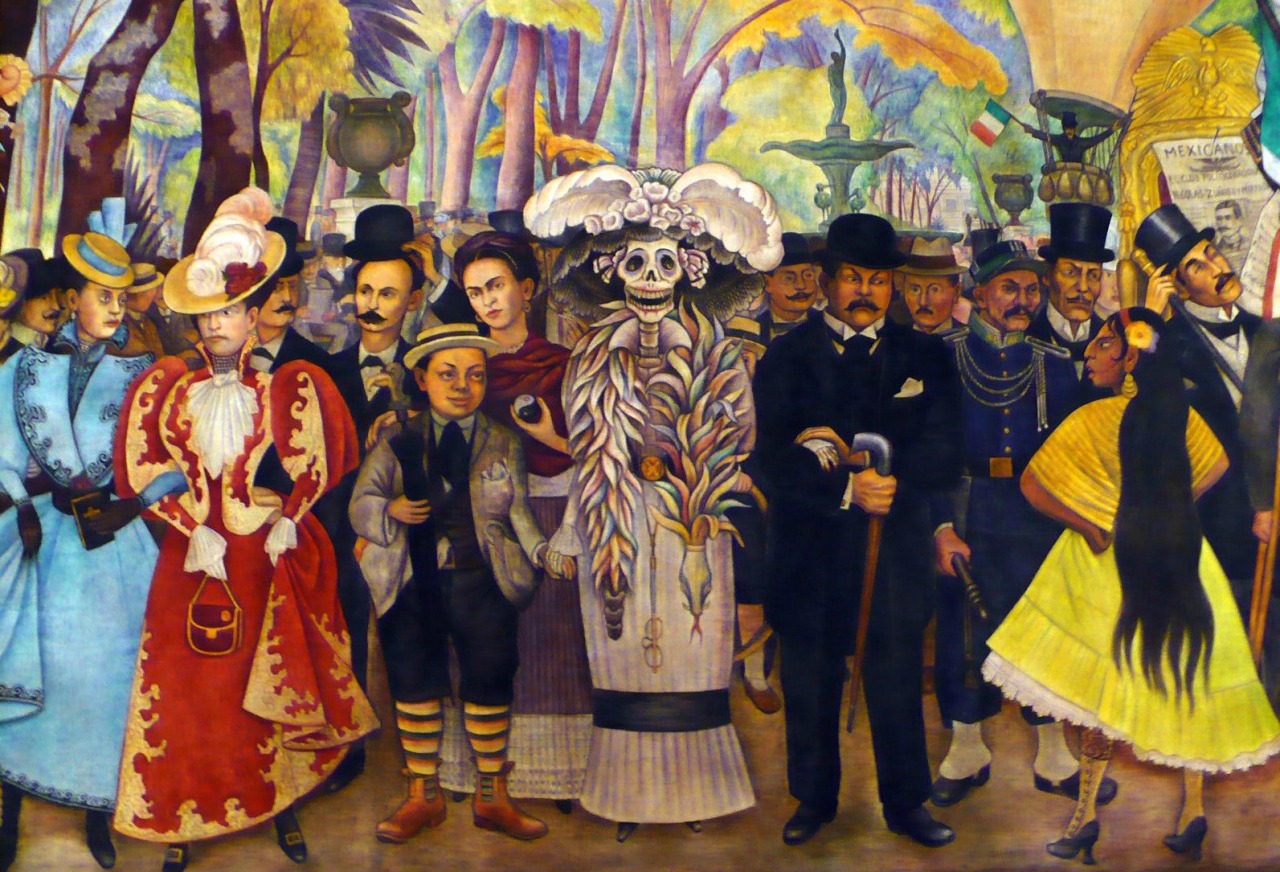
8. Dream of a Sunday Afternoon in the Alameda Central — 1947
This work was commissioned by Carlos Obregón Santacilia, the architect responsible for the Hotel del Prado, to decorate the building’s Versalles dining room. It was created in 1947. For this piece, Rivera decided to transform the Alameda Central into an imaginary setting where different eras and historical figures coexist.
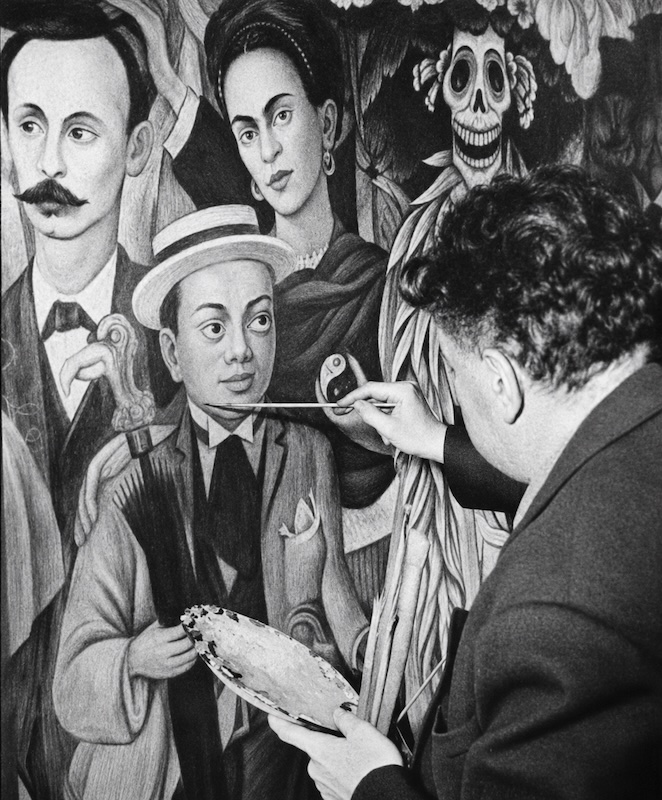
Thus appears La Catrina, a figure that Diego Rivera adapted from *La Calavera Garbancera*, created by José Guadalupe Posada, and whose depiction he helped popularize, as explained by INBAL in its documentation of the character’s history. Beside her is Rivera himself, depicted as a child, and Frida Kahlo behind him, linking her own biography to Mexican history.
Posada’s presence is fundamental because it allows for a connection between the tradition of popular print art and Rivera’s interpretation of national history. The painter revived that skull and turned it into a central figure in his composition, helping to popularize the image now known as La Catrina.
The scene also features political figures, writers, and individuals associated with various events in Mexico’s history. Some belong to periods separated by centuries, but Rivera brings them together in the same procession to present a vision of history built upon memories, events, and conflicts.
According to the Diego Rivera Mural Museum, part of INBAL, the work features figures ranging from the Conquest to modern times. Its composition allows viewers to observe how Rivera blended personal memory with an interpretation of Mexico’s past.
The mural is approximately 15 meters long. After the 1985 earthquake, which severely damaged the Hotel del Prado, the work was moved to a facility built to preserve it. Today it is housed at the Diego Rivera Mural Museum in Mexico City’s Historic Center.
The significance of this painting also lies in the way it tells the story: it does not follow a conventional chronological sequence but rather brings together characters and events within a single scene, as if different moments from the past could come together during an afternoon in the Alameda.
When a Mural Had to Coexist with Water
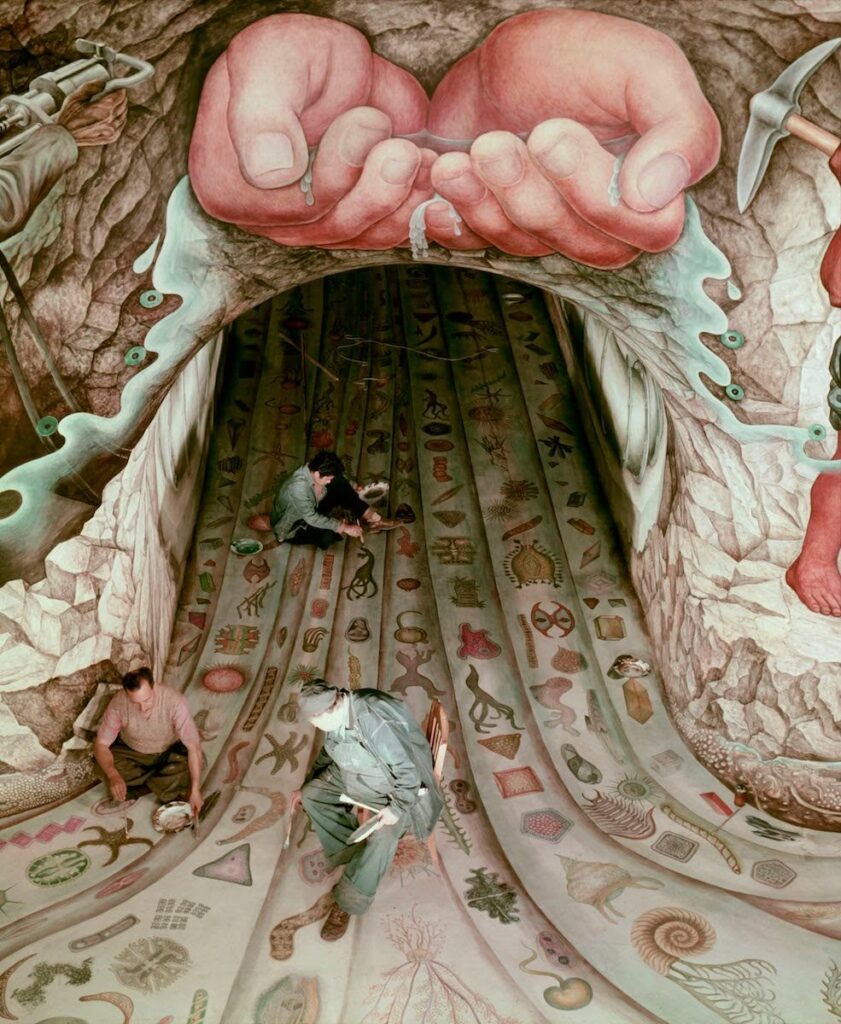
9. Water, the Origin of Life on Earth — Dolores Pumping Station, 1951
In 1951, Rivera created *Water, the Origin of Life on Earth* at the Dolores Pumping Station. This work fuses the architecture of Ricardo Rivas, the painting and sculpture of Diego Rivera, and the hydraulic engineering of Eduardo Molina Arévalo, serving as a historical expression of urban planning.
The pumping station was part of the hydraulic system that carried water from the Lerma River to Mexico City. What makes this work unique is that Rivera painted on the surfaces of a facility designed to receive the water that would supply the capital.
The mural depicts water as the origin of life, based on the theory of scientist Aleksandr Oparin. Similarly, the floor features depictions of the earliest organisms that inhabited the planet. On the side walls, other forms of life—such as plants and animals—can be seen, along with figures related to human evolution.
The painting was originally in direct contact with the water circulating through the hydraulic system. This condition made the project a unique experience, but it also posed challenges for preserving the pigments and the treated surfaces.
According to the National Water Commission, the mural remained underwater for decades, until changes in the facility’s operations allowed for its recovery and subsequent display.
The complex also includes an outdoor sculpture of Tláloc, the Mesoamerican god of water and rain, created by Rivera. The sculpture features two heads: one facing the sky and the other facing the pumping station.
With this project, Rivera brought mural painting to a setting where the building’s engineering and functionality were integral parts of the artwork. The water depicted in the images was also the very resource circulating through the infrastructure.
The mural that was meant to be part of a stadium
10. The University, the Mexican Family, Peace, and Youth in Sports — University Olympic Stadium, 1952–1954
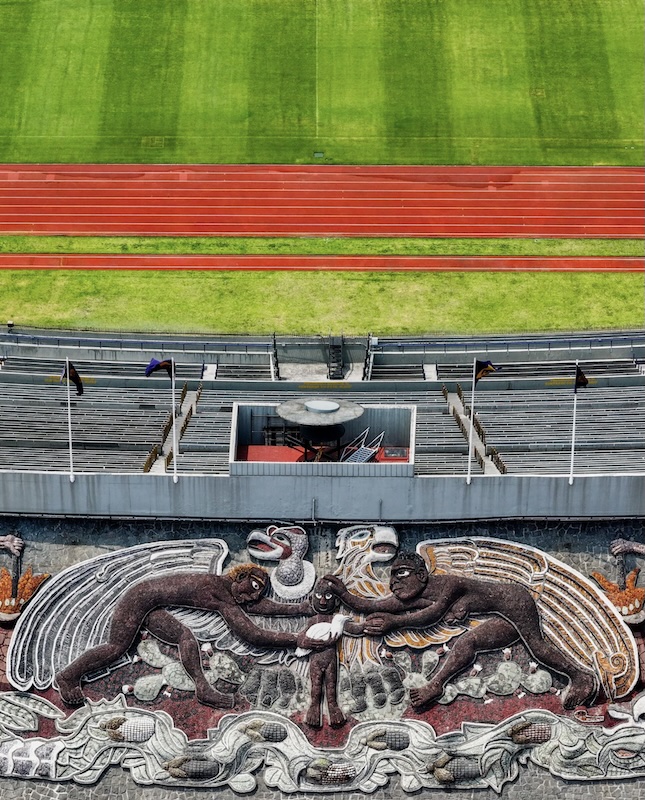
Between 1952 and 1954, Diego Rivera worked on the mural at the University Olympic Stadium in Ciudad Universitaria, at the UNAM, under a contract he signed with architect Carlos Lazo, general manager of construction and representative of the university administration.
For this work, he used natural stones of different colors to create a relief. The composition features symbols of the university, the family, sports, and peace, linking them to the nation’s identity.
The work is also known as “The University, the Family, and Sports in Mexico.” It features the university’s coat of arms, human figures, and references to pre-Hispanic cultures, such as corn and the feathered serpent.
The original project was more ambitious. Rivera intended to cover a much larger area of the stadium’s exterior walls, but he only managed to complete the relief on the eastern side, located above the main entrance.
According to research published by Gaceta UNAM, the project remained unfinished. Among the circumstances cited for its interruption are budgetary issues and the painter’s health, although there is no definitive explanation for all the causes.
This work demonstrates that Rivera continued to explore new ways of combining art and architecture in public spaces until the end of his career.
The use of natural stone also represented a departure from his fresco murals. By incorporating a relief onto the stadium’s façade, Rivera worked with weather-resistant materials and designed a surface intended to be viewed from outside a university building.
So, what did Diego Rivera change?
Diego Rivera transformed the scale and social function of painting. Art, which had traditionally been confined to canvases, moved into courtyards, onto walls, and into public buildings. Rivera brought art to those who did not visit museums, and in many works, viewers themselves could see themselves reflected as protagonists: peasants, workers, indigenous communities, and other social actors.
Diego Rivera’s work integrated painting, architecture, and even engineering in some cases, such as at the Cárcamo de Dolores. Furthermore, he created a visual interpretation of Mexican history and contributed to the international recognition of muralism.
His works also reflect a shift in the themes deemed worthy of monumental representation. Agriculture, industrial production, social struggles, and historical events took center stage within buildings dedicated to education, government, work, and public life.
His legacy was not only artistic; it also changed the understanding of who could be depicted in art and where such works could be displayed.
Diego Rivera Beyond These Ten Works
Diego Rivera’s body of work should not be limited solely to murals, even though they occupied a central place in the history of Mexican art; he also created portraits, easel paintings, illustrations, and other works.
He also assembled a significant collection of pre-Hispanic artifacts, which is preserved at the Anahuacalli Museum. According to the history of the collection published by the museum itself, Rivera had amassed more than 40,000 pieces by the time of his death in 1957, and the collection continued to grow thereafter.
Diego Rivera’s connection to the pre-Hispanic past, architecture, and other cultural projects completes the portrait of an artist whose work extended far beyond muralism.